


The lowest interest rate on your screen might actually be the most expensive mistake in your property portfolio. While searching for the best mortgage rates Dubai offers, many investors find themselves caught between attractive headlines and the reality of volatile EIBOR fluctuations. It’s natural to feel a sense of hesitation when faced with hidden fees or the complex eligibility requirements often placed on self-employed professionals. You want more than just a loan; you want a strategic tool that builds wealth.
If you’ve ever felt overwhelmed by the fine print of a ‘low-rate’ offer, then you’ll appreciate a strategy that prioritizes transparency and long-term security. I’ve spent over a decade guiding investors through these exact complexities to ensure their financing serves their long-term vision. This guide will show you how to master the 2026 financing landscape to secure mortgage terms that maximize your property portfolio’s growth. From understanding the 3.78% entry rates at Standard Chartered to leveraging FAB’s 3.99% fixed options, we’ll explore how to streamline your approval and align your debt with a clear exit strategy. We’ll examine current LTV ratios, dissect the impact of variable margins, and identify the lenders that prioritize your ROI over their own bottom line.
Key Takeaways
- Master the 2026 financing environment by understanding the vital relationship between Central Bank regulations and EIBOR fluctuations.
- Learn when to lock in a fixed-rate mortgage versus choosing a variable tracker to ensure your financing remains aligned with your portfolio’s exit strategy.
- Navigate complex LTV and DBR requirements to qualify for the best mortgage rates Dubai has to offer for both expatriates and UAE nationals.
- Secure a pre-approval letter and conduct a credit health check to transform your status from a casual buyer into a high-leverage negotiator.
- Discover how an integrated approach to real estate and lending can unlock exclusive terms that traditional service providers often overlook.
Navigating the 2026 Landscape for Mortgage Rates in the UAE
The 2026 mortgage market is a sophisticated arena where strategy outweighs simple arithmetic. While global economic shifts continue to influence national lending policies, the UAE remains a resilient hub for property acquisition. Investors searching for the best mortgage rates Dubai offers must look beyond the surface. Today’s environment is defined by a delicate balance between Central Bank regulations and the competitive appetite of local lenders. It’s no longer enough to compare numbers; you must compare the underlying structures that govern your capital. This year has seen a shift toward more personalized lending, where your professional profile and investment goals carry as much weight as your credit score.
Market Trends and Interest Rate Forecasts for 2026
Global fiscal trends have prompted the Central Bank of the UAE to maintain a vigilant stance on liquidity, directly impacting how banks price their products. EIBOR is the Emirates Interbank Offered Rate and serves as the benchmark interest rate used by UAE banks to price variable rate mortgages. Competition among national banks has intensified, driving entry-level rates to impressive lows to attract high-value investors. This rivalry has created a buyer’s market for those with the right guidance. From preferential rates for first-time buyers to exclusive packages for high-net-worth individuals, the options are broader than ever. We’re also seeing a significant rise in green mortgages. These products offer sustainable financing incentives, such as reduced margins or waived fees, for properties that meet specific energy-efficiency standards. Choosing a sustainable asset doesn’t just benefit the planet; it actively lowers your cost of borrowing.
Why ‘Lowest’ Doesn’t Always Mean ‘Best’ for Investors
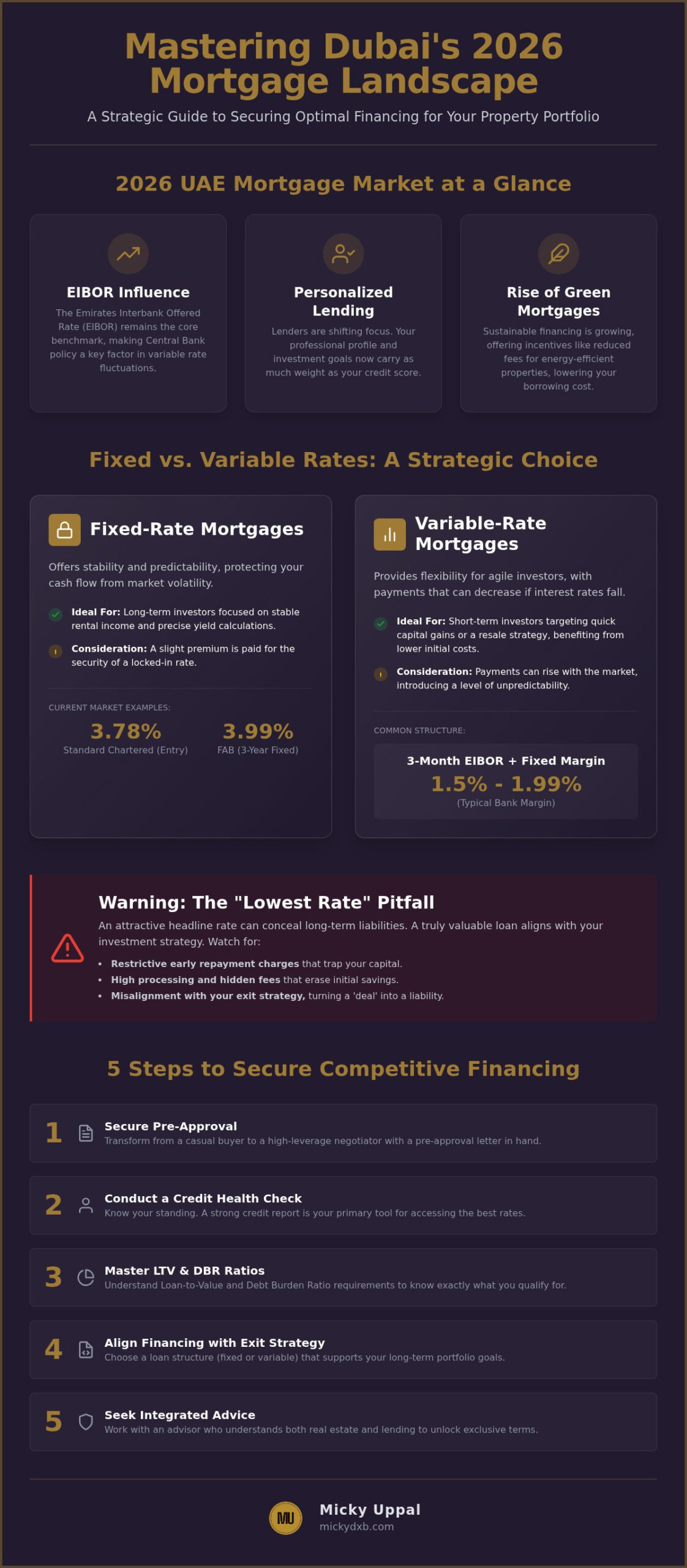
Chasing the absolute lowest headline number is a common pitfall that can jeopardize your long-term ROI. A rate that looks attractive on a brochure might hide restrictive early repayment charges that limit your ability to sell or refinance when the market peaks. High processing fees can quickly erase the savings from a slightly lower interest margin. Before committing, understanding fixed-rate mortgages is essential for those who prioritize cash flow stability over the gamble of variable trackers. True value lies in a loan structure that offers flexibility, transparency, and a clear path to ownership. If your financing doesn’t align with your five-year plan, then even the lowest rate becomes a liability. A seasoned advisor looks past the marketing to find the terms that actually protect your portfolio and ensure your exit strategy remains viable.
Fixed vs. Variable Rates: Choosing Your Financial Strategy
The choice between a fixed and variable rate isn’t just a financial preference; it’s a strategic decision that defines your investment’s resilience. While many focus solely on finding the best mortgage rates Dubai offers today, the true professional looks at where the market will be in five years. Your financing should act as a bridge to your goals, not a barrier. If your objective is long-term rental income, you’ll value the predictability of a fixed term. If you’re targeting a quick capital gain through a resell strategy, the lower initial costs of a variable rate might be your greatest asset.
The Security of Fixed-Rate Mortgages
Fixed-rate mortgages provide a sanctuary from market volatility. In 2026, national lenders offer fixed terms ranging from one to five years, with rates like the 3.99% offered by First Abu Dhabi Bank for three-year periods or the 3.78% entry points at Standard Chartered. This certainty allows you to calculate your net yields with precision, protecting your cash flow against any sudden spikes in the EIBOR. The trade-off is clear: you pay a slight premium for this peace of mind. By locking in your rate, you ensure that your mortgage remains a controlled expense rather than an unpredictable variable. It’s a choice for the investor who prioritizes stability, security, and long-term planning over short-term savings.
The Flexibility of Variable and Tracker Rates
Variable and tracker rates offer a different kind of advantage for the agile investor. These products typically follow the 3-month EIBOR plus a fixed margin, such as the 1.5% to 1.99% margins seen at major banks this year. If the Central Bank of the UAE shifts toward a more accommodative policy, your monthly payments will decrease automatically. This tracker advantage is ideal for those who anticipate a downward trend in interest rates or those planning a short-term exit. Short-term investors often prefer these rates because they frequently carry lower entry costs and more flexible early settlement terms. However, managing the risk of rate shock requires a savvy approach to portfolio management and a healthy cash reserve to absorb potential fluctuations.
Ultimately, your intended holding period dictates the ideal financing structure. Choosing the right path requires looking beyond the immediate transaction to see the larger narrative of your journey. If you are unsure which path aligns with your specific goals, seeking integrated real estate investment consulting can provide the clarity needed to make a confident choice. By aligning your debt with your exit strategy, you transform a simple loan into a powerful instrument for wealth creation.
Critical Factors That Determine Your Personal Mortgage Rate
Securing a loan isn’t a one-size-fits-all process. While the market provides a baseline, your personal financial profile is the ultimate architect of your final offer letter. Lenders evaluate your risk profile through several lenses, often prioritizing stability and collateral quality over the simple desire for the best mortgage rates Dubai can provide. Understanding these variables allows you to position yourself as a low-risk borrower, which is the most effective way to unlock exclusive terms and higher leverage. When you present a profile that suggests unwavering reliability, banks are far more likely to compete for your business.
Expat vs. National Eligibility Requirements
Residency status is the first filter through which every application passes. For UAE Nationals, the Central Bank allows for higher Loan-to-Value (LTV) ratios, typically up to 85% for a first home valued at AED 5 million or less. Expatriates usually face a cap of 80% LTV for properties under the same threshold. If the property value exceeds AED 5 million, these ratios tighten to 75% for Nationals and 70% for Expats. For those looking to expand their portfolio, second or investment properties see LTV limits drop further to 65% for Nationals and 60% for Expats.
Documentation requirements also diverge significantly. To help you prepare, I’ve compiled The 2026 Expat Checklist for Securing a Home Loan in Dubai to ensure your application remains seamless. Beyond paperwork, your Debt-to-Burden Ratio (DBR) is critical; your total monthly debt obligations cannot exceed 50% of your gross monthly income. Staying well below this limit doesn’t just guarantee approval; it gives you the leverage to negotiate a more favorable margin over the EIBOR. If your DBR is near the limit, lenders may increase your interest rate to compensate for the perceived risk.
The Impact of Property Type on Financing Terms
Banks categorize assets based on perceived risk, and this classification directly influences your interest rate. Luxury residential assets are often viewed as stable, high-value collateral, which can lead to more competitive pricing from premium lenders. Conversely, off-plan property investments carry a strict 50% LTV cap for all buyers, reflecting the inherent risks of uncompleted projects. Commercial real estate operates under a different lending framework entirely, often requiring higher down payments and shorter repayment terms compared to the standard 25-year residential limit. Self-employed investors face the most rigorous scrutiny, as lenders often require two years of audited financial statements to verify income stability. If you’re an entrepreneur, providing a clear narrative of your business’s growth can help mitigate the perceived risk and secure terms that align with your long-term success. For a comprehensive overview of how these asset categories fit within a broader investment framework, the Property Financing in Dubai: The 2026 Strategic Investor’s Guide offers an in-depth breakdown of LTV mechanics and off-plan financing strategies.
5 Steps to Securing the Most Competitive Financing in 2026
Securing a premium loan in the current market requires more than just a high income; it demands a calculated approach to your financial presentation. Finding the best mortgage rates Dubai has to offer is a process of elimination where you remove the obstacles that lead to higher margins. By the time you sit down with a lender, your profile should be an undeniable case for the lowest possible rates. This preparation ensures you aren’t just accepting an offer, but rather commanding the terms of your investment. A strategic approach turns the bank from a gatekeeper into a partner in your wealth creation.
- Step 1: Conduct a comprehensive credit health check. Before approaching any lenders, review your credit report from the Al Etihad Credit Bureau to ensure no historical errors are dragging down your score.
- Step 2: Obtain a pre-approval letter. This document serves as your passport to the property market, giving you the confidence to negotiate as a serious, qualified buyer.
- Step 3: Compare ‘Reducing Balance’ rates vs. ‘Flat’ rates. Always ask for the reducing rate to get an honest comparison of your total interest cost over the loan’s lifespan.
- Step 4: Negotiate on bank fees and mandatory life insurance premiums. Banks often have the flexibility to waive or reduce the standard 1% processing fee, especially during seasonal promotions.
- Step 5: Finalize the offer letter with a focus on early settlement clauses. Ensure your contract reflects the Central Bank cap of 1% or AED 10,000 to maintain your future exit flexibility.
Pre-Approval: Your Secret Weapon in Negotiations
A valid pre-approval letter transforms your standing in a competitive market. Sellers and developers prioritize buyers who can prove their liquidity, often leading to better property pricing that offsets your borrowing costs. Most pre-approval letters in the UAE remain valid for 60 days, providing a window of opportunity to strike when the right asset appears. This process also helps you define a realistic investment ceiling, preventing the emotional stress of falling for a property that sits outside your approved leverage. It allows you to act with the speed of a cash buyer while retaining the benefits of financing.
Comparing the ‘Hidden’ Costs Beyond Interest
The true cost of a mortgage extends far beyond the interest rate. You must account for the bank processing fee, which typically sits at 1% of the loan amount plus VAT, though lenders like FAB occasionally waive this for salaried first-time buyers during specific promotional windows. Additionally, you’ll need to budget for property valuation fees and the mandatory mortgage registration fee at the Land Department. Mandatory life insurance varies significantly between banks because each lender uses different underwriting partners and risk assessment models. To ensure you are capturing the full picture of your investment’s ROI, you can consult with an expert in mortgage lending who can dissect these costs before you sign. Understanding these nuances ensures that your ‘low-rate’ mortgage doesn’t become a high-cost burden over time.
Strategic Financing with Micky Uppal: Beyond the Transaction
While many digital platforms provide automated lists of the best mortgage rates Dubai offers, they often lack the human insight required to navigate the market’s grey areas. A mortgage is never just a standalone financial product. It’s a foundational component of your investment journey that must align with your acquisition goals and your eventual exit strategy. With over a decade of experience and more than 2,000 successful listings, I’ve seen how the right financing structure can transform a modest property acquisition into a high-performance asset. My approach moves beyond the immediate transaction to focus on the long-term health and growth of your property portfolio.
Integrated Real Estate and Mortgage Consulting
Choosing an integrated model simplifies the complex journey from property discovery to the final keys handover. If you have a single point of contact who understands both the real estate market and the lending environment, then you significantly reduce the friction that often delays disbursal. This synergy allows us to identify off-plan property investments or luxury residential sales and simultaneously secure the financing that makes them viable. It’s about efficiency, clarity, and the security of knowing every piece of the puzzle fits together perfectly. We treat mortgage lending as a strategic tool for asset acquisition rather than a bureaucratic hurdle. This unified perspective ensures that your financing is never a bottleneck, but rather a catalyst for faster, more confident decision-making.
Expert Guidance for High-Net-Worth Portfolios
High-net-worth investors require more than standard retail bank offers. They need customized financing solutions that reflect the scale of their ambitions and the complexity of their tax or corporate structures. Whether you are navigating complex commercial sales or looking for efficient resell services to rebalance your holdings, professional mentorship is the key to maintaining a competitive edge. We specialize in tailoring debt structures for multi-property investors who value discretion, precision, and the ability to move quickly on exclusive opportunities. For a deeper look into these high-level strategies, you should explore the Dubai Mortgage Guide: Finance Your Investment (2026). The value of a trusted advisor lies in their ability to see the larger narrative of your journey, ensuring that every financial decision provides the satisfaction and security you deserve. Let’s build a portfolio that stands as a testament to well-informed, strategic choices and unwavering reliability.
Mastering Your 2026 Investment Strategy
Your property portfolio’s success in 2026 depends on more than just selecting the right asset; it requires a financing structure that acts as a catalyst for growth. We’ve explored how understanding the nuances of EIBOR margins and maintaining a healthy Debt-to-Burden Ratio can transform your borrowing potential. By securing a pre-approval and aligning your rate choice with a clear exit strategy, you move from being a reactive buyer to a proactive strategist. Finding the best mortgage rates Dubai provides is about balancing the immediate cost with long-term flexibility.
If you’re ready to move beyond generic bank offers, then a partnership-oriented approach is your greatest advantage. With over 10 years of market expertise, I provide integrated mortgage and real estate services designed to simplify high-stakes decisions. From securing exclusive terms to navigating complex regulations, I specialize in luxury residential sales and off-plan acquisitions to provide a truly comprehensive experience. I invite you to Secure Your Strategic Financing Consultation with Micky Uppal today. Let’s work together to build a legacy of security and satisfaction through well-informed financial choices.
Frequently Asked Questions
What is the current average mortgage rate in the UAE for 2026?
Average mortgage rates in 2026 range from 3.78% to 4.5% for fixed terms, depending on your salary transfer status and the lender’s current promotions. Standard Chartered offers fixed rates starting from 3.78%, while First Abu Dhabi Bank (FAB) provides 3-year fixed options at 3.99%. These competitive figures reflect a market where banks are aggressively vying to offer the best mortgage rates Dubai investors can access to expand their property portfolios.
Can expats get a mortgage for off-plan property in the UAE?
Expatriates can certainly secure financing for off-plan property investments, though the regulations are stricter than for ready homes. The Central Bank of the UAE mandates a maximum Loan-to-Value (LTV) ratio of 50% for all off-plan acquisitions, regardless of the buyer’s residency status. This means you must provide a 50% down payment. Banks typically require the project to be registered with the relevant land department before they approve the final disbursal.
How much down payment is required for a residential mortgage in 2026?
Down payment requirements depend on your residency status and the property’s value. For a first home valued under AED 5 million, expatriates must provide a 20% down payment, while UAE Nationals only require 15%. If the property exceeds AED 5 million, the requirements increase to 30% for expats and 25% for Nationals. For investment properties or second homes, the down payment rises to 40% for expatriates and 35% for UAE Nationals.
Is it better to choose a fixed or variable mortgage rate right now?
The ideal choice depends on your holding period and risk tolerance. A fixed rate provides cash flow certainty for three to five years, protecting you from sudden EIBOR spikes. This is often preferred by long-term investors seeking stability. Conversely, a variable rate might be better if you expect interest rates to drop or if you plan to sell the property quickly. Variable margins currently sit between 1.5% and 1.99% above the 3-month EIBOR benchmark.
What are the hidden fees involved in securing a mortgage in the UAE?
Beyond the interest rate, you should budget for several transactional costs. Common fees include a bank processing fee of 1% plus VAT, a property valuation fee, and a mortgage registration fee. Mandatory life insurance is another recurring cost that varies by bank. Some lenders, like FAB, may waive processing fees for salaried first-time buyers during promotional windows, making it easier to find the best mortgage rates Dubai offers without excessive upfront capital.
How does the Central Bank of the UAE influence my monthly mortgage payments?
The Central Bank influences your payments by setting the regulatory framework for Loan-to-Value (LTV) ratios and the Debt-to-Burden Ratio (DBR). Your total monthly debt obligations cannot exceed 50% of your gross income, which limits your maximum loan amount. Additionally, the Central Bank’s monetary policy affects the EIBOR, which is the benchmark for all variable-rate mortgages. If the EIBOR fluctuates, your monthly installments on a variable or tracker mortgage will adjust accordingly.
Can I refinance my existing mortgage if rates drop later in 2026?
You can refinance or switch lenders to take advantage of lower rates, but you must account for the early settlement fee. The Central Bank caps this fee at 1% of the outstanding balance or AED 10,000, whichever is lower. Before refinancing, calculate whether the long-term interest savings outweigh the costs of the new bank’s processing fees and valuation charges. Refinancing is a strategic move to optimize your portfolio’s ROI.
What documents are required for a self-employed person to get a home loan?
Self-employed investors face more rigorous documentation requirements to prove income stability. You’ll typically need to provide your passport, Emirates ID, and a valid trade license. Lenders also require two years of audited financial statements for your business and six months of personal and corporate bank statements. Providing a clear narrative of your company’s growth and a clean credit report will significantly improve your chances of securing competitive financing terms.

Leave a Reply