


Most investors view debt as a necessary burden, but in the UAE’s sophisticated property market, a mortgage is actually your most powerful tool for capital preservation and liquidity. You likely feel the weight of opaque bank requirements and the shifting sands of EIBOR rates, wondering if your non-resident status or the complexity of LTV ratios will stall your progress. It’s natural to feel cautious when high-stakes capital is on the line. Navigating the nuances of mortgage lending Dubai shouldn’t feel like a gamble; it should feel like a calculated move toward generational wealth.
This guide provides the comprehensive roadmap you need to master these financial complexities. If you understand the underlying structures of national lending, then you can unlock the best available rates and secure your assets with total confidence. We’ll demystify the journey from initial pre-approval to the implementation of tax-efficient financing. By the end, you’ll have the clarity to move from uncertainty to action, from a simple buyer to a bold strategist, and from a dreamer to a secure property owner. Let’s begin the process of turning your investment vision into a grounded, profitable reality.
Key Takeaways
- Learn to utilize property financing as a strategic lever for liquidity by aligning your investment with the latest Central Bank of the UAE regulations.
- Identify the precise eligibility criteria and documentation needed to navigate mortgage lending Dubai as either a resident or a non-resident investor.
- Evaluate the long-term impact of fixed versus variable rates by understanding how EIBOR fluctuations influence your debt obligations.
- Gain a competitive edge by mastering the pre-approval process and professional valuation steps that confirm the quality of your asset.
- Transition from a simple transaction to a holistic wealth strategy through expert guidance that connects financing with high-value property selection.
Navigating the Fundamentals of Mortgage Lending in Dubai and the UAE
View financing as a catalyst rather than a hurdle. It’s not merely a way to cover a shortfall; it’s a strategic lever that allows you to optimize your capital and maintain liquidity. In 2026, the appetite for mortgage lending Dubai remains robust, supported by a stable regulatory environment and competitive interest rates that favor the long-term investor. The Central Bank of the UAE provides the foundational framework that ensures both lender stability and borrower protection, creating a transparent marketplace for global wealth.
Choosing to finance a property instead of committing 100% cash can be the difference between a static asset and a dynamic portfolio. If you utilize leverage effectively, then you can control high-value assets while keeping your capital available for other high-growth opportunities. This shift from a “debt-averse” mindset to a “strategic-leverage” approach is what defines the modern investor’s journey from simple ownership to sophisticated asset management.
The Strategic Advantage of Leveraged Investment
Cash is a finite resource, but leverage is the architect of wealth. By securing a mortgage, you can acquire multiple national assets simultaneously, spreading your risk and increasing your exposure to capital appreciation. This is the essence of “good debt.” It’s a calculated move to use the bank’s capital to build a resilient real estate portfolio. Many investors use financing for ready-to-move properties to free up the liquid cash required for off-plan installments, ensuring their investment journey maintains a steady, upward momentum.
Regulatory Standards and National Compliance
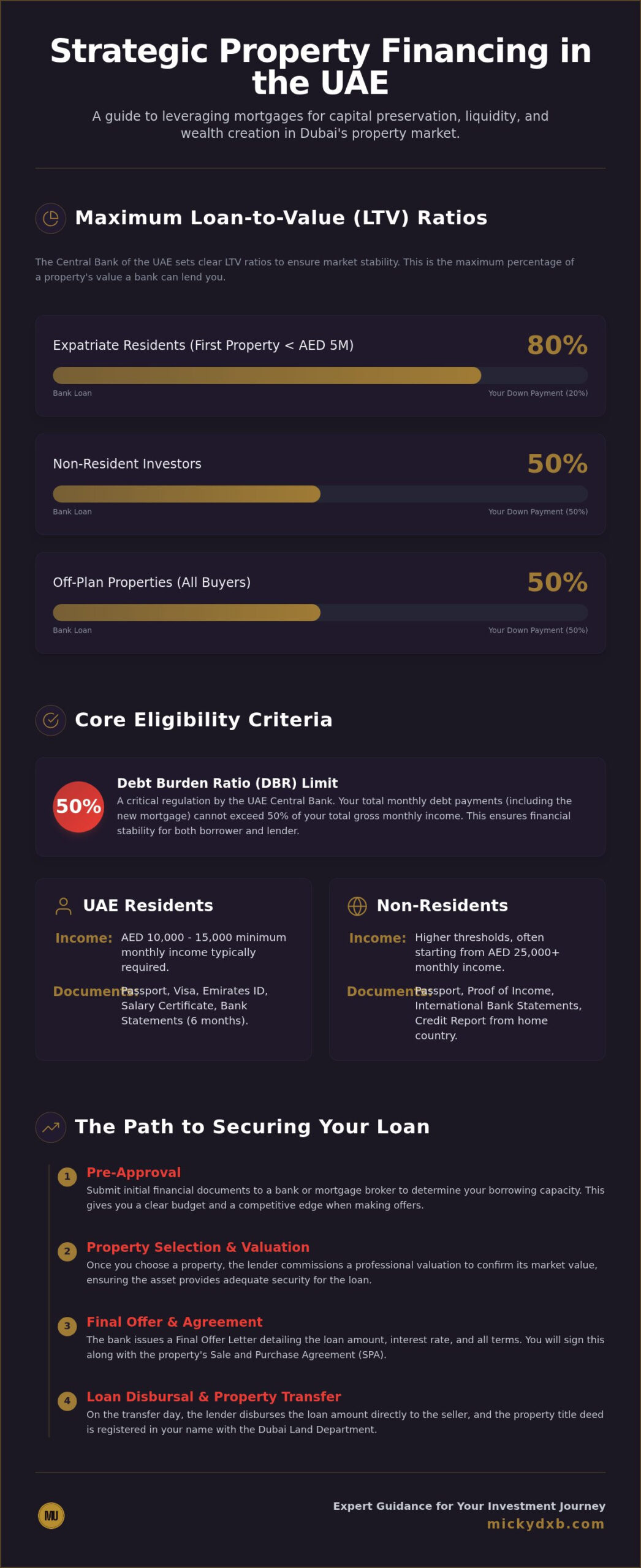
The UAE Mortgage Cap Law serves as the bedrock of the market’s integrity. These regulations prevent the market volatility seen in other global hubs, providing a sense of unwavering reliability for international stakeholders. Understanding how these rules integrate with the broader UAE economic landscape is vital for anyone looking to secure their financial future here. In 2026, the Central Bank maintains clear Loan-to-Value (LTV) ratios to ensure stability:
- Expatriate Residents: Up to 80% LTV for first homes under AED 5 million.
- Non-Resident Investors: Typically capped at 50% LTV, reflecting a more conservative risk profile.
- Off-Plan Properties: Capped at 50% for all buyer types to manage construction-phase exposure.
Navigating these mandates requires a seasoned guide who understands the nuances of national compliance. Transparency is the priority here. There’s an absence of hidden complexities when you work with an industry-aware consultant who prioritizes doing things right over doing things fast. This partnership-oriented approach ensures that your transition from financing to ownership is handled with professional polish and strategic precision.
Evaluating Your Eligibility for National Property Financing
Securing a loan starts with a clear understanding of your standing within the national framework. While the process is rigorous, it’s designed to ensure long-term asset security for both the lender and the investor. Whether you’re a resident building a life here or an international investor expanding a global portfolio, the requirements for mortgage lending Dubai are structured around stability and transparency. If you meet the foundational criteria, the path to pre-approval becomes a logical progression rather than a series of hurdles.
The UAE Central Bank mortgage regulations mandate strict adherence to the Debt Burden Ratio (DBR). This ensures your total monthly debt obligations don’t exceed 50% of your gross monthly income. It’s a protective measure that maintains the health of the national economy and your personal liquidity. For residents, a minimum monthly income typically ranges from AED 10,000 to AED 15,000. Non-residents often face higher thresholds, sometimes requiring a monthly income of AED 25,000 to qualify for premium financing. If you’re ready to see how your specific profile aligns with these standards, a specialized real estate investment consultation can clarify your path forward.
Criteria for Salaried and Self-Employed Investors
The documentation you provide is the first impression you make on a national lender. Salaried employees must typically provide a salary certificate, six months of bank statements, and proof of residency. For company owners and independent consultants, the requirements are more detailed. You’ll need to demonstrate two years of audited financial statements and stable business cash flow. A polished credit profile is your most valuable currency; it allows you to negotiate from a position of strength and secure exclusive lending terms that may not be available to the general public. For a detailed breakdown of every document required, the 2026 expat checklist for securing a home loan in Dubai provides a rigorous step-by-step guide tailored to resident and non-resident profiles alike.
Loan-to-Value (LTV) Ratios for 2026
LTV ratios act as the guardrails for your investment journey. They determine the level of personal capital required versus the amount of bank leverage you can employ. In 2026, these ratios are clearly defined to prevent market overheating:
- First-Time Resident Buyers: 80% LTV for properties under AED 5 million; 70% for those above.
- Second or Investment Properties: Typically capped at 60% for expatriates.
- Non-Resident Investors: A maximum of 50% LTV is the national standard. International buyers seeking a comprehensive overview of how to navigate these thresholds can benefit from the 2026 guide to securing a mortgage for non residents in Dubai, which covers income requirements, documentation, and lender expectations in detail.
- Off-Plan Assets: All buyers are capped at 50% LTV during the construction phase.
Understanding these limits is essential for effective capital allocation. If you know exactly how much the bank will provide, then you can plan your liquidity for the remaining balance and associated fees with absolute confidence. This meticulous approach ensures your investment is grounded in reality, protecting your long-term wealth from the stress of unexpected capital requirements.
Comparing Loan Structures: Fixed vs. Variable National Rates
Your choice of loan structure is the engine that drives your investment’s long-term performance. In the context of mortgage lending Dubai, you’ll encounter two primary pathways: the predictable security of fixed rates or the market-responsive nature of variable rates. Variable loans are inextricably linked to the Emirates Interbank Offered Rate (EIBOR). If EIBOR fluctuates due to global or local economic shifts, then your monthly commitment will adjust accordingly. This structure offers lower initial costs but requires a higher tolerance for market movement.
Fixed-rate mortgages provide a necessary shield for those who prioritize cash flow certainty. In 2026, many national lenders offer fixed periods of three to five years, starting from approximately 3.78%. This structure allows you to build a financial fortress around your asset, ensuring that your repayment obligations remain static regardless of external volatility. Hybrid options have also gained significant traction, offering an initial fixed-rate period that transitions into a variable margin. Understanding these Dubai mortgage market drivers is essential for selecting a structure that complements your broader wealth strategy. For a deeper analysis of how to identify and secure the best mortgage rates Dubai investors can access in 2026, including how entry rates from 3.78% interact with EIBOR fluctuations, a dedicated rate comparison guide can sharpen your decision-making.
Islamic vs. Conventional Financing
The UAE’s financial landscape is defined by its inclusivity, offering both conventional and Sharia-compliant products. Islamic financing operates on the principles of Murabaha (cost-plus-profit) or Ijarah (lease-to-own). Rather than paying interest, you enter into a partnership where the bank buys the asset and sells or leases it back to you at a profit. Both structures are highly regulated and provide similar end-results, yet they offer different philosophical alignments. Choosing between them often comes down to your preference for a traditional loan agreement versus a joint-ownership model that prioritizes shared risk and transparency.
Assessing Fees and Hidden Costs
Successful acquisition requires a clear view of the “from-to” cost journey. Beyond the property price, you must account for the 4% Dubai Land Department fee and the 0.25% mortgage registration fee. Professional valuation fees and bank processing charges also factor into the initial capital requirement. Strategic investors often look for products with capped early settlement fees, which are currently limited to 1% of the outstanding balance or AED 10,000, whichever is lower. Accounting for these details early ensures you maintain the liquidity needed to navigate the nuances of mortgage lending Dubai without unexpected financial strain. By addressing these costs upfront, you secure your asset with the confidence of a seasoned strategist.
How to Secure Your Property Loan: A Step-by-Step Implementation Guide
Securing a loan in 2026 isn’t just about completing paperwork; it’s about executing a strategic plan with quiet authority. The process moves through five distinct stages, taking you from initial discovery to full asset ownership. If you follow this roadmap with precision, then the complexities of mortgage lending Dubai become manageable milestones rather than stressful obstacles. This journey requires a blend of patience and proactive decision-making to ensure your capital is protected at every turn.
- Step 1: Obtain a Pre-approval Letter. This establishes your “Bold Strategist” status and defines your exact purchasing power.
- Step 2: Professional Property Valuation. The bank appoints an independent expert to confirm the asset’s quality and market value.
- Step 3: Secure the Final Offer Letter (FOL). This document outlines your optimized interest rates, repayment terms, and any specific conditions.
- Step 4: Execute Mortgage Registration. You’ll finalize the legal charge with the Dubai Land Department (DLD), involving a 0.25% mortgage registration fee.
- Step 5: Final Disbursal. The bank releases the funds to the seller or developer, completing your transition to property ownership.
The Power of Pre-approval
You shouldn’t begin your property search without a pre-approval letter in hand. In a fast-moving market, this document is your most effective negotiation tool. It signals to sellers that you’re a serious, liquid buyer, often allowing you to secure better terms than those without financing in place. In the 2026 market, these letters are typically valid for 60 to 90 days. If your circumstances remain stable during this window, then you can commit to a purchase the moment the right opportunity arises. It’s the difference between reacting to the market and leading it.
Valuation and Final Documentation
The valuation phase is a critical safeguard. Independent valuers act as a third party to ensure you aren’t overpaying for an asset, providing a necessary layer of protection for your investment. Common pitfalls during the documentation phase include missing bank statements or delays in securing the required life insurance policies. From the initial submission to the final signature, every step must be handled with professional transparency. You can streamline this entire “discovery to security” journey by working with a mortgage lending expert who anticipates lender requirements before they become bottlenecks. This partnership-oriented approach ensures that your path to ownership is steady, predictable, and successful.
Strategic Wealth Building Through Professional Mortgage Consulting
Wealth isn’t built by chance; it’s engineered through the precise integration of capital and opportunity. In the complex environment of mortgage lending Dubai, a Trusted Advisor does more than just secure a rate. They align your debt structure with your specific investment goals. If you choose the right partner, then your financing becomes a bridge to high-value assets rather than a weight on your cash flow. This partnership-oriented approach moves you from the inherent stress of high-stakes decisions to the satisfaction of well-informed choices.
Micky Uppal leverages over a decade of market experience and a record of 2,000 successful listings to streamline your journey. This deep commitment to your long-term well-being ensures that every step, from initial discovery to final security, is handled with quiet authority. Whether you’re targeting luxury residential sales or expanding into commercial sales, the integration of financial and property expertise is your greatest advantage. We look beyond the immediate transaction to see how your mortgage impacts your eventual exit. If your financing is structured correctly from the start, then your property resale Dubai outcomes will be more efficient and your capital gains more secure.
Integrated Financial and Real Estate Support
Managing multiple vendors during a property acquisition creates unnecessary friction. By utilizing a single point of contact for both real estate consulting and mortgage lending, you eliminate the noise and focus on strategic advancement. This integrated model provides clarity, openness, and the absence of hidden complexities. You gain access to over 10 years of national market insights, allowing for a level of precision that a standalone bank simply cannot offer. It’s a process built on transparency, stability, and unwavering reliability.
Next Steps for Your National Portfolio
The most successful investors are those who plan for the next five years, not just the next five days. Your current borrowing capacity is a snapshot in time, but your wealth strategy is a lifelong journey. To move forward with confidence, you must align your debt structures with your broader portfolio objectives. Preparing for a professional assessment allows you to understand the cause and effect of every financial move you make. We invite you to schedule a strategic consultation with Micky Uppal to evaluate your position and refine your roadmap. This is your opportunity to move from a simple transaction to a bold, comprehensive wealth strategy.
Securing Your Future in the UAE Property Market
Your investment journey is more than a series of transactions; it’s a deliberate progression toward long-term asset security. We’ve explored how to transform debt into a strategic tool for liquidity and how to navigate the specific LTV ratios mandated by national regulations. If you align your financial structure with your five-year goals, then you move from a position of uncertainty to one of quiet authority. This clarity is the foundation of a resilient, high-growth portfolio.
Mastering the nuances of mortgage lending Dubai requires a partner who understands the larger narrative of your wealth journey. Leveraging over 10 years of market expertise and a record of 2,000 successful property listings, Micky Uppal provides the comprehensive consulting needed to streamline your acquisition. Don’t let the complexity of financing stall your progress. Secure Your Financing Strategy with Micky Uppal and transition from discovery to ownership with absolute confidence. The market is ready for your next move, and with the right roadmap, your success is a logical outcome.
Frequently Asked Questions
How much deposit do I need for a mortgage in Dubai in 2026?
In 2026, the required deposit depends on your residency status and the property’s value. For expatriate residents purchasing their first home under AED 5 million, a 20% down payment is the national standard. If the property exceeds this value, the requirement increases to 30%. Non-resident investors typically need a 50% deposit. These mandates ensure market stability and protect your long-term asset security by maintaining healthy equity levels from the start.
Can non-residents and foreigners get a home loan for UAE property?
Yes, non-residents and international investors can secure financing for property acquisitions within the UAE. While the criteria are more stringent than for residents, mortgage lending Dubai remains accessible to global capital. You’ll typically be eligible for a loan-to-value ratio of up to 50%. Banks will require proof of stable international income, such as three to six months of personal bank statements and tax returns, to confirm your borrowing capacity. To ensure your documentation meets every lender requirement, reviewing the home loan Dubai expat approval checklist for 2026 can help you avoid common pitfalls that stall applications. For a dedicated breakdown of the full process, the 2026 guide to obtaining a mortgage for non residents in Dubai covers income thresholds, LTV benchmarks, and documentation requirements specific to international buyers.
What is the maximum loan term for a national mortgage?
The maximum term for a property loan in the UAE is generally 25 years. However, this is subject to the applicant’s age at the time of loan maturity. Most national lenders require the mortgage to be fully repaid by the age of 65 for salaried individuals or 70 for self-employed investors. Choosing a longer term can lower your monthly commitment, while a shorter term reduces the total interest paid over the life of the asset.
How does the EIBOR rate affect my monthly mortgage payments?
The Emirates Interbank Offered Rate (EIBOR) serves as the benchmark for variable-rate mortgages. If you choose a variable structure, your monthly payment consists of a fixed bank margin plus the prevailing EIBOR rate. When EIBOR rises or falls, your interest obligation adjusts accordingly. This responsiveness allows you to benefit from market dips, but it also necessitates a financial buffer to manage periods of upward rate volatility without compromising your liquidity.
Is it better to choose a fixed or variable rate mortgage for an investment property?
This choice depends on your personal risk tolerance and investment horizon. A fixed-rate mortgage, often available for three to five years, provides absolute cash flow certainty and protects you from sudden EIBOR spikes. Conversely, a variable rate may offer lower initial costs and greater flexibility for early repayment. Many strategic investors opt for fixed terms during the initial years to stabilize their portfolio before transitioning to a market-responsive variable margin. To understand how to evaluate and secure the best mortgage rates Dubai’s 2026 lending landscape offers across both fixed and variable structures, a comprehensive rate strategy guide can help you make a fully informed decision.
What are the additional costs of securing a mortgage beyond the interest rate?
Beyond the interest rate, you must account for several national fees. These include the 4% Dubai Land Department registration fee, a 0.25% mortgage registration fee, and bank processing charges which typically range around 1%. You should also budget for a professional valuation fee and mandatory life insurance premiums. Accounting for these upfront costs ensures you maintain the necessary liquidity to finalize your acquisition without encountering unexpected financial bottlenecks during the closing process.
Can I get a mortgage for off-plan property investments?
Financing is available for off-plan properties, but it’s regulated differently than ready-to-move assets. The UAE Central Bank caps off-plan mortgages at 50% loan-to-value for all buyers. Many investors utilize developer payment plans during the construction phase and then transition to a mortgage once the property reaches a specific completion milestone or handover. This strategic approach allows you to leverage bank capital while managing your initial construction-phase outlays effectively. For investors already thinking ahead to their exit strategy, understanding the property resale Dubai secondary market landscape for 2026 can help you plan a high-value divestment from the very start of your acquisition.
How long does the mortgage pre-approval process typically take?
A mortgage pre-approval typically takes between three to seven working days, provided all your documentation is in order. This timeframe allows the lender to conduct a thorough assessment of your credit profile and income stability. Once issued, the pre-approval letter is generally valid for 60 to 90 days. Having this document in hand allows you to act with quiet authority when the right investment opportunity appears, giving you a distinct advantage in mortgage lending Dubai.

Leave a Reply