


What if the most significant cost of your investment isn’t the purchase price, but the hidden complexities buried within your mortgage contract? Many investors face the same hurdles, from navigating the nuances of expat eligibility to managing the impact of shifting interest rates on long-term ROI. It’s natural to feel a sense of hesitation when the path to a predictable monthly payment feels obscured by jargon and fine print. You deserve a strategy that prioritizes transparency, security, and growth.
This guide offers a comprehensive roadmap to mastering property financing Dubai in 2026, providing the clarity you need to secure the best possible rates for your portfolio. If you understand the underlying mechanics of UAE lending, then you can transform debt into a powerful lever for scalability. We’ll move from the fundamentals of current LTV ratios to the intricacies of high-leverage off-plan assets, and finally, to a streamlined approval process designed for the strategic investor. By the end of this article, you’ll have the tools to build a stable, high-performing asset base with total confidence.
Key Takeaways
- Understand the evolving national mortgage market and how current liquidity trends impact your ability to scale a diverse property portfolio.
- Discover the specific frameworks for property financing Dubai, including the essential 50% construction milestone required to mortgage off-plan assets.
- Evaluate the strategic advantages of fixed versus variable rates by mastering the mechanics of EIBOR and long-term interest rate cycles.
- Follow a streamlined approval roadmap that prioritizes pre-approval and accurate valuations to eliminate hidden fees and unexpected delays.
- Learn how an integrated brokerage and lending approach provides a competitive edge through exclusive bank negotiations and optimized loan structures.
Navigating the National Property Financing Landscape in 2026
Property financing is the strategic acquisition of capital specifically designed to optimize real estate assets. It isn’t merely a loan; it is a calculated financial lever that allows you to control high-value property while maintaining your liquid capital. In 2026, the national mortgage market is characterized by high liquidity and a sophisticated regulatory framework that protects both the lender and the borrower. This stability is largely anchored by Dubai’s diversified economy, which continues to provide a fertile ground for sustainable real estate growth. The Central Bank of the UAE remains the primary architect of these lending standards, setting the thresholds for Loan-to-Value (LTV) ratios and debt burden limits to ensure long-term market health. Engaging with property financing Dubai requires an understanding that clarity, openness, and the absence of hidden complexities are the foundations of a successful portfolio.
Navigating this landscape successfully requires a partnership with a guide who understands the nuances of these national regulations. Without professional oversight, investors often fall prey to misaligned loan structures or unexpected costs. A strategic approach focuses on three pillars: transparency, security, and growth. By aligning your acquisition strategy with current national trends, you secure a foundation for a resilient and profitable property portfolio.
The Evolution of UAE Lending Standards
The landscape of UAE lending has transitioned from traditional, paper-heavy banking to a modern, digital-first mortgage approval system. This shift has streamlined the journey from application to offer, providing investors with rapid clarity on their borrowing capacity. Today, your national credit score is more than just a number; it is a critical asset that dictates your interest rate tier. If your credit history demonstrates consistent reliability, then you can unlock premium rates that currently start as low as 3.75% for fixed-term products. The 2026 regulations specifically favor long-term residential stability, encouraging a shift toward sustainable ownership and away from short-term speculation. This evolution ensures that the national market remains attractive to sophisticated global investors who value predictability and institutional transparency.
Why Strategic Financing Beats Cash Purchases
Choosing to finance a property rather than purchasing with cash is a hallmark of the strategic investor. This decision allows you to leverage debt to increase your total portfolio size without depleting your immediate liquidity. By spreading your capital across multiple assets rather than sinking it into a single purchase, you diversify your risk and amplify your potential for capital appreciation. If you utilize high-leverage financing for off-plan assets, then you can secure your position in the market with a significantly lower upfront commitment. Leverage is the strategic use of borrowed capital to amplify the potential return on a real estate investment. This method supports wealth preservation, provides a safety net for unexpected market shifts, and ensures your capital remains available for other high-yield opportunities. A well-structured mortgage is a tool for discovery, security, and strategic advancement.
Mortgage Structures and Property Financing Dubai Options
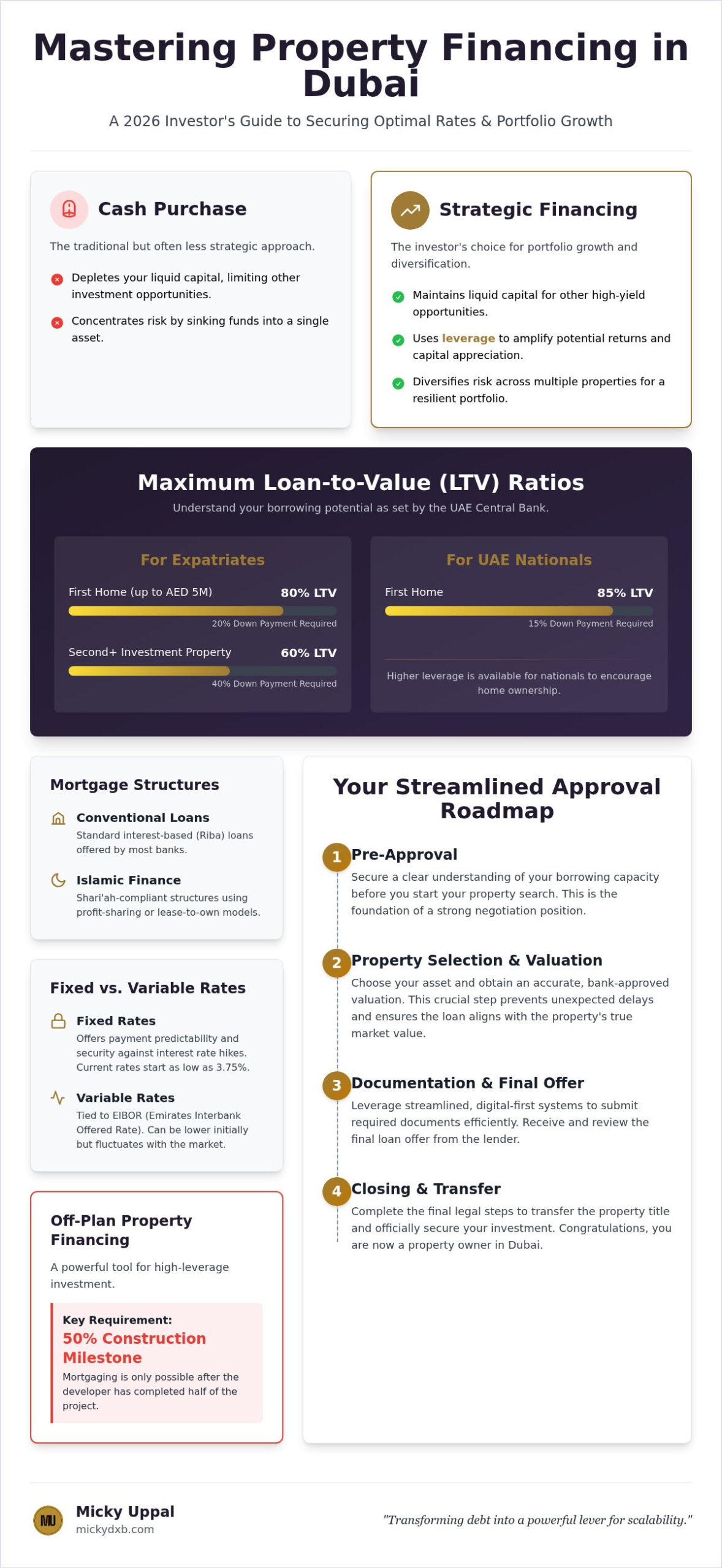
Choosing the right loan structure is as vital as picking the property itself. The national market offers a diverse spectrum of products tailored to your residency status and long-term investment goals. For expatriates, a first home purchase allows for an 80% Loan-to-Value (LTV) ratio on properties valued up to AED 5 million. If you’re expanding your portfolio with a second investment property, the LTV shifts to 60%. UAE nationals benefit from slightly higher leverage, reaching 85% for initial homes. This regulatory framework ensures a resilient market, a point highlighted in the recent World Bank economic update regarding the strength of the non-oil sector. Mastering property financing Dubai options means understanding how these ratios impact your initial capital outlay and your overall ROI.
You can also choose between conventional interest-based loans or Shari’ah-compliant Islamic finance. Islamic options avoid interest, known as Riba, and use profit-sharing or lease-to-own models instead. Both paths offer competitive rates, though the documentation and legal structures differ. Commercial property financing is also available for business owners or institutional investors looking to acquire office space or retail units, typically requiring a more robust business case and higher down payments.
Off-Plan vs Ready Property Financing
Ready properties offer the highest leverage, but off-plan assets provide unique entry points for capital growth. Under current Central Bank regulations, off-plan mortgages are capped at 50% LTV for all buyer categories. A critical development in 2026 is the refined off-plan mortgage framework. This allows you to mortgage the outstanding amount once you’ve paid 50% of an eligible unit’s value or when construction reaches a specific milestone. This structure is a powerful tool for investors who want to transition from developer payment plans to traditional bank financing before handover. For a deeper dive into these strategies, read The Ultimate Guide to Off-Plan Property Investment in Dubai (2026).
Specialized Loans for Non-Resident Investors
International buyers don’t need UAE residency to access capital. Banks look for global income stability, typically requiring three to six months of international bank statements and verified salary certificates. Non-resident rates usually carry a slight premium due to the perceived risk of lending to individuals outside the national jurisdiction. For example, a 3-year fixed rate for a resident might start at 3.78%, while a non-resident might see rates starting around 4.19%. If you’re unsure about your eligibility as an overseas buyer, consulting with a mortgage specialist can provide the clarity you need to move forward with confidence.
Fixed vs. Variable Rates: Evaluating Your Financing Strategy
Selecting a rate structure is a strategic decision that balances immediate cash flow against long-term portfolio security. In the current national market, your choice determines how resilient your investment remains against global economic shifts. Most property financing Dubai products are either fixed for an initial term or fluctuate based on a benchmark. If you value absolute predictability, then locking in a fixed rate for three to five years ensures your monthly obligations remain unchanged. Conversely, variable rates offer the potential for savings if national liquidity increases and benchmark rates soften. A bold strategist looks beyond the initial offer to understand the underlying mechanics that drive these costs over the life of the loan.
Variable loans are intrinsically tied to the Emirates Interbank Offered Rate (EIBOR). As of September 2026, the 3-month EIBOR stands at 3.850650%, while the 12-month benchmark is 4.357240%. When you opt for a variable structure, your bank adds a fixed margin to these rates. For those seeking the best of both worlds, hybrid products have gained popularity. These allow you to enjoy the stability of a fixed rate for the first few years before transitioning to a variable margin, providing a window of certainty as you stabilize a new asset. Calculating the break-even point for any financing strategy requires a tripartite view of the interest saved, the fees paid, and the time you intend to hold the property.
Risk Management in a High-Interest Environment
Fixed rates act as a robust hedge against national inflation and unpredictable global volatility. By securing a 3-year fixed rate at approximately 3.85%, you insulate your ROI from the stress of rising benchmarks. Variable rates are more appropriate when market cooling is predicted, allowing you to benefit from downward adjustments without the need for a full refinance. To manage the inherent risks of variable products, many investors look for an Interest Rate Cap. An Interest Rate Cap is a contractual limit on the maximum interest rate a borrower can be charged on a variable-rate loan during a specific period, ensuring your payments never exceed a predetermined ceiling.
Refinancing and Buy-Out Options
The decision to switch lenders can often unlock significant capital or reduce monthly overhead. Refinancing rates currently start from 3.85%, making it a viable path for those who secured loans during previous high-rate cycles. You should consider a buy-out when the interest differential covers the cost of the transition within eighteen to twenty-four months. This process involves your new lender paying off the existing mortgage, which requires a clear understanding of early settlement fees, typically capped by the Central Bank to ensure fair competition. For a detailed breakdown of how to time these moves, explore Securing the Best Mortgage Rates in the UAE: A 2026 Investor’s Guide. A streamlined transition can move your portfolio from a position of maintenance to one of aggressive strategic advancement.
The Step-by-Step Roadmap to Securing Property Financing
Securing capital in a high-stakes market requires a methodical, step-by-step approach. You shouldn’t begin your property search without a bank’s formal nod. Pre-approval is the essential first step, serving as a green light that defines your exact purchasing power. If you have a pre-approval in hand, then you possess the leverage to negotiate with confidence; sellers prioritize buyers who can prove their financial readiness. This document typically remains valid for 60 to 90 days, giving you a clear window to identify the right asset for your portfolio. Mastering property financing Dubai is about moving from initial validation to final ownership with absolute precision.
Once you’ve selected a property, the bank initiates a professional valuation to determine the actual loan amount. It’s a common misconception that the loan is based solely on the purchase price. In reality, lenders use the lower of the purchase price or the independent valuation. After the valuation is confirmed, you’ll receive a Letter of Offer, often called a Facility Letter. This is where you must scrutinize the fine print, including interest rate structures and processing fees. The journey concludes with the registration of the mortgage through national authorities, where a fee of 0.25% of the registered loan amount is required, alongside a Title Deed issuance fee of AED 250.
Document Checklist for Expats and Residents
Your application is only as strong as your documentation. Salaried residents must provide salary certificates, six months of bank statements, and a comprehensive credit report from the AECB. If you’re an entrepreneur, the requirements expand to include audited financial statements and trade licenses. International investors face a different set of criteria, often requiring global income verification and certified bank records from their home country. To ensure you have every detail covered, consult The 2026 Expat Checklist for Securing a Home Loan in Dubai for a comprehensive breakdown of required filings.
Avoiding Common Approval Bottlenecks
Approval delays often stem from a lack of preparation regarding your Debt Burden Ratio (DBR). National regulations cap your DBR at 50% of your gross monthly income. The bank doesn’t just look at what you earn; it looks at what you owe. Even unused credit cards impact your eligibility, as lenders typically calculate 5% of your total credit limit as a monthly debt obligation. Additionally, life insurance is a mandatory national requirement for all borrowers. This policy protects your family and the bank, ensuring the debt is covered in unforeseen circumstances. If you’re ready to bypass these complexities and secure your future, speak with a mortgage expert today to streamline your approval process.
Strategic Financial Planning with Micky Uppal
Strategic success in real estate isn’t just about finding a building; it’s about engineering the capital behind it. Integrated brokerage and mortgage lending services provide a seamless bridge between your investment goals and the financial products required to reach them. If you work with a professional who understands both the property’s intrinsic value and the bank’s lending criteria, then you eliminate the risk of a valuation gap or a rejected application. This unified approach transforms property financing Dubai from a hurdle into a strategic advantage, ensuring your acquisition is optimized for long-term yield from the very beginning. Clarity is our foundation, and your security is our priority.
Micky Uppal acts as your Trusted Advisor, handling the heavy lifting of bank negotiations so you don’t have to. Banks often reserve their most competitive, exclusive rates for established partners who bring high-quality, verified applications to the table. By leveraging these existing relationships, you gain access to terms and structures that aren’t available to the general public. This is where the transition from a mere transaction to a strategic partnership occurs. We look beyond the immediate purchase to see the larger narrative of your journey, ensuring each loan structure supports the next phase of your portfolio growth. Well-informed choices lead to lasting satisfaction.
The Micky Uppal Advantage
With over a decade of market experience, Micky has navigated multiple national market cycles, providing a steady hand during periods of both rapid growth and economic consolidation. This longevity translates into a deep, intuitive understanding of how national lending institutions operate and evolve. Whether you’re a first-time buyer seeking personalized mentorship or a seasoned investor looking for institutional-grade efficiency, you benefit from direct access to a curated network of lenders. We prioritize doing things right over doing things fast, focusing on the security, clarity, and stability that come from expert guidance. Our commitment is to your long-term well-being, not just the closing of a deal.
Start Your Financing Journey Today
Your next successful acquisition starts with a conversation, not a contract. Booking a strategic consultation allows us to map out a low-friction path from initial pre-approval to the moment you hold the keys in your hand. We handle the complexities of the 2026 regulations, debt burden ratios, and bank disclosures, allowing you to focus on the growth of your assets. For a broader perspective on the national lending landscape, explore the Dubai Mortgage Guide: Finance Your Investment (2026). Let’s move beyond the surface of the industry and build a foundation of unwavering financial reliability together. Strategic advancement is within your reach.
Mastering Your National Investment Future
The 2026 market offers a unique landscape for those who approach it with a bold strategist’s mindset. By mastering the nuances of property financing Dubai, you move from the stress of uncertainty to the security of a well-informed portfolio. We’ve explored how to navigate national lending standards, from identifying the right mortgage structure to executing a precise step-by-step roadmap. If you align your capital with the current regulatory framework, then you ensure your assets remain resilient against fluctuating interest rates and global shifts.
Success in this high-stakes environment requires more than just a loan; it requires a partnership built on transparency, security, and growth. With over 10 years of market experience and a track record of more than 2,000 successful listings, we provide the integrated mortgage and real estate services necessary for a seamless transaction. We’re committed to your long-term well-being, focusing on doing things right to ensure your lasting financial satisfaction. Secure your strategic property financing with Micky Uppal today and take the first step toward a predictable, high-performing future. Your journey to strategic advancement begins with a single, confident decision.
Frequently Asked Questions
How much deposit is required for property financing in the UAE in 2026?
Expatriates typically require a 20% deposit for their first home purchase, as national regulations cap the Loan-to-Value (LTV) ratio at 80% for properties valued up to AED 5 million. If you’re a UAE National, the required deposit is lower at 15%. For investment properties or second homes, the deposit requirement increases to 40% for expats and 35% for nationals to ensure market stability.
Can expats get a mortgage for property in Dubai without residency?
Yes, international investors can access capital without holding UAE residency. Banks evaluate your global income stability and credit history to determine eligibility for these specialized products. While resident rates are often more competitive, non-resident loans are widely available with LTV ratios typically capped at 60% or 70%. This path allows you to build a national property portfolio while living and working abroad.
What is the maximum age for a mortgage applicant in the UAE?
The maximum age for mortgage completion is generally 65 years for salaried individuals and 70 years for self-employed entrepreneurs. This means your mortgage tenor, which is capped at a maximum of 25 years nationally, must conclude before you reach these age milestones. Banks set these limits to ensure your repayment capacity aligns with your professional earning years, protecting both your legacy and the lender’s security.
How long does the property financing approval process typically take?
You can typically secure a pre-approval within three to five business days once all documentation is submitted. The entire journey, from property valuation to the final Letter of Offer, usually takes between two to three weeks. If you work with an integrated mortgage service, the process is often streamlined because the broker manages the heavy lifting of bank negotiations and document verification on your behalf.
Are there hidden fees when securing a mortgage for property in Dubai?
No fees are hidden, but they are often overlooked by unprepared investors. You should budget for the 4% DLD transfer fee, a 0.25% mortgage registration fee, and bank processing charges which are typically 1% of the loan amount. There are also property valuation fees and mandatory life insurance premiums. Transparency is a core value of our mentorship, ensuring you understand every cost before committing to property financing Dubai.
What happens if interest rates rise during my fixed-rate period?
If interest rates rise nationally, your monthly payments remain completely unchanged until your fixed-rate period concludes. This protection is the primary advantage of choosing a three or five-year fixed term. Once the period ends, your loan typically reverts to a variable rate based on EIBOR plus a bank margin. You can then choose to renew your fixed term or explore refinancing options to maintain your long-term ROI.
Is it possible to finance commercial property as an individual investor?
Individual investors can certainly finance commercial assets like office spaces or retail units. These loans generally require a higher deposit, with LTV ratios often capped at 60% compared to residential products. Banks will scrutinize the property’s income-generating potential and your personal financial standing. It’s a powerful way to diversify your portfolio beyond the residential sector while utilizing professional property financing Dubai structures to manage your capital.
Can I use property financing for off-plan investments?
You can use mortgage products for off-plan acquisitions, but national regulations cap the financing at 50% of the property value for all buyer categories. Many investors utilize developer payment plans for the initial construction phase and then switch to a mortgage once the project reaches the 50% completion milestone. This strategy allows you to manage your cash flow effectively while securing long-term debt for the asset’s final handover.

Leave a Reply