
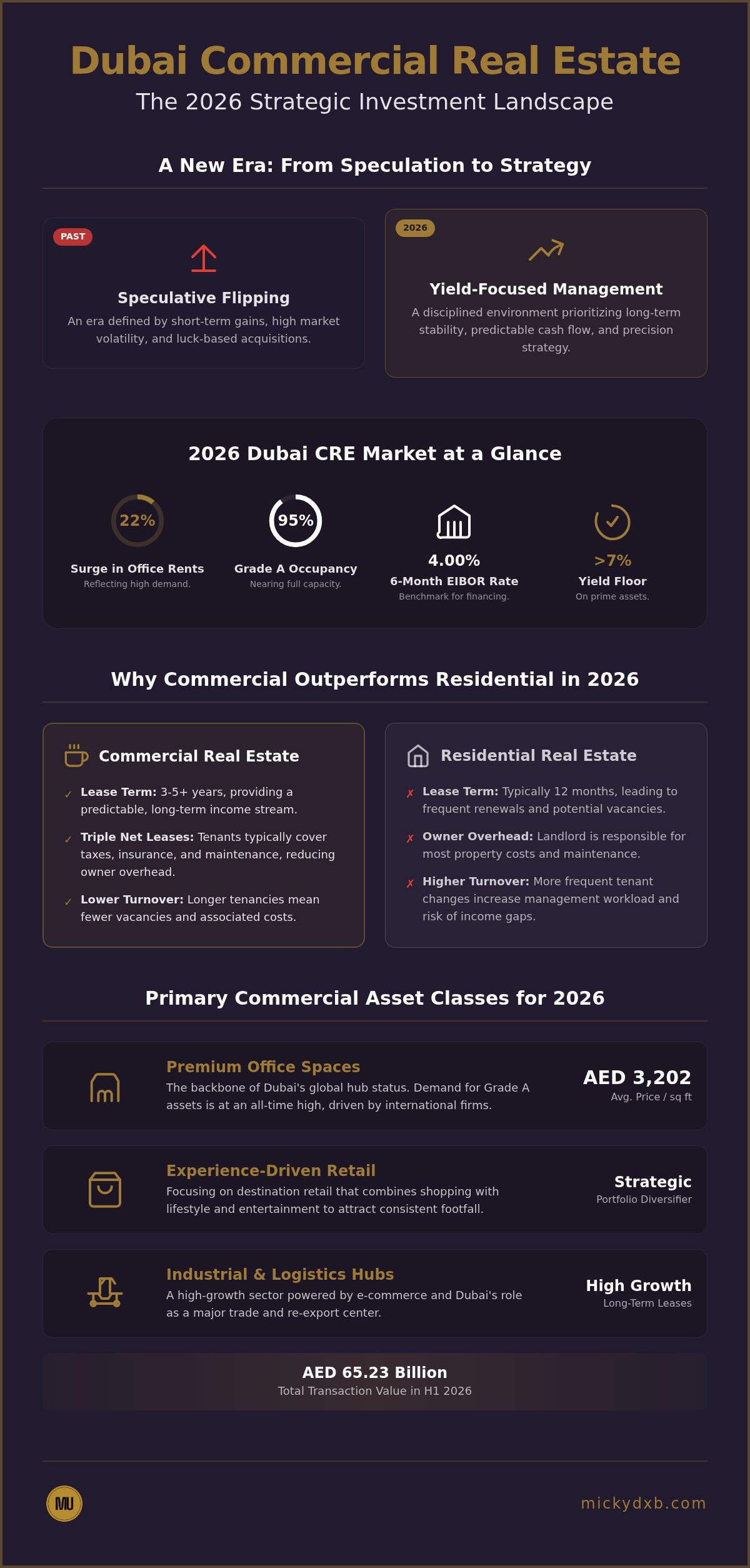
In 2026, the era of speculative flipping in the Gulf has officially ceded ground to a new, disciplined era of yield-focused asset management. With office rents surging 22% and Grade A occupancy hovering near 95%, the landscape for Dubai commercial real estate investment has become a high-stakes environment where precision beats luck every time. You’ve likely noticed that while the potential rewards are higher than ever, the barrier to entry has shifted from simple capital to sophisticated strategy.
It’s understandable if you feel the weight of these shifting dynamics. Between the nuances of the new Public Safety Law and the intricacies of securing a commercial mortgage with 6-month EIBOR rates at 4.00%, the path to a secure 10% yield can feel clouded by complexity. This guide is designed to clear that fog. We’ll provide a definitive roadmap for your next acquisition, break down the current yield environment, and show you how to navigate professional financing with total confidence. From identifying resilient Grade A assets to mastering the latest DLD regulations, you’ll gain the clarity needed to turn market volatility into your greatest strategic advantage.
Key Takeaways
- Understand the 2026 market shift from speculative flipping to a disciplined, yield-driven environment that prioritizes long-term stability and Grade A assets.
- Identify the highest-performing asset classes, including the surging demand for premium office spaces and the strategic expansion of logistics hubs.
- Learn to accurately calculate the difference between gross yields and net ROI to ensure your Dubai commercial real estate investment aligns with your financial goals.
- Navigate the five-step acquisition journey with confidence, utilizing integrated mortgage lending and strategic consulting to streamline the DLD registration process.
- Transition from a single-unit mindset to a bold strategist approach by diversifying your portfolio across retail, office, and industrial sectors.
The Evolution of Dubai Commercial Real Estate Investment in 2026
Dubai’s commercial real estate (CRE) sector in 2026 represents a fundamental shift in how wealth is preserved and grown. While residential properties often capture the headlines, the commercial market provides the structural backbone for the city’s economic expansion. A strategic Dubai commercial real estate investment now moves beyond simple square footage; it’s a calculated play on the city’s role as a global headquarters hub. The speculative “buy and flip” mentality that characterized the History of Dubai’s Real Estate Market has matured into a sophisticated strategy focused on sustainable cash flow.
This evolution is driven by a regulatory environment that prioritizes investor security. Business-friendly policies, such as 100% foreign ownership and the removal of minimum property values for certain residency visas, have transformed the city into a permanent base for international firms. For those seeking a hedge against global inflation, commercial assets offer a tangible, dollar-pegged security that few other asset classes can match. If the global economy fluctuates, then the demand for physical operational space in a tax-efficient jurisdiction like Dubai remains a constant stabilizer for diversified portfolios.
Market Maturity and Investor Confidence
The influx of institutional capital in 2026 is a direct result of increased transparency and standardized reporting. Large-scale funds now compete alongside private investors, driving a flight to quality that rewards well-maintained assets. Long-term residency visas have anchored business owners to the region, ensuring that the demand for physical office and retail space remains resilient. In the current economic climate, the 2026 commercial “yield floor” has established itself at approximately 7% for prime assets, providing a clear benchmark for risk-adjusted returns relative to prevailing interest rates.
Why Commercial Outperforms Residential in 2026
The primary advantage of a Dubai commercial real estate investment lies in the stability of the tenant relationship. Residential leases typically reset every 12 months, creating a constant cycle of renewal and potential vacancy. Commercial agreements, by contrast, generally span three to five years, or even longer for industrial assets. This longevity provides a predictable income stream that simplifies long-term financial planning.
Investors also benefit from the “Triple Net Lease” structure, where the tenant assumes responsibility for property taxes, insurance, and maintenance costs. This arrangement shifts the operational burden away from you, the owner, and onto the business occupying the space. With lower tenant turnover and reduced overhead, the net ROI on commercial units consistently outpaces residential alternatives in the 2026 market.
Primary Commercial Asset Classes for Strategic Portfolios
A strategic portfolio isn’t built on guesswork. It’s built on a clear understanding of asset performance and economic utility. In the first half of 2026, the market saw transaction values reach AED 65.23 billion, a testament to the growing appetite for diversified holdings. For a successful Dubai commercial real estate investment, you must look beyond the surface of a building. You need to evaluate its functional purpose within the broader economy. Today’s market is primarily defined by three pillars: premium office space, experience-driven retail hubs, and the high-growth industrial sector.
The demand for Grade A office space has reached a fever pitch. With occupancy rates for prime buildings hitting 95% in early 2026, the competition for quality space is intense. This scarcity has driven average office prices to approximately AED 3,202 per square foot. According to the 2026 UAE Commercial Real Estate Outlook, institutional capital is increasingly flowing into assets that offer both high yields and operational efficiency. From flexible co-working hubs to expansive industrial warehouses, the variety of assets allows for precise portfolio tailoring.
The Rise of Specialized Office Spaces
Corporate tenants no longer settle for four walls and a desk. They demand environments that reflect their brand values and support employee well-being. Flexible, co-working layouts have become the standard for international firms establishing regional headquarters. There’s also a significant premium placed on “Green” or ESG-compliant buildings. If a property lacks modern sustainability certifications, then its long-term tenant retention often suffers. High-quality assets don’t just attract better tenants; they keep them longer, reducing the costly vacancies that can erode your ROI.
Retail and Logistics: The Backbone of Diversification
Retail has undergone a radical transformation. Traditional storefronts have moved from simple transactional spaces to integrated experience centers that blend shopping with dining and entertainment. These high-footfall hubs remain incredibly resilient because they offer something digital platforms cannot replicate. Parallel to this, the logistics sector has become the market’s quiet powerhouse. The explosion of e-commerce has triggered a boom in “last-mile” delivery warehouses.
Strategic location is the deciding factor here. Properties situated near major transport arteries or global trade ports command the highest rents. If you’re looking to balance your portfolio, then adding an industrial asset provides a sturdy counterweight to more volatile sectors. Investors seeking to capitalize on this trend should explore the technical and financial complexities outlined in our comprehensive guide to warehouse for sale Dubai opportunities in 2026. To ensure your selection aligns with these shifting trends, engaging in professional Real Estate Investment Consulting is a vital step in your due diligence process.
Analyzing Yields and ROI in the 2026 Commercial Sector
Understanding your return is the difference between a passion project and a professional Dubai commercial real estate investment. Gross yields in 2026 typically range from 7% to 12%, which clearly outpaces the 5% to 8% seen in the residential sector. While these numbers are attractive, you need to look closer. Gross yield is simply the annual rent divided by the purchase price; it doesn’t tell the whole story. Net ROI is what actually lands in your account after accounting for VAT, service charges, and maintenance.
Commercial transactions in Dubai are subject to a 5% VAT. If you’re a VAT-registered investor, you can often recover this on expenses, but it’s a critical factor in your initial capital outlay. Capital appreciation also works differently here. While residential prices might fluctuate based on lifestyle trends, commercial assets gain value through corporate density and infrastructure improvements. If a district becomes a primary business hub, then the underlying land value experiences a structural shift that’s far more resilient than speculative residential cycles.
Calculating Net Operating Income (NOI)
Your true commercial profitability is found through Net Operating Income. Use this formula: (Annual Rental Income) – (Operating Expenses). Operating expenses include service charges, maintenance reserves, and a vacancy allowance. Even with Grade A occupancy at 95%, smart strategists still budget for a 5% vacancy to stay grounded. In 2026, the Cap Rate serves as the ultimate benchmark. It’s the ratio of NOI to the asset’s purchase price, allowing you to compare a warehouse in an industrial zone directly against a premium office suite.
The Role of Capital Appreciation
Capital growth in the commercial sector follows a distinct rhythm. It isn’t just about market sentiment; it’s about infrastructure and corporate utility. When the government announces a new transport artery or business hub expansion, the surrounding land value sees a permanent structural lift. This steady climb in value often parallels the trends found in luxury real estate Dubai, where high-end residential demand signals a broader influx of global wealth and corporate talent into a specific district.
Navigating Acquisition: Financing and Legal Frameworks
The path to a successful Dubai commercial real estate investment is paved with procedural milestones. It isn’t enough to find a high-yield asset; you must navigate a rigorous five-step acquisition framework to protect your capital. This journey begins with a strategic search, followed by deep-dive due diligence. From there, you sign the Memorandum of Understanding (Form F), secure your financing, and conclude with the official Dubai Land Department (DLD) registration. Each stage requires a bold strategist mindset to ensure no detail is overlooked.
Professional Real Estate Investment Consulting is your greatest asset during this process. It’s the difference between buying a liability and securing a legacy. Documentation requirements differ significantly between buyer profiles. Individual investors typically provide passports and proof of residency. Corporate entities, however, must submit valid trade licenses, Articles of Association, and board resolutions. Understanding these requirements early prevents delays that could jeopardize your position in a competitive market.
Securing Commercial Mortgages in 2026
Financing is the engine of any large-scale acquisition. In 2026, Loan-to-Value (LTV) ratios for ready commercial properties typically sit between 75% and 80% for expats. My integrated mortgage lending Dubai services bridge the gap between bank requirements and investor needs, ensuring your application is presented with institutional-grade clarity. We handle the complexities so you can focus on the bigger picture.
The logic of commercial lending is simple: if the property is already tenanted by a reputable firm, then banks view the asset as lower risk, which can lead to higher LTV approvals. Conversely, if the unit is vacant, then lenders may require more substantial down payments. We help you navigate these variables to secure the most favorable terms for your portfolio. For investors also holding or considering high-value residential assets, understanding how to structure a mortgage for luxury property Dubai can further optimize your overall financing strategy. We believe in doing things right rather than just doing them fast.
Due Diligence and Legal Safeguards
Never sign a contract without verifying the structural and legal health of the asset. This means scrutinizing building permits, checking for outstanding service charges, and validating the title deed through official DLD channels. If you’re considering a project still under construction, then the role of escrow accounts becomes paramount. These accounts ensure your funds are only released as construction milestones are met. For a deeper look at protecting your capital in these scenarios, read our off-plan property investment dubai guide.
Commercial lease laws also dictate your long-term success. You must understand the rights of existing tenants and the legal procedures for rent reviews before you commit. To ensure your next move is backed by over a decade of market expertise, you can explore our mortgage lending and consulting services today.
Strategic Advancement: Building a Commercial Portfolio
Successful wealth creation isn’t a series of isolated events. It’s a cohesive narrative. To truly master Dubai commercial real estate investment, you must move beyond the single-unit mindset and adopt the perspective of a Bold Strategist. This means viewing your assets not just as individual rent collectors, but as interconnected components of a resilient financial engine. Diversification is your primary tool for stability; it’s the difference between a fragile income stream and a fortified empire.
Mixing asset types provides a natural hedge against market fluctuations. If you combine a stable, long-term Grade A office lease with a high-footfall retail outlet, then you create a balanced risk profile that can weather shifting economic cycles. This approach ensures your cash flow remains steady even if one sector experiences a temporary cooling. As your initial assets appreciate, you can leverage that equity to expand your footprint. By using existing value to fund new acquisitions, you grow your commercial footprint without depleting your liquid reserves. I position myself as your long-term partner in this journey, focusing on the security and satisfaction that come from these well-informed choices.
The Power of Professional Consulting
Expert market timing can be the difference between a standard entry price and an exceptional one. Under the guidance of a seasoned advisor, your journey transforms from a stressful search into a structured advancement. We provide a from-to experience: moving you from the noise of market volatility to the clarity of strategic asset selection. Having a single point of contact for both commercial sales and mortgage lending streamlines the entire process. This integration ensures your financial structure is perfectly aligned with your property acquisition, removing the friction that often stalls high-stakes transactions.
Next Steps for the 2026 Investor
Your first action should be a comprehensive portfolio audit. This isn’t just about looking at current yields; it’s about evaluating how each asset fits into your long-term vision. You must look beyond the immediate transaction to consider future exit strategies. Whether you plan to hold for decades or seek a strategic resell after a period of capital growth, every decision today should serve that final goal. We invite you to begin this process with a low-friction consultation. We’ll map out a roadmap tailored to your specific objectives, focusing on discovery, security, and strategic advancement. Let’s build a legacy that stands the test of time.
Securing Your Future in the 2026 Commercial Landscape
The 2026 market has matured into a disciplined, yield-focused landscape where precision outweighs speculation. You’ve seen how the surge in Grade A office demand and the rise of specialized logistics hubs provide a robust foundation for wealth preservation. Mastering a Dubai commercial real estate investment now requires a sophisticated blend of market timing, legal due diligence, and integrated financial structuring. If you align your portfolio with these high-performance sectors, then you’re building a resilient engine for long-term growth.
Navigating this complex environment is simpler with a trusted advisor by your side. With over a decade of specialized market experience and a proven track record of 2,000 successful listings, I focus on the security and satisfaction that come from well-informed choices. My integrated mortgage lending services streamline your acquisition, ensuring your financing is as strategic as your asset selection. It’s time to move from observation to action. Secure your strategic commercial consultation with Micky Uppal today. You have the vision; let’s build the roadmap to achieve it.
Frequently Asked Questions
Is commercial real estate more profitable than residential in Dubai for 2026?
Commercial assets typically offer higher gross yields than residential properties. In 2026, commercial yields range from 7% to 12%, while residential returns generally hover between 5% and 8%. This performance is driven by longer lease terms and “Triple Net Lease” structures that shift maintenance costs to the tenant. If you prioritize steady cash flow over speculative capital gains, then a Dubai commercial real estate investment is your most strategic option.
What are the typical mortgage rates for commercial property in the UAE?
Interest rates from UAE banks for commercial properties currently range between 3.89% and 5.99% per annum. These rates are often pegged to the 3-month or 6-month EIBOR, which stood at approximately 3.74% and 4.00% respectively in August 2026. LTV ratios for expats typically sit at 75% to 80% for ready assets. Securing professional mortgage lending Dubai services ensures you find the most competitive structure for your specific asset class.
Can foreigners own 100% of a commercial property in Dubai?
Foreign investors can enjoy 100% ownership of commercial properties in designated freehold areas across the UAE. Recent regulatory shifts have expanded these opportunities, allowing companies based in free zones to own commercial assets more broadly than in previous years. This transparency creates a secure foundation for international capital. If you’re looking to establish a regional headquarters, then the legal framework provides the protection and autonomy your business requires.
What is the minimum investment required for a commercial asset?
There’s no legal minimum for a Dubai commercial real estate investment, though market prices dictate the entry point. Small office suites or retail units may start in the low millions; Grade A office space averaged AED 3,202 per square foot in the first half of 2026. It’s essential to consider the 4% DLD transfer fee and 2% agent commission when calculating your initial capital requirements for any strategic acquisition.
Are there any specific taxes on commercial property income in the UAE?
The UAE remains a tax-efficient environment, but specific regulations apply to the commercial sector. Rental income is generally subject to a 5% Value Added Tax (VAT), which registered investors can often recover on their operational expenses. Additionally, corporate tax may apply to business profits exceeding AED 375,000. Navigating these requirements requires clarity and strategic advancement to ensure your net ROI remains as high as your gross yield suggests.
How long are standard commercial leases, and can they be terminated early?
Standard commercial leases typically span three to five years, providing much greater stability than the one-year cycles found in residential property. Early termination clauses are strictly governed by the specific terms of your contract. If a tenant needs to exit before the term ends, then they’re usually required to provide substantial notice or pay a pre-agreed penalty. This predictability is a cornerstone of professional commercial portfolio management.
What is the difference between a shell-and-core and a fitted office space?
A shell-and-core office is a raw space with only the basic structure and utility connections, allowing the tenant to customize the layout entirely. Fitted offices are ready for immediate occupation, complete with flooring, ceilings, and lighting. If you’re looking for immediate rental income, then fitted spaces are often the preferred choice. However, shell-and-core units attract long-term corporate tenants who value the ability to design their own bespoke workspace.
Does the Golden Visa apply to commercial real estate investors?
The 10-year Golden Visa applies to investors who hold property with a minimum value of AED 2,000,000. This threshold can be met through a single commercial asset or a combination of properties within your portfolio. Securing this long-term residency provides the stability needed to manage your investments with confidence. If your asset value meets this requirement, then you gain the security of a permanent base in the region. Investors holding high-value assets above AED 5 million should also explore how a structured mortgage for luxury property Dubai can help preserve liquidity while maximizing portfolio reach.

Leave a Reply