


What if the most significant obstacle to your Dubai property ambitions isn’t the market price, but a single overlooked detail in your financial profile? You’ve likely felt the pressure of shifting interest rates and the rigid 80% Loan-to-Value requirements that define the current lending environment. It’s a complex landscape where a single documentation error can stall your progress for months. We understand that for a self-employed professional or a busy resident, the path to a home loan Dubai expat lenders approve can feel like a gauntlet of hidden hurdles and high stakes.
This article promises to strip away the ambiguity, offering you a masterclass in UAE property financing through a rigorous, step-by-step checklist. If you follow this strategic roadmap, then you’ll move from initial curiosity to a position of absolute borrowing confidence. We’ll explore the nuances of current 2026 regulations, detail the exact paperwork required, and show you how to secure the most competitive rates. From calculating your maximum capacity to receiving that final approval letter, you’re about to gain the clarity needed to turn a high-stakes investment into a secure, satisfying reality.
Key Takeaways
- Master the 2026 eligibility criteria, including the 80% Loan-to-Value limit for first-time resident buyers, to ensure your financial foundation is solid.
- Gain clarity on the trade-offs between fixed-rate stability and variable EIBOR-linked products to choose a financing structure that fits your risk profile.
- Navigate the application process with a streamlined checklist designed to help you secure a home loan Dubai expat lenders prioritize for approval.
- Learn how integrating your property search with expert mortgage lending services reduces transaction friction and accelerates your path to ownership.
- Discover the “Golden Document” strategy to present a flawless profile to banks, minimizing delays and maximizing your borrowing capacity.
Navigating the 2026 Home Loan Landscape for Expats
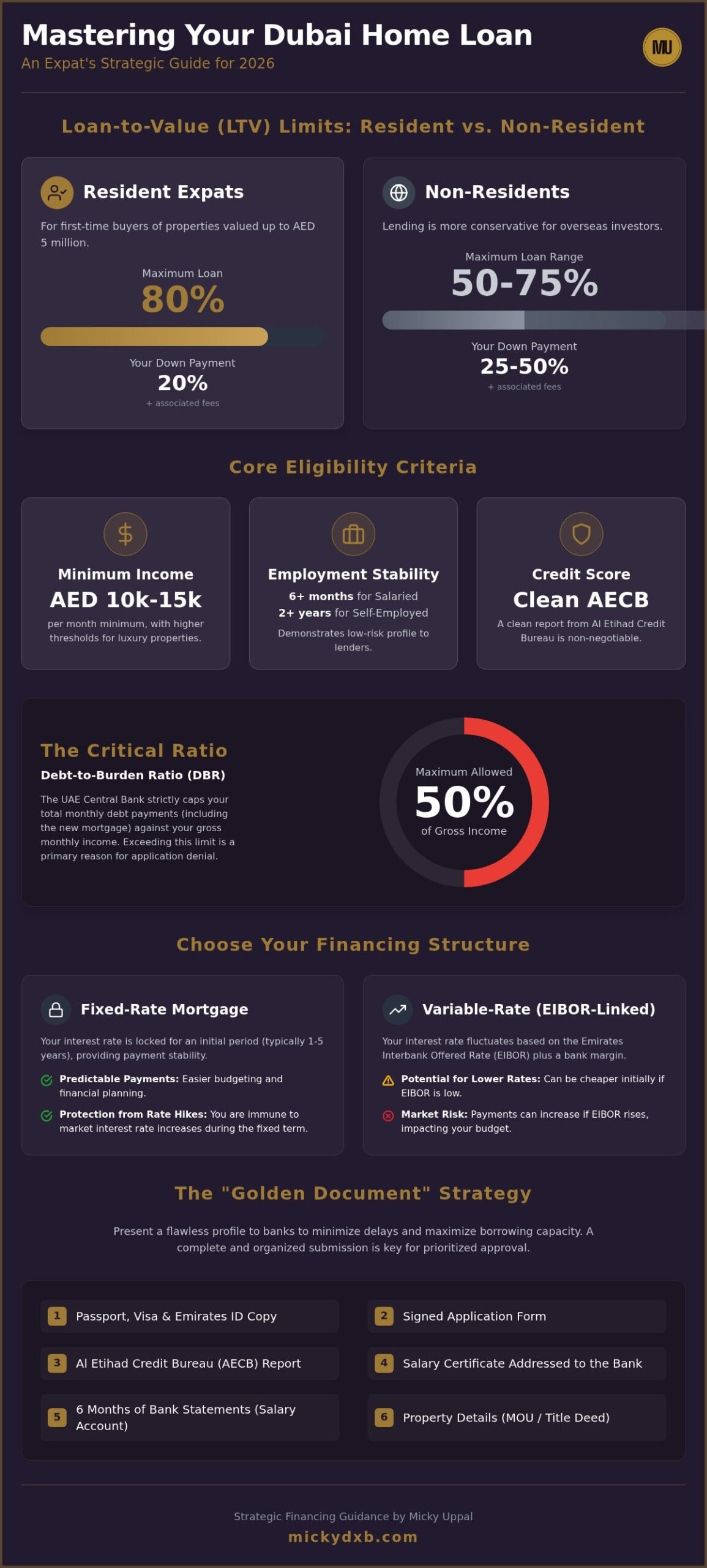
The UAE financial sector has matured into a sophisticated ecosystem where a home loan Dubai expat residents secure is no longer a mere transaction, but a strategic asset. Historically, Dubai’s real estate market was dominated by cash purchases; however, 2026 marks a decisive shift toward leveraged growth. Understanding the distinction between resident and non-resident lending is the first step toward clarity. While residents benefit from higher Loan-to-Value (LTV) ratios of up to 80%, non-residents typically navigate a more conservative range of 50% to 75%. This evolution reflects a national commitment to long term stability, moving away from high stakes volatility toward a predictable, regulated environment.
Adopting a structured approach is essential for any investor looking to transition from the stress of fluctuating rentals to the security of ownership. A well-timed mortgage doesn’t just provide a roof; it serves as a foundational pillar in a sophisticated luxury real estate investment strategy. By viewing property financing as a component of your broader wealth narrative, you can navigate the market with the quiet authority of a seasoned strategist.
The Strategic Advantage of Financing for Expats
Smart investors recognize that financing is a tool for liquidity. If you use bank capital to fund your home, then you preserve your personal cash reserves for high yield opportunities or business expansion. This approach transforms the mortgage from a debt into a hedge against the rising costs of the rental market. It facilitates a vital psychological shift: you’re no longer just a temporary tenant paying for someone else’s equity. Instead, you become a strategic asset owner. This shift provides three key benefits: financial control, long term security, and the ability to scale your portfolio with precision.
Current Market Sentiment and Lending Trends
The lending climate in 2026 is defined by speed and transparency. Digital first mortgage approvals have become the standard, reducing the time from application to pre-approval to mere hours in some cases. Banks are showing a clear preference for long term expat residents, rewarding career stability and local credit history with more favorable terms. With the UAE Central Bank base rate stabilizing near 3.65% earlier this year, the market offers a window of opportunity for those who have prepared their financial profiles. This availability is a direct result of robust national economic growth, creating a ripple effect of confidence that benefits every home loan Dubai expat applicant who approaches the process with a clear plan.
Eligibility Criteria and Loan-to-Value (LTV) Limits
Securing a home loan Dubai expat lenders approve starts with a clear-eyed assessment of your borrowing power. In 2026, the 80/20 rule remains the cornerstone for first-time resident buyers. If you’re purchasing a property valued up to AED 5 million, then you can typically secure up to 80% of the value through bank financing. This leaves you responsible for a 20% down payment, plus associated transaction fees. For non-residents, the landscape is more conservative, with LTV limits generally hovering between 50% and 75%. This distinction emphasizes the value the UAE places on residency and long-term commitment to the local economy.
Stability is the currency of the UAE banking sector. Lenders prioritize applicants who demonstrate a steady professional trajectory. Most banks require a minimum monthly income between AED 10,000 and AED 15,000, though prime lenders often look for higher thresholds for luxury acquisitions. Your length of service is equally vital. Salaried employees usually need at least six months with their current employer, while self-employed entrepreneurs must show a business history of at least two years. This track record proves you’re a low-risk partner in the eyes of the bank, often resulting in more favorable interest rate offers.
Financial Readiness: Beyond the Down Payment
Your Debt-to-Burden Ratio (DBR) is the silent factor that determines your approval. This ratio measures your total monthly debt obligations against your gross income, and it’s strictly capped at 50% by the UAE Central Bank. If your DBR is too high, then you might need to consolidate existing liabilities or increase your down payment to lower the monthly installment. A clean report from the Al Etihad Credit Bureau (AECB) is non-negotiable. Banks scrutinize this data to assess your reliability, and even minor defaults can impact your ability to secure a competitive rate. For those looking to optimize their profile before applying, seeking strategic financial guidance can clarify your path to a successful application.
Age and Tenure Restrictions
Time is a critical lever in your mortgage strategy. The maximum loan tenure for expats is 25 years, providing a long horizon to manage repayments. However, your age at the time of application dictates the final duration. Banks require that the loan is fully settled by the age of 65 for salaried individuals or 70 for the self-employed. If you’re entering the market later in your career, then your tenure will be compressed, leading to higher monthly installments. Strategic planning ensures your mortgage completes before retirement, protecting your long-term liquidity and providing the peace of mind that comes with full asset ownership. Every year you wait to enter the market can significantly alter the math of a home loan Dubai expat residents rely on for wealth creation.
Evaluating Mortgage Types: Fixed Rates vs. Variable EIBOR
Choosing your rate structure is a pivotal decision that dictates your long-term financial health. A fixed-rate mortgage offers the luxury of predictability. In early 2026, fixed rates for expats ranged from 3.89% to 5.8%, providing a vital safeguard against global economic shifts. If you value budgeting with absolute precision, then a fixed term of three to five years is your strongest ally. It transforms a fluctuating expense into a stable, known quantity, allowing you to plan your future with quiet confidence. A home loan Dubai expat applicants choose often hinges on this delicate balance between security and flexibility. To understand how these rates compare across lenders and what entry-level terms are realistically available, reviewing a comprehensive breakdown of the best mortgage rates Dubai investors can access in 2026 will sharpen your negotiating position.
Conversely, variable rates are linked directly to the Emirates Interbank Offered Rate (EIBOR). With the 3-month EIBOR hovering around 3.58% in early 2026, these products can offer immediate savings compared to fixed alternatives. However, they require a higher tolerance for market fluctuations. For many, a hybrid approach serves as the ideal middle ground, offering a fixed introductory period before transitioning to a variable rate. This structure is particularly effective when planning an off-plan property investment, as it aligns your financing costs with the property’s construction and handover phases. Selecting the right home loan Dubai expat investors prefer requires balancing these immediate savings against your long-term risk profile.
The Real Cost of Borrowing: Fees and Charges
Transparency is the foundation of a healthy partnership. Beyond the interest rate, you must account for bank processing fees, which typically range from 0.5% to 1% of the loan amount. Property valuation costs generally fall between AED 2,000 and AED 3,500. You’ll also need to budget for the mortgage registration fee of 0.25% and mandatory life insurance. If you intend to resell your asset quickly, then pay close attention to early settlement fees. These are generally capped at 1% of the outstanding balance, but they can significantly impact your net ROI if they aren’t factored into your exit strategy from the start.
Refinancing and Buy-Out Options
Refinancing is not just a reactive measure; it’s a strategic tool. As your equity grows or market rates dip, switching lenders through a buy-out can significantly reduce your monthly burden. A rigorous cost-benefit analysis will reveal if the long-term savings outweigh the new processing and registration fees. Using refinancing as a lever allows you to extract capital for further acquisitions. It transitions your journey from owning a single residence to managing a strategic property portfolio with the authority of a seasoned investor.
The Ultimate Home Loan Checklist for Expats
Securing a home loan Dubai expat lenders approve is a process that rewards the disciplined. Transitioning from a casual browser to a serious buyer requires a shift in mindset; you must move from exploration to execution. This roadmap ensures you don’t just find a property, but you secure it with the most favorable terms available in the 2026 market. By following a structured checklist, you eliminate the guesswork and project an image of financial reliability to your lending partner. For a deeper understanding of the underlying mechanics that govern these decisions, a comprehensive guide to property financing Dubai investors rely on in 2026 can help you approach each step with greater strategic clarity.
- Step 1: Obtain an “Approval in Principle.” This document defines your exact borrowing capacity. It transforms your property search from a wide-reaching inquiry into a focused, strategic mission.
- Step 2: Consolidate your “Golden Document” folder. Speed is a currency in Dubai real estate. If your paperwork is ready for immediate submission, then you can lock in favorable interest rates before they fluctuate.
- Step 3: Property valuation and the Final Offer Letter (FOL). Once you’ve selected a home, the bank conducts an independent valuation. If the valuation aligns with the purchase price, then the bank issues the FOL, which is the binding contract for your financing.
- Step 4: Legal signing and mortgage registration. You’ll sign the final mortgage contracts and register the charge with the Dubai Land Department. This step involves paying the 0.25% mortgage registration fee.
- Step 5: Final disbursement and property handover. The bank releases the funds to the seller; the title deed is updated, and you receive the keys to your new asset.
To begin this journey with the support of a seasoned guide, you can consult with our mortgage experts to verify your eligibility today.
The Documentation Folder: Essential Paperwork
Your documentation is the foundation of your application. For identity verification, you’ll need clear copies of your passport, residency visa, and Emirates ID. Salaried residents must provide a salary certificate addressed to the bank and six months of original bank statements. If you’re self-employed, the requirements are more rigorous. You’ll need to present audited financial statements for the last two years, your company’s trade license, and the memorandum of association to prove business stability and income consistency.
Pre-Approval Strategy: Why Speed Matters
In a fast-moving market, a pre-approval is your strongest negotiating lever. It signals to sellers that you’re a “cash-ready” buyer, which often allows you to secure a better price or more flexible terms. Most pre-approvals are valid for 60 to 90 days. During this window, avoid making large purchases on credit or changing your employment status. If you maintain a stable financial profile, then the transition from pre-approval to the final offer remains seamless. This proactive approach is the hallmark of a savvy home loan Dubai expat applicant who values efficiency over haste.
Strategic Financing with Micky Uppal’s Professional Guidance
A mortgage is more than a simple financial obligation; it’s a powerful strategic lever that can accelerate your journey toward property wealth. While many banks offer digital apps that promise rapid approvals, they often lack the nuanced mentorship required for high-stakes decisions. Micky Uppal moves beyond the role of a traditional service provider, acting instead as a Trusted Advisor who integrates market expertise with financial precision. With over a decade of experience and more than 2,000 successful listings, our approach ensures that your home loan Dubai expat application is positioned for maximum success from the very first consultation.
The synergy between finding a luxury asset and securing the right capital is where true value is created. How integrated mortgage lending Dubai services streamline your acquisition is by removing the silos between brokerage and banking. If you align your financing strategy with your property search from the outset, then you eliminate the common risks of valuation shortfalls or last-minute documentation hurdles. Through an extensive professional network, we provide access to competitive rates and bespoke structures that aren’t always visible to the public, ensuring your investment remains both secure and liquid.
A Partnership-Oriented Approach to Property Wealth
Our philosophy centers on a commitment to doing things right rather than just doing them fast. We provide personalized mentorship through every stage of the transaction, from initial asset discovery to the final disbursement of funds. This partnership-oriented style is designed to alleviate the inherent stress of the Dubai market, replacing confusion with steady, professional confidence. We focus on strategic advancement, helping you plan your next portfolio move before your current acquisition is even finished. This long-term perspective ensures that every home loan Dubai expat residents secure through our guidance serves a larger purpose in their wealth narrative.
Start Your Journey Today
Identifying the right asset for your specific financial profile requires a blend of transparency and local insight. We believe in honest, open communication that respects the gravity of your investment. Whether you’re a first-time resident buyer or a seasoned international investor, the path to a successful acquisition starts with a clear, grounded understanding of your capacity. We invite you to experience a more sophisticated way to invest, where clarity and security are the standard. Take the first step toward a well-informed choice by scheduling a strategic consultation to review your 2026 property goals.
Securing Your Future in the Dubai Property Market
The transition from a tenant to a strategic asset owner is a journey that requires both foresight and a rigorous commitment to detail. You’ve seen how mastering the 2026 landscape, from navigating LTV limits to selecting the right rate structure, can transform a complex transaction into a stable investment. Successfully obtaining a home loan Dubai expat lenders approve isn’t just about speed. It’s about the precision of your preparation, the clarity of your documentation, and the strength of your professional support. With over 10 years of market expertise and a focus on integrated real estate and mortgage services, we ensure your acquisition is handled with quiet authority.
Strategic advancement depends on having a guide who prioritizes your long-term well-being. We provide personalized mentorship for high-net-worth investors, ensuring every choice is grounded in transparency and strategic value. If you’re ready to move beyond the checklist and into the reality of ownership, then it’s time to partner with an advisor who knows the market’s inner workings. Secure your strategic mortgage consultation with Micky Uppal today. Your journey toward a secure and satisfying portfolio starts with a single, well-informed decision. We look forward to building that future together.
Frequently Asked Questions
Can an expat get a home loan in Dubai if they are a non-resident?
Yes, non-residents can secure a home loan Dubai expat investors use to build their international portfolios. While resident expats can access up to 80% LTV, non-residents typically face more conservative limits between 50% and 75%. You’ll need to provide proof of income from your home country and maintain a down payment between 25% and 50%. This structure ensures the bank’s security while allowing you to leverage robust rental yields, which currently average between 6% and 9%.
What is the minimum down payment required for an expat home loan?
The minimum down payment depends on your residency status and the property’s value. For resident expats purchasing their first home valued under AED 5 million, a 20% down payment is standard. If the property exceeds AED 5 million, then the requirement increases to 30%. Non-residents should prepare for a higher entry point, usually ranging from 25% to 50%. These thresholds ensure you have significant equity in the asset, providing a stable foundation for your long-term financial growth.
How long does the mortgage approval process typically take for expats?
Efficiency has increased significantly in 2026 due to digital-first banking. You can often obtain an “Approval in Principle” within 24 to 48 hours if your documentation is complete. However, the transition from a property valuation to a Final Offer Letter typically takes two to three weeks. If you consolidate your paperwork early, then the entire process from search to handover can be completed within 30 to 45 days, depending on the seller’s readiness and legal processing times.
Is it better to choose a fixed or variable interest rate in 2026?
Your choice depends on your personal tolerance for market fluctuations. Fixed rates, currently ranging from 3.89% to 5.8%, offer absolute budget certainty for a term of one to five years. Variable rates are linked to the 3-month EIBOR, which was near 3.58% in early 2026, plus a bank margin. If you anticipate a decline in global interest rates, then a variable product might be advantageous. Most strategic investors choose a hybrid structure to balance immediate stability with future flexibility.
What happens if I want to sell my property before the mortgage is paid off?
You can sell your property at any time, but you must settle the outstanding mortgage balance first. The buyer’s bank will typically issue a manager’s cheque to your lender to clear the debt. You should account for an early settlement fee, which is generally capped at 1% of the remaining loan amount or AED 10,000, whichever is lower. This process is a standard part of the resell services we provide to ensure a smooth transition for both parties.
Are there specific mortgage options for off-plan property purchases?
Specific mortgage products exist for off-plan acquisitions, though they operate differently than ready-property loans. Banks often limit financing to 50% of the property value during the construction phase. The remaining 50% is typically covered by the developer’s payment plan. Once the project reaches a certain completion milestone, the mortgage disbursements begin. This integrated approach allows you to secure a luxury asset early while managing your cash flow through structured, milestone-based payments that align with construction progress.
What are the main fees associated with getting a home loan in the UAE?
Budgeting for transaction costs is essential to avoid surprises. You’ll encounter four primary charges: the Dubai Land Department fee of 4% of the property value, a mortgage registration fee of 0.25% of the loan amount, bank processing fees ranging from 0.5% to 1%, and property valuation fees between AED 2,000 and AED 3,500. Accounting for these ensures your home loan Dubai expat application remains fully funded from the outset, allowing for a seamless transition to property ownership without financial strain.
Do I need life insurance to secure a mortgage in Dubai?
Life insurance is a mandatory requirement for all mortgages in the UAE. Banks require this to ensure the loan is settled in the event of the borrower’s passing, protecting both the lender and your heirs. You can choose the bank’s group insurance plan or assign a private policy if it meets the bank’s specific criteria. While it adds a small monthly cost, it provides the essential security needed for high-stakes property investments and gives you peace of mind.

Leave a Reply