


With the UAE expected to attract nearly 10,000 millionaires by 2025, the global rush for Gulf real estate has never been more pronounced. You’ve likely heard that this market is a tax haven, yet you might still worry about how the 9% corporate tax or international reporting standards affect your bottom line. It’s natural to feel a sense of hesitation when the rules of the game shift from a tax-free vacuum to a more sophisticated, tax-optimized environment. Understanding the tax implications of owning property in UAE for non-residents is no longer just about avoiding fees; it’s about strategic wealth preservation.
This guide provides the clarity you need to move forward with absolute confidence. We’ll show you how to protect your yields through a network of over 137 Double Taxation Agreements, navigate the AED 1 million income threshold for individuals, and ensure your home-country reporting is flawless. From transactional costs like the 4% transfer fee to the nuances of the Common Reporting Standard, you’ll gain a complete map of your financial obligations. If you align your strategy with these regulations, then you can unlock the full potential of a market that remains one of the highest-yielding in the world.
Key Takeaways
- Master the nuances of the tax implications of owning property in UAE for non-residents to differentiate between zero-rated income and mandatory administrative costs.
- Account for primary transactional fees, such as the standard 4% registration charge, to ensure your financial planning is grounded in current 2026 regulatory requirements.
- Identify the specific triggers for the 9% corporate tax and commercial VAT to protect your international property yields from unexpected liabilities.
- Utilize the UAE’s network of over 137 Double Taxation Agreements to shield your global income and satisfy home-country reporting obligations with total transparency.
- Learn how strategic asset acquisition and professional guidance can streamline your investment journey and maximize net returns across the entire UAE market.
Understanding the UAE Tax Landscape for International Property Owners
The UAE has built a global reputation as a sanctuary for capital. This isn’t because it’s a lawless frontier, but because it has mastered the balance between transparency and investor freedom. The Federal Tax Authority (FTA) manages the broader framework of Taxation in the United Arab Emirates, ensuring the market aligns with international standards like the Common Reporting Standard. You must distinguish between “taxes” in the traditional sense and the administrative fees that fund the nation’s world-class infrastructure. While you won’t face a monthly bill for simply owning a home, you’ll encounter one-time registration costs that act as a gateway to the market. As of 2026, the UAE is defined as a tax-optimized jurisdiction where non-resident property owners are exempt from personal income and capital gains taxes on residential assets.
The “No Personal Income Tax” Advantage
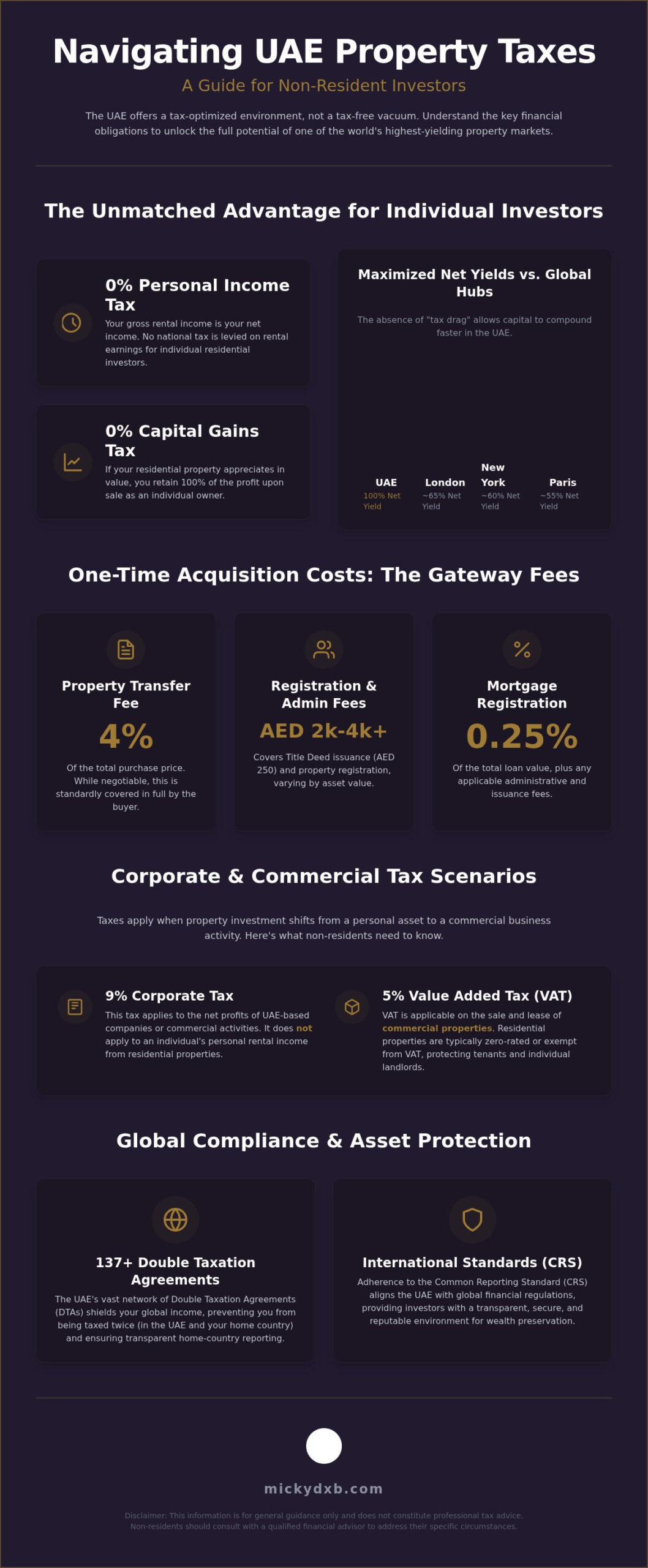
Rental yields in many global hubs are often eroded by aggressive fiscal policies. In the UAE, your gross rental income is typically your net income. There is no national tax on the rental earnings of individual residential investors. If your property appreciates in value, you keep the entirety of that gain because capital gains tax doesn’t apply to individuals here. When you compare these net yields to the high tax brackets found in London, Paris, or New York, the strategic advantage is undeniable. This environment allows your capital to compound faster, providing a level of financial security that’s increasingly rare in many Western markets. It’s a steady, predictable landscape for those who value long-term growth and want to avoid the “tax drag” that slows down portfolio expansion.
Defining Non-Resident Status for Property Ownership
You’re generally considered a non-resident if you don’t hold a UAE residency visa or meet the specific day-count requirements for tax residency. Owning a property doesn’t automatically grant you residency, though specific investment thresholds can unlock long-term Golden Visas for those seeking more than just a financial stake. Understanding the tax implications of owning property in UAE for non-residents requires a clear view of your legal standing. While you don’t need to live here to own, high-value portfolios often require a local financial representative to navigate reporting requirements. This ensures your assets are managed according to local regulations while you remain focused on your global interests. It’s about doing things right from the start to avoid future friction. This partnership-oriented approach protects your peace of mind while you explore off-plan property investments or luxury residential sales.
Primary Transactional Fees and Recurring Holding Costs
Every successful investment begins with a precise calculation of entry costs. While the absence of a recurring annual property tax is a major draw, you must account for the transactional fees that act as the primary fiscal gateway. These are not hidden charges; they are transparent government levies designed to secure your ownership rights. Understanding the tax implications of owning property in UAE for non-residents involves looking past the “zero-tax” headlines to the actual line items on your settlement statement. For a comprehensive view of the national framework, you can consult the Official UAE government tax information portal.
One-Time Acquisition Costs
The most significant entry cost is the property transfer fee, which is standard at 4% of the purchase price. While local law allows this to be split between buyer and seller, market practice typically sees the buyer covering the full amount. You’ll also encounter administrative charges, including a title deed issuance fee of AED 250 and registration fees that range from AED 2,000 to AED 4,000 depending on the asset’s value. If you’re leveraging your acquisition, you must factor in a mortgage registration fee of 0.25% of the loan value plus an issuance fee. Integrating mortgage lending Dubai into your initial strategy can help streamline these costs, ensuring your financing is as tax-efficient as your property choice. Expert legal oversight during this transfer process is essential to ensure every dirham is correctly allocated.
Annual Maintenance and Service Charges
Once you hold the title, your recurring costs shift toward maintenance and civic contributions. The Service Charge Index provides a transparent breakdown of what you’ll pay for the upkeep of common areas, and these rates vary based on the specific community and property type. You’ll also see a municipality housing fee, which is typically 5% of the property’s annual rental value. This isn’t a separate tax bill; it’s collected conveniently through your monthly utility payments. We also advise investors to account for sinking funds. These are long-term reserves set aside for major future repairs, protecting your capital preservation and ensuring the asset remains a premium listing for years to come. If you’re unsure how these costs impact your specific ROI, a strategic investment consultation can provide the clarity you need to move forward.
Commercial VAT and the 2026 Corporate Tax Framework
The transition from a purely tax-free environment to a regulated, tax-optimized jurisdiction is a sign of a maturing market. As an investor, you need to look beyond the surface to understand how these frameworks actually impact your net returns. The introduction of Value Added Tax (VAT) and federal corporate tax reflects the UAE’s commitment to global transparency standards. While these changes might seem complex, they are designed with clear thresholds that protect the majority of individual residential investors. Understanding the tax implications of owning property in UAE for non-residents requires a precise look at the nature of your assets and the scale of your annual revenue.
VAT Rules for Non-Resident Investors
VAT in the UAE is set at a standard rate of 5%, but its application depends heavily on the asset type. If you are focused on residential property, the news is generally positive. Residential leases are exempt from VAT, and the first sale of a new residential property within three years of completion is zero-rated. This means most luxury residential investors won’t see their yields diluted by VAT. However, commercial property follows a different set of rules. The sale and lease of commercial units are subject to the 5% rate. If your taxable supplies in the UAE exceed the mandatory registration threshold of AED 375,000, you’ll need to register with the Federal Tax Authority. One strategic advantage for commercial owners is the ability to recover input VAT on expenses related to the property, such as maintenance and utility costs, provided you are VAT-registered.
The New Corporate Tax Regime for Individuals
The 9% corporate tax is perhaps the most discussed change in the 2026 landscape. For non-resident individuals, the liability only triggers if your income from “licensed real estate activities” exceeds AED 1 million within a calendar year. This is a high bar designed to exempt casual investors and smaller portfolios. It’s vital to draw a clear line between passive and active income. Passive rental income derived from personal property ownership is distinct from commercial trading, which involves frequent buying and selling or operating a licensed real estate business. If your portfolio remains a personal investment vehicle, your rental earnings and capital gains typically remain outside the scope of corporate tax. For high-volume landlords who do cross the threshold, compliance involves:
- Registering with the Federal Tax Authority for Corporate Tax purposes.
- Maintaining accurate financial records that distinguish between personal and business-related income.
- Filing annual tax returns even if the taxable income falls below the AED 375,000 profit threshold.
By keeping your activities focused on long-term residential yields, you can often maintain the tax-efficient status that makes this market so attractive. If you’re considering expanding into commercial assets or high-frequency trading, then a more structured tax strategy becomes a necessity to protect your global yields.
Global Compliance: Double Taxation Agreements and Reporting
The UAE’s fiscal landscape is designed for the modern, global citizen. It isn’t just about what you pay locally; it’s about how those payments reflect in your home country’s tax return. With a network of over 137 Double Taxation Agreements (DTAs) in place, the UAE provides a robust shield for international investors. Understanding the tax implications of owning property in UAE for non-residents requires a deep look at this cross-border interplay. These treaties are specifically crafted to ensure that your hard-earned yields aren’t taxed twice, allowing you to move capital with confidence and clarity. When you align your investment with these global standards, you transform a simple asset into a strategically protected wealth vehicle.
Leveraging Tax Treaties
If you seek to prove your tax status to foreign authorities, obtaining a Tax Residency Certificate (TRC) is a vital step. While non-residents may not always qualify for a TRC under the same criteria as residents, the DTA provisions still offer significant protection. These agreements typically allow you to credit any UAE-based costs against your home-country liabilities or exempt certain income types entirely. It’s a matter of strategic alignment. We always recommend consulting with home-country tax experts to ensure your UAE portfolio is reported correctly. From the initial acquisition to the eventual exit, these treaties act as a bridge, ensuring your international property yields remain high without the friction of double taxation.
Automatic Exchange of Information (AEOI)
Transparency is the new global standard, and the UAE is a committed participant. Through the Common Reporting Standard (CRS), UAE banks and authorities share specific financial information with your home country’s tax office. This exchange includes account balances and income generated from assets, making total transparency a requirement rather than an option. If you are entering the market through an off-plan property investment, you’ll find that “Know Your Customer” (KYC) protocols are rigorous. These measures are not hurdles; they are safeguards that verify the legitimacy of the market and protect your long-term interests.
Securing mortgages for non-residents can also play a role in this compliance narrative. By utilizing local financing, you create a clear, bank-verified trail of capital that simplifies reporting to your home authorities. It’s about building a narrative of stability and compliance from day one. As your Trusted Investment Advisor, I help you navigate these global complexities to ensure your portfolio remains both profitable and fully compliant with international standards.
Strategic Asset Acquisition: Minimizing Friction in Your Journey
Success in the UAE real estate market isn’t just about finding a beautiful property; it’s about selecting an asset that aligns with your fiscal reality. If you choose residential over commercial, then you’re often opting for a simpler VAT path. If you prioritize off-plan acquisitions over secondary sales, you might benefit from developer-paid commissions and structured payment plans that keep your liquid capital free. Understanding the tax implications of owning property in UAE for non-residents is the essential foundation, but strategic selection is the architecture that supports your long-term wealth. Every choice, from the asset class to the financing method, affects your net ROI and your reporting obligations at home.
Professional Guidance and Risk Mitigation
Navigating national regulatory shifts requires more than just a search engine. It demands a “Trusted Advisor” who has seen the market evolve through every cycle and knows its inner workings intimately. With over a decade of UAE market expertise and more than 2,000 successful listings, Micky Uppal provides the steady, reassuring hand needed to avoid common documentation pitfalls. We ensure that your “Know Your Customer” (KYC) filings are precise and your property registration is handled with absolute transparency. This isn’t about doing things fast; it’s about doing things right to protect your long-term well-being. By leveraging seasoned expertise, you move from a position of uncertainty to one of strategic advancement, discovery, and security.
Next Steps for the Global Investor
Your journey from discovery to acquisition should follow a methodical, logical progression. Start by securing pre-approval for national financing to understand your exact leverage. Our integrated mortgage lending services are designed to streamline this for non-residents, providing a clear map of your borrowing capacity before you even initiate a search for high-yield assets. Once your financing is steady, you can focus on the final checklist for a tax-aware acquisition:
- Verify the asset’s VAT status to ensure it aligns with your registration thresholds.
- Confirm how your home country’s DTA provisions apply to your specific UAE income.
- Ensure your local mortgage and property documents are perfectly aligned for CRS reporting.
The inherent stress of high-stakes financial decisions disappears when you have a partner who prioritizes your long-term success over immediate transactions. We look beyond the individual sale to see the larger narrative of your investment journey. If you’re ready to protect your yields and ensure total regulatory compliance, then it’s time to take the next step. Consult with Micky Uppal for a tailored investment strategy that transforms these complex regulations into a clear, high-yield roadmap for your future.
Securing Your High-Yield Future in the UAE
The shift toward a more regulated fiscal environment in 2026 doesn’t diminish the UAE’s appeal; rather, it solidifies the nation’s status as a mature and transparent global hub. By mastering the tax implications of owning property in UAE for non-residents, you transition from a cautious observer to a bold strategist. You now understand how to navigate municipality fees, leverage over 137 tax treaties, and select assets that maximize your net ROI. If you align your portfolio with these international standards, then you can ensure your wealth remains both secure and high-yielding for years to come.
Navigating these nuances requires a guide who prioritizes your long-term success over a single transaction. With over 10 years of national market expertise and a track record of more than 2,000 successful listings, I provide the steady authority needed to simplify high-stakes financial decisions. My approach is built on a foundation of clarity, openness, and unwavering reliability. From bespoke mortgage lending for international buyers to identifying exclusive off-plan and luxury assets, I am here to ensure your journey is seamless. Secure your UAE investment future with a professional consultation from Micky Uppal today. Your path to strategic advancement starts with a single, well-informed choice.
Frequently Asked Questions
Do non-residents pay income tax on rental earnings in the UAE?
No, the UAE doesn’t levy personal income tax on rental earnings for non-resident individuals. Your gross rental income is typically your net income, as there’s no federal requirement to pay tax on these earnings. This remains a primary incentive for global investors seeking high-yield assets. You should account for municipality fees and service charges that are deducted at the source or paid via utility bills to ensure your ROI calculations are accurate.
What is the 4% transfer fee, and who is responsible for paying it?
The 4% transfer fee is a one-time administrative charge paid to the Land Department to register a change of ownership. While the law technically allows a split between buyer and seller, the buyer usually pays the full amount in a standard transaction. You must also budget for administrative costs like title deed issuance and registration trustee fees. These payments are essential for securing your legal rights and ensuring the transaction is officially recognized.
Are there capital gains taxes when selling property in the UAE as a foreigner?
There is currently no capital gains tax on the sale of residential property for individual investors in the UAE. If your property appreciates in value, you retain the full profit from the resale. This exemption applies to both residents and non-residents, making the market exceptionally attractive for those focused on long-term capital preservation. It’s a significant advantage over high-tax jurisdictions where capital gains can significantly erode your total investment returns.
Does the 9% UAE Corporate Tax apply to my personal rental income?
The 9% corporate tax generally doesn’t apply to personal rental income derived from residential property ownership. For non-resident individuals, this tax is only triggered if your revenue from licensed real estate activities exceeds the AED 1 million threshold in a calendar year. Most passive investors fall well below this limit. Understanding the tax implications of owning property in UAE for non-residents helps you distinguish between personal investment and commercial business activities to maintain efficiency.
Can I get a mortgage in the UAE as a non-resident investor?
Yes, non-resident investors can secure financing through national banks and specialized lenders. Many institutions offer bespoke mortgage products tailored specifically for international buyers, though loan-to-value ratios often differ from those available to residents. Securing a mortgage pre-approval is a vital first step in your acquisition journey. It provides a clear view of your purchasing power and allows you to move quickly when high-yield luxury residential or off-plan opportunities arise in the national market.
What is a Tax Residency Certificate, and do I need one?
A Tax Residency Certificate (TRC) is an official document issued by the Federal Tax Authority to help you claim benefits under Double Taxation Agreements. You might need one if you want to prevent your home country from taxing your UAE-sourced income. While not mandatory for property ownership, it’s a powerful tool for global tax optimization. It requires meeting specific stay requirements or showing a center of financial interest, so professional guidance is recommended to assess your eligibility.
Is VAT applicable to residential property purchases for non-residents?
Residential property purchases are generally exempt or zero-rated for VAT purposes in the UAE. This means you won’t pay the 5% tax on the purchase price of a home or on your rental income. However, VAT does apply to commercial property transactions and services like real estate agent commissions. Understanding these distinctions is crucial when calculating the tax implications of owning property in UAE for non-residents, as it ensures you avoid unexpected costs during the transfer process.
How does the UAE share my property ownership data with my home country?
The UAE participates in the Common Reporting Standard (CRS), which involves the automatic exchange of financial information with other participating countries. Local banks and authorities share data regarding account balances and income generated from assets with your home country’s tax office. This global transparency standard is designed to prevent tax evasion and ensure compliance. Maintaining accurate records and being transparent in your reporting is the best way to safeguard your international property yields and long-term reputation.

Leave a Reply