


In August 2026 alone, Dubai recorded 3,390 mortgage transactions worth a staggering AED 14.36 billion. This surge in activity highlights a powerful reality: the city’s real estate market remains a global magnet for capital, even for those who don’t call the UAE home. You likely recognize the immense potential of this landscape, yet the prospect of securing a mortgage for non residents in Dubai often brings a sense of hesitation. It’s natural to feel overwhelmed by shifting LTV ratios, currency exchange fluctuations, and the rigorous documentation required by local lenders.
If you’re looking for a successful property acquisition with optimal leverage, then understanding the nuances of the 2026 financial climate is essential. This guide provides a clear, step-by-step roadmap to mastering the complexities of international property financing. We will explore everything from the current 50% down payment benchmarks to the specific income thresholds that banks demand today. We offer the clarity you need to move from initial discovery to final security, focusing on transparent cost analysis, rigorous document preparation, and strategic lender selection. By the end of this article, you’ll have a grounded understanding of the total cost of borrowing and the strategic insight needed to navigate the local market like a seasoned insider.
Key Takeaways
- Master the 2026 financial landscape by understanding current LTV limits and the specific down payment expectations for international investors.
- Learn how to construct a robust “bankable profile” to streamline the process of obtaining a mortgage for non residents in Dubai.
- Identify the essential steps of the application journey, from leveraging pre-approval as a negotiation asset to navigating the property valuation phase.
- Calculate the true cost of your investment by accounting for the latest Central Bank regulations regarding upfront fee payments.
- Discover the strategic advantage of integrated mortgage lending services to ensure a seamless transition from property selection to successful financing.
The Landscape of Mortgage for Non-Residents in Dubai (2026)
International investors possess a clear, legally protected right to access national financing for property acquisitions. This framework is anchored in freehold property laws, which permit foreign nationals to own property and secure debt against those assets in specific designated areas. By 2026, the UAE mortgage market has matured into a highly accessible, transparent environment that welcomes global capital with open arms. It’s no longer a niche service but a cornerstone of the city’s real estate ecosystem.
Before diving into the specifics of local regulations, Understanding Mortgages in a cross-border context is essential for any serious investor. In Dubai, this financing acts as a key driver for international portfolio diversification. It allows you to distribute your capital across multiple high-yield assets rather than tying it all into a single, cash-purchased unit. This evolution from a restricted, cash-heavy market to a sophisticated credit environment reflects a commitment to remaining a top-tier global investment hub.
Why Leverage Matters for International Investors
Strategic borrowing is often the difference between a static portfolio and a dynamic, growing one. By utilizing a mortgage for non residents in Dubai, you can effectively balance your immediate cash flow against long-term capital appreciation. If you use bank capital to cover a portion of the purchase price, then your personal liquidity remains available for other high-growth opportunities. This creates a sense of financial agility that cash buyers often lack.
This approach significantly increases your entry point into the luxury residential market. It enables you to target premium properties that might otherwise require a prohibitive upfront cash outlay. Many investors also find that property debt is a tax-efficient tool within their home jurisdictions, providing a strategic layer of fiscal protection that enhances the overall net return on the investment. It’s about working smarter, not harder, with your available capital.
The 2026 Market Outlook for Foreign Borrowers
The current appetite of national banks for international debt is robust, with lenders actively competing for high-net-worth individuals. As of September 2026, the best available fixed rates for non-residents hover around 4.19% for a three-year term. This stability is bolstered by the national currency (AED) being pegged to the US Dollar, which mitigates the risk of sudden exchange rate volatility for many international borrowers. You don’t have to worry about the shifting sands of currency devaluation when your debt is tied to a stable, globally recognized peg.
Your financing strategy should align closely with your acquisition goals, particularly when considering off-plan property investment dubai. National banks have streamlined their processes to support these forward-looking purchases, offering structured disbursements that match construction milestones. This synergy between lending and development ensures that your path to ownership is both secure and strategically sound, allowing you to capture value from the ground up.
Understanding LTV Limits and Financial Eligibility
Your initial capital outlay is dictated by a single, pivotal metric: the Loan-to-Value (LTV) ratio. It represents the percentage of the property’s value that a bank is willing to finance, with the remainder serving as your down payment. In 2026, securing a mortgage for non residents in Dubai requires a disciplined approach to liquidity. While residents might enjoy higher leverage, international investors should expect a more conservative lending environment where a 40% to 50% down payment is the standard entry requirement.
This conservative stance is a direct reflection of UAE Central Bank Regulations, which prioritize long-term fiscal health over rapid expansion. It’s also vital to remember that a significant change in 2026 requires all mortgage-related fees, such as registration and valuation costs, to be paid upfront in cash. They can’t be rolled into your loan amount anymore. If you’re planning your acquisition, consulting with a strategic investment advisor early on helps you map out these total costs with absolute precision.
Non-Resident vs. Resident: The Financing Gap
The gap between resident and non-resident financing is primarily a matter of risk assessment. Banks typically cap LTV at 50% to 60% for those living abroad, applying a “risk margin” to interest rates that reflects the complexities of cross-border debt recovery. Your country of residence plays a significant role here. Lenders maintain specific lists of “approved” jurisdictions. Your eligibility, and the specific rate you’re offered, often depends on the strength of the financial treaties between the UAE and your home nation.
Minimum Income and Age Requirements
Financial eligibility extends beyond your down payment. Lenders generally require a minimum monthly income of at least AED 15,000, though this figure can vary depending on whether you’re a salaried executive or a self-employed business owner. They also strictly enforce a Debt Burden Ratio (DBR) of 50%. This means your total monthly debt obligations, including the new mortgage, can’t exceed half of your gross income. Your “bankable profile” is also tied to your age. National banking standards include a “retirement cap,” typically requiring that the loan is fully settled by the time you reach age 65 or 70. Finally, don’t underestimate the power of your global credit report. Banks will pull data from agencies like Equifax or Experian to verify your repayment history, ensuring that your global financial conduct meets their high standards for security.
Essential Documentation: Preparing Your Global Profile
Securing a mortgage for non residents in Dubai requires more than just a valid passport. It demands the construction of a “bankable profile” that tells a story of consistent global income and disciplined wealth management. Local lenders look beyond simple identification; they seek to understand your source of wealth and the stability of your financial footprint in your home country. This thorough review process ensures that the transaction remains secure for both the bank and the investor.
For international salaried employees, the requirements are relatively straightforward but rigorous. You’ll need to provide salary certificates from your employer and pay slips that match the credits in your bank accounts. If you’re looking at HSBC Mortgage Options, you’ll find that international banks often have specific formats they prefer for these documents. Global business owners and entrepreneurs face a higher threshold of scrutiny. You must provide audited financial statements for your company, business bank statements, and often a trade license to prove the legitimacy and longevity of your enterprise.
Bank statements are perhaps the most critical component of your application. Lenders typically require 6 to 12 months of history to verify liquidity and track the source of funds for your down payment. They’re looking for patterns of income rather than just a final balance. If your funds have recently moved between international accounts, be prepared to provide a clear audit trail. Transparency is your greatest asset in this phase. As you assemble your documentation, it’s equally important to protect yourself by learning how to avoid property scams Dubai investors commonly encounter, ensuring that every developer and document you engage with is fully verified before you commit capital.
The Core Document Checklist
Preparation is the key to a frictionless approval. Your core checklist should include:
- High-resolution passport copies and proof of residence, such as a certified utility bill.
- International tax identification numbers to comply with global reporting standards.
- 6 to 12 months of personal and business bank statements showing consistent cash flow.
- Official salary certificates or three years of audited accounts for self-employed applicants.
Attestation and Legalization Procedures
One of the most common hurdles for international investors is the legalization process. Documents issued outside the UAE usually require an apostille or attestation from the UAE embassy in your home country. This process can add several weeks to your timeline, so it’s vital to start early. If your documents are not in English or Arabic, certified translations are mandatory. In 2026, verification timelines have become more streamlined, yet the precision of your initial submission remains the primary factor in how quickly you can move from application to offer.
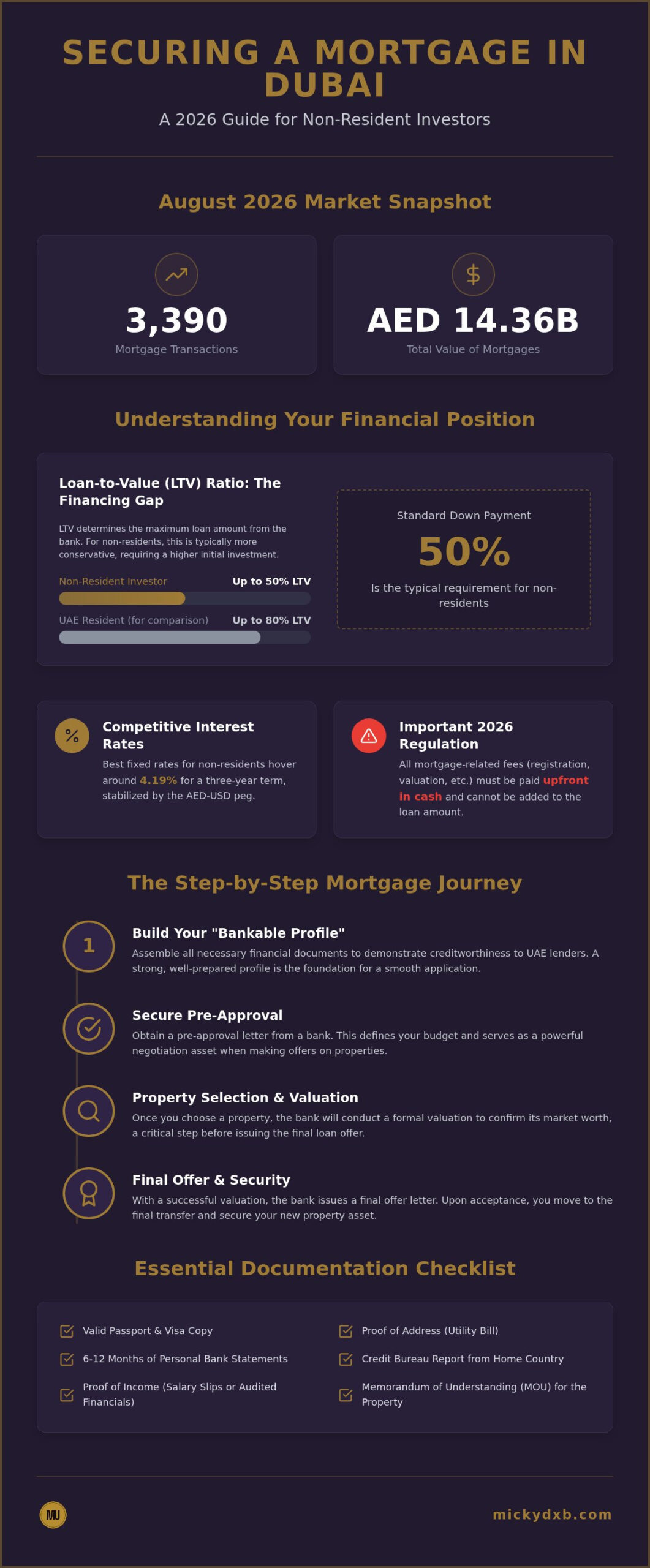
The Step-by-Step Journey to Mortgage Approval
To win in a competitive international market, you need more than just intent. You need a verified position of strength. Securing a mortgage for non residents in Dubai is a linear progression that begins long before you choose a specific property. By obtaining a pre-approval first, you transform from a casual browser into a committed buyer with the backing of a major financial institution. This proactive approach ensures that when the right opportunity appears, you’re ready to act without delay.
The journey involves a series of logical checkpoints designed to protect your capital and ensure the asset’s long-term viability. Integrating your financing strategy with expert mortgage lending Dubai services allows you to synchronize your property search with your actual borrowing capacity. This alignment is what separates a stressful transaction from a strategic acquisition.
Securing Your Pre-Approval
A pre-approval is your strongest negotiation asset. It’s an official document from a lender confirming the maximum amount they’re willing to provide based on your “bankable profile.” In 2026, most pre-approval letters remain valid for 60 to 90 days. If you’re targeting high-value residential assets, having this letter in hand allows you to lock in a deal quickly, often giving you an edge over other international buyers who haven’t yet cleared the bank’s initial hurdles. You’ll need to account for processing fees during this stage, which are paid upfront to the lender to initiate the deep-dive review of your global finances. Whether you’re a seasoned investor or a first time property buyer Dubai residents and international clients alike rely on, securing pre-approval is the single most effective step you can take to strengthen your position in any negotiation.
From Valuation to Final Signing
Once you’ve identified a property and signed a Memorandum of Understanding (MOU), the bank will commission an independent valuation. This step is critical. Independent valuators ensure the purchase price reflects the true market value, preventing you from over-paying. If the valuation matches or exceeds the price, the bank issues your Final Offer Letter. At this stage, several mandatory requirements come into play:
- Life and Property Insurance: All national mortgages require comprehensive insurance coverage to safeguard the asset and the loan.
- No Objection Certificate (NOC): You must obtain this from the developer to confirm there are no outstanding dues on the property.
- Mortgage Registration: The final step is the formal registration of the mortgage with the national land authorities during the ownership transfer.
This methodical process ensures every legal and financial detail is settled before the final keys are handed over. For a deeper understanding of each ownership transfer step, reviewing the complete Dubai property buying process will help you anticipate every regulatory requirement with confidence. If you’re ready to move from planning to action, you can consult with a seasoned guide to secure your pre-approval and begin your search with total confidence.
Navigating the Market with a Trusted Advisor
Managing a mortgage for non residents in Dubai from thousands of miles away requires more than just a digital portal. It demands a “Bold Strategist” who understands the pulse of the local market and the intricacies of international credit. Micky Uppal brings over a decade of UAE market experience and a track record of 2,000+ successful listings to every client engagement. This deep-rooted expertise is the foundation of a “Trusted Advisor” relationship that prioritizes your long-term well-being over a quick transaction. By integrating property acquisition with comprehensive mortgage lending services, he provides a seamless, one-stop experience that simplifies the cross-border journey for international high-net-worth clients.
This partnership-oriented approach is built on transparency and a commitment to “doing things right” rather than just doing them fast. If you’re navigating the complexities of 2026 banking regulations, then having a guide who has seen the market evolve is your greatest security. It’s about moving beyond the immediate purchase to see the larger narrative of your financial legacy. You deserve a partner who advocates for your interests at every step of the lending process, ensuring your capital is deployed with maximum efficiency and minimum risk. Understanding how real estate investment consulting drives high-growth portfolios can help you appreciate the structured advisory approach that transforms individual property picks into a cohesive engine for long-term wealth.
The Advantage of Local Expertise
A seasoned guide offers access to bespoke lending products and “off-market” banking relationships that aren’t visible on a standard comparison website. These connections often lead to preferential terms or more flexible eligibility reviews for non-resident profiles. If you’re investing from abroad, having a local partner mitigates the inherent stress of high-stakes financial decisions. You don’t have to worry about time zone delays, opaque banking requirements, or document discrepancies when your representative is on the ground. This level of support ensures your financing strategy aligns perfectly with your broader portfolio diversification goals, ensuring every asset works in harmony with your global holdings.
Your Next Strategic Step
The path to a successful mortgage for non residents in Dubai begins with a personalized consultation. Approaching banks without a tailored strategy can lead to unnecessary rejections that might impact your global credit profile. A low-friction inquiry is the most effective way to test the waters and understand your specific borrowing capacity in the current 2026 climate. This initial conversation moves beyond the numbers to look at the larger narrative of your investment journey. It’s a discovery phase where we align your capital with the city’s most resilient opportunities. The Advisor acts as a vital bridge between your global capital and the unique national opportunities within this resilient market.
Your Path to Strategic Global Ownership
Securing a mortgage for non residents in Dubai is a sophisticated move that requires both technical precision and local market insight. You now understand that while LTV limits and documentation requirements are rigorous, they’re designed to maintain the stability of your investment. By focusing on a bankable global profile and leveraging pre-approval as a negotiation tool, you’re not just buying a property; you’re building a resilient international portfolio. Success in this market doesn’t happen by chance; it happens through careful selection and expert advocacy.
You don’t have to navigate these cross-border complexities alone. With 10+ years of specialized market guidance and over 2,000 successful property listings managed, Micky Uppal offers a unique blend of integrated mortgage and acquisition services. This partnership-oriented approach ensures that your financing is as robust as the asset itself. If you’re ready to move from discovery to strategic advancement, secure your strategic mortgage consultation with Micky Uppal today. Your journey toward a secure financial legacy in the UAE starts with a single, well-informed step. The market is evolving quickly, but with a seasoned guide, your path remains clear and steady.
Frequently Asked Questions
Can I get a mortgage for property in the UAE if I am not a resident?
Yes, international investors have the legal right to secure a mortgage for non residents in Dubai and the wider UAE for properties located in freehold zones. While the process is more stringent than for residents, national banks actively lend to global buyers. You’ll need to meet specific income thresholds and provide a “bankable profile” that demonstrates financial stability in your home country. This ensures the transaction remains secure for all parties involved.
What is the minimum down payment for a non-resident mortgage in 2026?
In 2026, the standard minimum down payment for non-residents is typically between 40% and 50% of the property value. This corresponds to a Loan-to-Value (LTV) ratio of 50% to 60%. Additionally, a Central Bank rule change in September 2026 requires that all mortgage-related fees, such as bank arrangement and registration fees, must be paid upfront in cash. These costs can’t be rolled into the loan amount, so plan your liquidity accordingly.
Do I need to visit the UAE in person to sign my mortgage documents?
While much of the initial application can be handled remotely, the final mortgage contract signing usually requires your physical presence or a legally attested Power of Attorney (POA). Many international investors choose to appoint a local representative via POA to manage the process without traveling. This ensures the transaction continues to move forward efficiently even if you’re managing your global portfolio from a distance. It’s a practical solution for high-stakes decisions.
Are interest rates higher for non-residents than for residents?
Non-residents generally face slightly higher interest rates compared to residents due to the perceived risk of cross-border lending. As of September 2026, the best available fixed rate for non-residents is approximately 4.19% for a three-year term. In contrast, eligible residents may access rates starting from 3.75%. This difference, often called a risk margin, reflects the bank’s additional due diligence and the complexities of international debt recovery. Choosing a stable rate helps protect your long-term returns.
Can I use a mortgage to buy off-plan property as a foreigner?
You can certainly secure a mortgage for non residents in Dubai and the UAE for off-plan property investments. Banks provide structured financing that aligns with construction milestones, though LTV caps might be more conservative during the building phase. It’s a strategic way to lock in current prices while utilizing bank capital. Many investors use this leverage to capture capital appreciation as the development nears completion, ensuring their entry point is optimized for growth.
What happens if I lose my job or business income during the mortgage term?
If your financial circumstances change, it’s vital to communicate with your lender immediately to explore restructuring options. National banks prioritize loan performance and may offer temporary payment holidays or adjusted terms if you’ve maintained a strong repayment history. Your initial life and disability insurance policies, which are mandatory, provide a layer of security for the bank. Proactive management is always the best approach to maintain the security of your international asset.
Is life insurance mandatory for non-resident mortgages in the UAE?
Yes, life insurance is a mandatory requirement for all mortgages issued within the UAE, including those for non-residents. This policy protects both the lender and your estate by ensuring the loan is settled in the event of an unforeseen tragedy. Most banks require you to use their preferred providers, though some allow you to assign an existing international policy if it meets their specific criteria. This step is a cornerstone of the national lending system’s stability.
How long does the mortgage approval process take for international buyers?
The timeline for international mortgage approval typically spans three to five weeks from the initial application to the final offer letter. This duration accounts for the deep-dive review of your global income and the necessary attestation of foreign documents. Starting with a pre-approval significantly accelerates this journey. It clears the most time-consuming financial checks before you even identify a specific property to purchase, allowing you to act with the confidence of a cash buyer.

Leave a Reply