


In 2026, mastering the Dubai property market has shifted from a race for the fastest deal to a masterclass in strategic financial orchestration. While the skyline continues to reach new heights, the real victories are won through a deep understanding of the Dubai property buying process and its evolving regulatory framework. It’s natural to feel a sense of hesitation when faced with the complexities of freehold versus leasehold titles, the nuances of DLD fees, or the shifting landscape of off-plan payment plans. You want the security of a high-yield asset without the anxiety of hidden administrative costs or legal loopholes.
This guide is designed to provide you with a clear, risk-free roadmap to ownership that prioritizes your long-term capital appreciation. We’ll examine every essential phase, from securing your No Objection Certificate to optimizing your mortgage options in a market where resident fixed rates currently start at 3.75%. If you master these underlying mechanics, then the path to a high-performing investment becomes a matter of strategy rather than luck. By the end of this guide, you’ll have the confidence to move from a curious observer to a decisive, protected property owner.
Key Takeaways
- Understand the legal protections of Law No. 7 and how the Dubai Land Department regulates your international investment.
- Master every milestone of the Dubai property buying process, from the initial Memorandum of Understanding to the final title deed issuance.
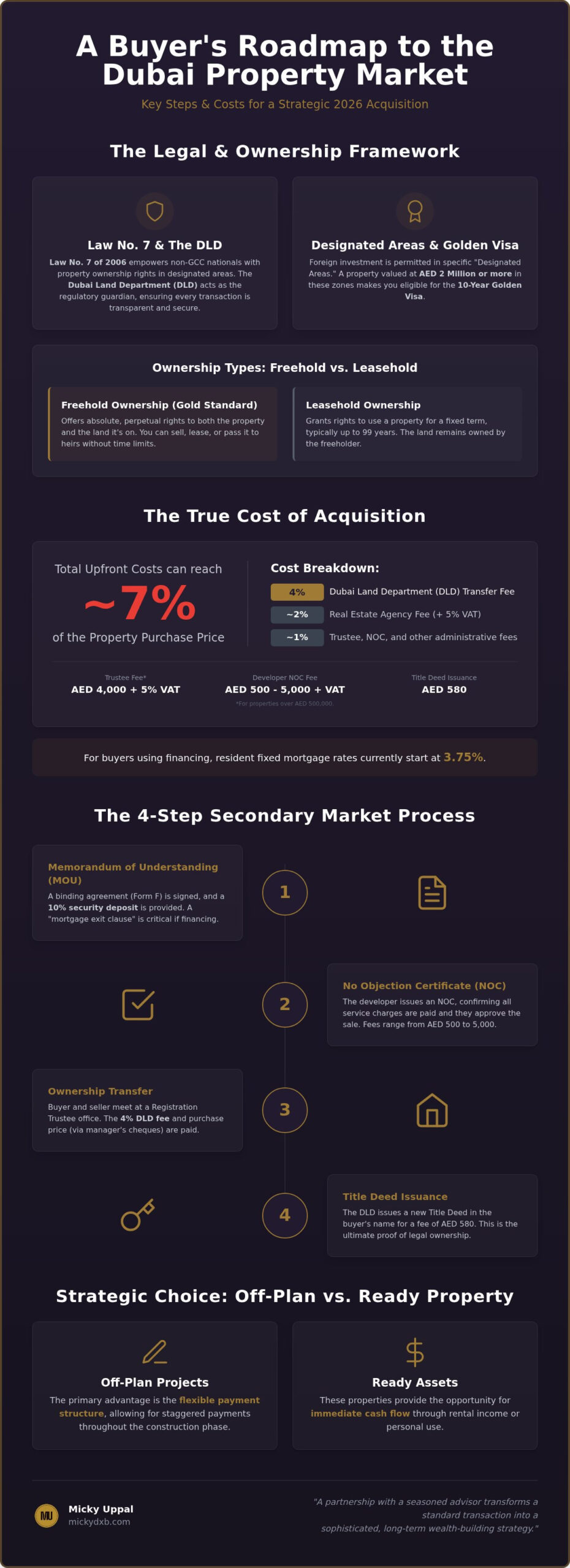
- Identify the true cost of acquisition by budgeting for the 4% DLD fee and total administrative expenses that often reach 7% of the purchase price.
- Evaluate the strategic trade-offs between the flexible payment structures of off-plan projects and the immediate cash flow of ready assets.
- Learn why a partnership with a seasoned advisor transforms a standard transaction into a sophisticated, long-term wealth-building strategy.
The Legal Framework: Ownership Rights and Law No. 7
Law No. 7 of 2006 changed everything. It transformed a local market into a global powerhouse. Before this legislation, ownership was largely restricted to local citizens, but the introduction of this law created a transparent framework that serves as the foundation of the modern Dubai property buying process. This legislation empowers non-GCC nationals to acquire property in designated areas with total legal certainty. To understand how far the market has come, you can look at an overview of Dubai’s real estate sector which highlights the city’s transition into a transparent, world-class investment hub.
The Dubai Land Department (DLD) serves as the ultimate regulator. It isn’t just an administrative body; it’s the guardian of your investment. Every transaction is recorded, every title deed is verified, and every escrow account for off-plan projects is monitored to ensure capital is used correctly. This level of openness has turned the UAE into a sanctuary for global capital, offering a level of security that rivals established markets in London or New York. If you understand the DLD’s role, then you can approach your acquisition with the steady confidence of a seasoned investor.
In 2026, freehold ownership grants international investors absolute, perpetual rights to both the physical structure and the land it sits upon, registered directly in their name with the Dubai Land Department.
Freehold vs. Leasehold Ownership
Choosing between freehold and leasehold is a matter of long-term vision. Freehold ownership is the gold standard for those seeking permanent security. It offers full rights without an expiry date, allowing you to sell, lease, or pass the asset to heirs. In contrast, leasehold ownership provides rights for a fixed term, typically up to 99 years. While leasehold might offer lower entry points in some instances, bold strategists prioritize freehold assets. If you own the land, you capture the full spectrum of capital appreciation over decades without the ticking clock of a lease expiration.
Designated Areas for Foreign Investment
Non-GCC nationals must focus their search on “Designated Areas.” These are specific zones where the government permits absolute foreign ownership. These hubs have evolved from simple residential clusters into sophisticated commercial and luxury residential ecosystems. Choosing the right zone is a critical step in the Dubai property buying process because it dictates your legal rights and residency options. For instance, a property value of at least AED 2 million is required to be eligible for the 10-year Golden Visa, provided the asset is within a designated freehold area. This synergy between property ownership and residency status provides a layer of lifestyle security that complements your financial goals.
Success in the Dubai property buying process depends on a disciplined sequence of actions. It’s not enough to find a property you love; you must execute the transaction with precision to protect your capital. This roadmap ensures that every legal and financial safeguard is activated. It’s a journey that moves from a philosophical vision of ownership to the practical reality of a registered title deed.
Contract F: The Buyer/Seller Agreement
Form F, also known as the Memorandum of Understanding (MOU), is the heartbeat of the secondary market. It’s more than a standard template. It’s the binding agreement that dictates your timeline, responsibilities, and penalties. Usually, you’ll provide a 10% deposit check at this stage. This is held by the authorized broker until the transfer. If you’re using financing, ensure your “mortgage exit clause” is clearly defined. This protects your deposit if the bank’s valuation falls short or the mortgage is rejected. A bold strategist doesn’t just sign; they negotiate terms that provide a safety net for their liquidity.
The NOC and Ownership Transfer
The developer’s No Objection Certificate (NOC) is the critical bridge between agreement and ownership. It confirms that all service charges are paid and the developer has no objection to the sale. These fees range from AED 500 to AED 5,000 plus VAT. Once secured, the final transfer happens at a Registration Trustee office. You’ll need your original passport and the signed MOU. For properties over AED 500,000, the trustee fee is AED 4,000 plus 5% VAT. You’ll also settle the 4% Dubai Land Department transfer fee at this stage. It’s a formal process where the buyer pays the purchase price to the seller via manager’s checks, ensuring a clean and recorded exchange of value.
Finalizing the Title Deed
After the transfer is complete, the DLD issues a Title Deed, which carries a fee of AED 580. This is your ultimate proof of ownership. Don’t forget utility registrations with DEWA and cooling providers like Empower. Integrating these steps into a single strategy is where expert real estate investment consulting adds the most value, ensuring no administrative detail is overlooked. If you handle these steps correctly, then the transition from investor to owner is seamless and secure. This level of attention to detail is what separates a standard purchase from a strategic asset acquisition in the 2026 market.
Financial Requirements: Admin Costs and Mortgage Integration
Successful investors look beyond the sticker price. While the headline figure on a listing captures your attention, the Dubai property buying process requires a more nuanced financial strategy. In 2026, a prudent investor budgets between 6% and 7% of the purchase price for administrative and closing costs. If you fail to account for these upfront outlays, you risk liquidity issues that can stall your transaction or even jeopardize your deposit. The largest component is the 4% Dubai Land Department (DLD) transfer fee. While local regulations allow this to be split equally between buyer and seller, market custom usually dictates that the buyer covers the full amount.
The Trustee Fee is a mandatory administrative charge paid to the DLD-authorized Registration Trustee for the legal verification and processing of your property transfer documents. This fee is currently set at AED 4,000 plus 5% VAT for properties valued at AED 500,000 or more. By integrating your financial planning with the legal steps, you ensure that every dirham is strategically allocated to secure your asset.
A Breakdown of Administrative Fees
Transparency is the foundation of a secure investment. Beyond the DLD fee, several smaller but essential costs contribute to the final balance sheet. You should prepare for the following expenses:
- No Objection Certificate (NOC): Paid to the developer to clear outstanding service charges, typically ranging from AED 500 to AED 5,000 plus VAT.
- Title Deed Issuance: A standard fee of AED 580.
- Real Estate Commission: The industry standard is 2% of the purchase price plus 5% VAT, which compensates for the professional guidance and negotiation provided by your consultant.
- First-Time Home Buyer Programme: Check for eligibility for reduced registration fees if you are entering the market for the first time as a UAE resident.
Securing Financing and Pre-Approvals
If you’re using leverage, speed is your greatest ally. High-value assets in the 2026 market move quickly, and sellers prioritize buyers with pre-approval. There is a powerful synergy between property acquisition and mortgage lending services; having both handled under one strategic umbrella prevents the communication gaps that lead to lost deals. It’s particularly vital for international buyers to secure a mortgage for non residents in Dubai before signing a Memorandum of Understanding (MOU). This ensures your Loan-to-Value (LTV) ratio is confirmed, as non-residents typically require a 35% to 40% deposit.
A critical rule change from February 2025 mandates that all transaction fees, including DLD and agency fees, must be paid upfront in cash and cannot be financed as part of the mortgage. This means your initial cash outlay must cover both your down payment and your closing costs. If you plan your liquidity with this “cash-first” reality in mind, then your path to ownership remains clear and stress-free.
Evaluating Off-Plan vs. Ready Property Procedures
The choice between an off-plan project and a ready-to-move-in home is a fundamental crossroad in the Dubai property buying process. Each path serves a different strategic objective. Ready properties offer the security of immediate rental yields and the ability to physically walk through your investment before committing capital. Off-plan properties, however, provide lower entry points and the potential for significant capital appreciation during the construction phase. If you are looking for more technical depth on the latter, you should consult our ultimate guide to off-plan property investment.
The Off-Plan Purchase Cycle
Buying a property that hasn’t been built yet requires a unique set of legal safeguards. It begins with a reservation form and a down payment, typically followed by the signing of the Sales and Purchase Agreement (SPA). A critical step often overlooked is Oqood registration. This is a mandatory DLD system that registers the property in your name while it’s still under construction, ensuring your rights are protected from the outset. All payments are directed into a project-specific escrow account, which the DLD monitors to ensure funds are only released as construction milestones are met. This structure provides a layer of security that allows you to focus on the long-term growth of your asset. To further protect your capital at every stage, it’s worth reviewing how to avoid property scams in Dubai so you can identify unregistered developers and fraudulent listings before committing funds.
Secondary Market (Ready) Nuances
The secondary market demands a more hands-on approach to due diligence. You aren’t just buying a title; you’re buying a physical structure with a history. A professional snagging or inspection report is non-negotiable to identify hidden defects before the final transfer. If the property is currently occupied, you must review the existing tenancy contract. UAE law requires a 12-month notice period if you intend to move in or sell the property, so understanding these timelines is vital for your ROI projections. When navigating the Dubai property buying process for a ready asset, remember that bank valuations can take several working days, which must be factored into your MOU expiration date. Given the volume of transactions in 2026, following a rigorous checklist on how to avoid property scams in Dubai is an essential layer of protection when dealing in the secondary market.
Ready to find your next asset? Explore our latest property listing services to see what’s currently available in the 2026 market.
Strategic Asset Selection and Professional Guidance
In the 2026 market, the difference between a mediocre return and a high-performing asset lies in your mindset. A passive buyer looks for a home; a bold strategist looks for an entry point into a larger narrative of wealth. Mastering the Dubai property buying process with a seasoned advisor allows you to see beyond the immediate transaction. If you align your acquisition with a broader luxury real estate strategy, then your portfolio gains the resilience needed to weather market cycles. This approach focuses on the security, clarity, and strategic advancement required for long-term satisfaction rather than just the immediate excitement of the purchase.
The Role of a Real Estate Consultant
A seasoned guide offers much more than a simple list of available units. With over 10 years of local market experience, a professional Dubai real estate consultant provides deep market analysis, rigorous developer vetting, and expert negotiation. This expertise is built on a foundation of over 2,000 successful listings, ensuring your interests are protected at every turn. They handle the complex choreography between mortgage lenders, developers, and the Dubai Land Department to ensure a seamless execution. This level of partnership transforms the Dubai property buying process from a stressful administrative hurdle into a calculated move for capital growth. It’s about doing things right rather than just doing things fast.
Managing the Transaction Lifecycle
Your journey as an owner begins the moment the title deed is issued, but the work of a strategist continues. The post-purchase phase is critical for maintaining the momentum of your investment. You’ll need to coordinate DEWA registration, set up Ejari for rental income, and secure move-in permits from the developer management. A bold strategist always considers the exit on the day of the entrance. Your initial buying process dictates your future resale potential and liquidity. If you’ve chosen a high-yield asset with professional support, then your path to long-term appreciation is already secure. You can move from a single transaction to a growing portfolio with the right guidance.
The 2026 market rewards those who act with clarity and precision. Don’t leave your financial legacy to chance. Consult with Micky Uppal to start your strategic acquisition today and secure your place in Dubai’s evolving skyline.
Securing Your Legacy in the Dubai Skyline
The journey to property ownership in Dubai is a sophisticated transition from financial aspiration to tangible security. By mastering the Dubai property buying process, you’ve moved beyond the surface-level glamour to understand the legal, financial, and strategic mechanics that drive real returns. You now know that success requires more than just a signed contract. It demands a clear understanding of DLD regulations, a disciplined approach to administrative costs, and the foresight to choose between off-plan potential and ready-asset yields. If you align your capital with these proven principles, then your investment becomes a pillar of long-term stability.
With over 10 years of market expertise and a track record of 2,000+ successful listings, Micky Uppal is ready to act as your trusted advisor in off-plan and luxury residential sales. We specialize in navigating the complexities of the market so you don’t have to. Secure Your Dubai Investment Strategy with Micky Uppal and transform your vision into a high-performing reality. Your future in this vibrant market is waiting for those who act with precision and confidence. It’s time to take the next step toward a secure and prosperous portfolio.
Frequently Asked Questions
Can foreigners legally buy property in Dubai?
Yes, non-GCC nationals can legally buy property in designated freehold areas. Law No. 7 of 2006 established this right, allowing for absolute ownership of the land and the structure. This legal framework serves as the foundation of the Dubai property buying process for international investors. Ownership in these zones also provides a pathway to residency, such as the 10-year Golden Visa for properties valued at AED 2 million or more.
What are the total government fees for buying a property in 2026?
You should budget 4% of the purchase price for the Dubai Land Department (DLD) transfer fee. Additionally, there’s a registration trustee fee of AED 4,000 plus 5% VAT for properties valued at AED 500,000 or more. Other costs include the AED 580 title deed issuance fee and a mortgage registration fee of 0.25% of the loan value if you’re using financing. All transaction fees must be paid upfront in cash.
How long does the property buying process typically take?
The timeline depends on whether you are a cash buyer or using financing. A cash transaction in the secondary market can often be completed within 2 to 4 weeks. If a mortgage is involved, the process typically extends to 6 or 8 weeks due to bank valuations and letter of offer requirements. Off-plan purchases are much faster initially, as the reservation and SPA signing often happen within a few working days.
Is a mortgage available for non-residents in the UAE?
Yes, mortgages are widely available for non-resident investors through UAE-based lenders. Non-residents can typically secure financing with a loan-to-value (LTV) ratio of 60% to 65%, which requires a 35% to 40% down payment. Interest rates for non-residents in 2026 start around 4.19% for fixed terms. Securing pre-approval is a vital step in the Dubai property buying process to ensure you can act quickly when you find the right asset.
What is the difference between an MOU and an SPA?
An MOU, also known as Form F, is the primary agreement used in secondary market transactions between a buyer and seller. It outlines the price, timelines, and penalties. An SPA (Sales and Purchase Agreement) is the legal contract used for off-plan properties directly from the developer. While the MOU is a standardized DLD form, the SPA is a more detailed document covering construction milestones, escrow protections, and specific project details.
Do I need a real estate agent to buy property in Dubai?
While not legally mandatory, a seasoned consultant is essential for navigating the complexities of the market. An expert handles developer vetting, price negotiation, and the coordination of DLD and bank requirements. With over 10 years of experience and 2,000 successful listings, a professional advisor ensures you avoid legal loopholes and hidden fees. They provide the strategic guidance needed to move from a simple transaction to a high-yield investment. To understand what separates a high-tier advisor from the rest, our guide on selecting a Dubai real estate consultant in 2026 outlines the key criteria you should evaluate before committing to a partnership.
What happens to my deposit if the seller backs out?
The standard MOU includes a clause that protects your 10% deposit. If the seller defaults on the agreement without a valid legal reason, they are typically required to return your deposit and pay an additional penalty equal to the deposit amount. This check is usually held by the authorized broker in a secure manner to ensure compliance. If you have a clear contract, then your liquidity is legally protected against seller default.
Are there specific benefits for first-time home buyers in Dubai?
First-time buyers who are UAE residents often benefit from higher LTV ratios, allowing for a lower initial deposit of 20% for properties under AED 5 million. Some banks also offer specialized fee waivers or lower interest rates to encourage end-users to enter the market. Additionally, first-time buyers can occasionally access reduced registration fees through specific DLD initiatives. These benefits help lower the entry barrier for those looking to secure their first residential asset.

Leave a Reply