


In 2026, the national property market has matured from a speculative arena into a sophisticated engine for long-term wealth preservation. You likely recognize the immense potential of this landscape, yet feel the weight of common anxieties regarding market stability or the nuances of freehold versus leasehold rights. It’s a significant milestone that requires more than just capital; it demands a strategist’s perspective. Mastering the essential financial planning for your first property ensures you move from a place of uncertainty to a position of absolute market authority.
This strategic roadmap is designed to dismantle those barriers, offering you the clarity needed to acquire your first high-yield asset with unwavering confidence. We will demystify the path to the 10-year Golden Visa for investments over AED 2,000,000, explain federal escrow protections for off-plan projects, and show you how to leverage integrated mortgage lending to your advantage. By the end of this guide, you’ll understand how to build a resilient portfolio that delivers security, growth, and prestige. If you follow this structured approach, then the transition from a curious observer to a successful property owner becomes a seamless, rewarding reality.
Key Takeaways
- Discover why the national market has transitioned from a speculative trade to a stable, high-liquidity environment designed for long-term wealth preservation.
- Clarify the legal distinctions between freehold and leasehold ownership to ensure your investment is fully protected by government-regulated frameworks.
- Evaluate the “from-to” progression of off-plan capital appreciation versus the immediate yield of ready assets to align with your specific risk appetite.
- Execute precise financial planning for first property Dubai by establishing mortgage capacity and budgeting for the 6% to 8% in total transaction fees.
- Learn how to scale your portfolio from a single unit to a diversified collection of luxury assets that qualify you for a 10-year Golden Visa.
Why the UAE Remains a Global Magnet for Property Investors
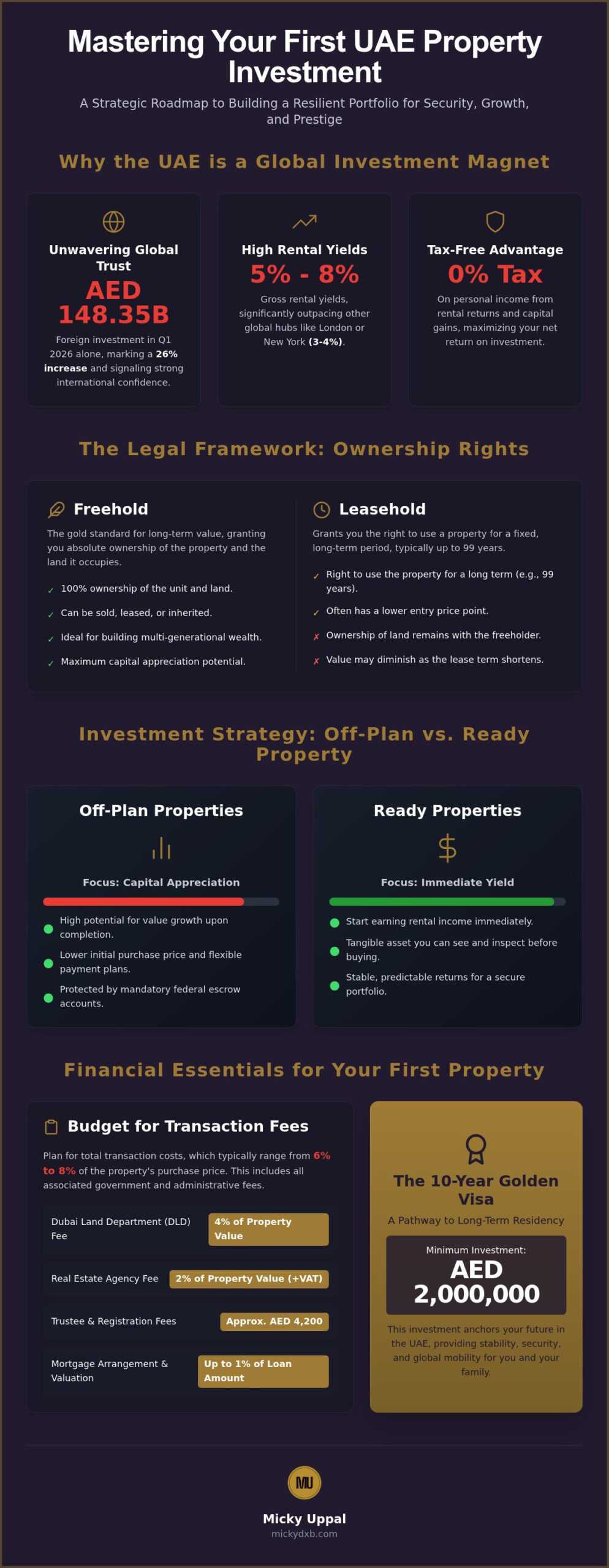
The national real estate landscape has shed its image as a high-risk frontier. It is now a high-liquidity, tax-efficient harbor for global capital. If you look at the evolution of the market, you’ll see a transition from speculative trading to a mature, regulated investment hub. This shift provides a stable foundation for anyone beginning their journey into financial planning for first property Dubai. The national economy supports long-term value through aggressive diversification, ensuring that real estate remains a resilient asset class even amidst global shifts. In the first quarter of 2026 alone, foreign investment in the sector reached AED 148.35 billion, a 26% increase that signals unwavering international trust.
Investors are drawn by a rare trifecta of advantages: high rental yields, consistent capital appreciation, and long-term residency incentives. This isn’t just about owning bricks and mortar; it’s about securing a strategic foothold in one of the world’s most dynamic economies. For a foundational perspective, reviewing Dubai’s real estate market overview helps contextualize how these regulations protect your capital. The market has become a sophisticated wealth-preservation tool, offering a level of transparency that was previously unseen.
The Tax-Free Advantage and ROI Potential
One of the most compelling reasons to invest is the total absence of personal income tax on rental returns and capital gains. While cities like London or New York often struggle to provide 3% to 4% yields, the national market consistently delivers gross rental yields between 5% and 8%. This gap represents a significant boost to your long-term wealth. To understand your true returns, you must master the “net yield” calculation: subtract all annual maintenance, service charges, and fees from your total annual rent, then divide that figure by the total acquisition cost of the property. This clarity allows you to compare assets with mathematical precision.
Residency through Real Estate: The Golden Visa
Ownership is more than a financial transaction; it’s a pathway to stability. The connection between property investment and long-term residency permits has never been stronger. For international entrepreneurs and families, a property serves as a secure “home base” that facilitates global mobility. As of August 2026, the requirements for the 10-year Golden Visa are clear: you must invest in property with a value of AED 2 million or more. This residency status empowers you to plan your future with certainty, knowing your right to remain is anchored by a tangible asset. Successful financial planning for first property Dubai often targets this threshold to maximize the non-financial returns of the investment.
The Legal Framework: Navigating Ownership Rights Safely
The UAE real estate market operates under a robust, highly regulated umbrella. This isn’t just about local customs; it’s a formalized system designed to protect global capital with absolute transparency. Central to this security is the role of national land departments. These entities maintain the definitive record of all transactions, ensuring that every title deed is registered and state-sanctioned. For those engaged in financial planning for first property Dubai, understanding this transparency is the first step toward peace of mind. You can verify laws and project statuses directly through the official Dubai Land Department portal, which serves as a beacon of clarity for international investors.
Freehold vs. Leasehold: Which is Right for You?
Choosing between these two ownership types is a foundational decision that dictates your long-term asset security. Freehold ownership grants you 100% rights to both the structure and the land it sits on in designated zones. It’s the gold standard for long-term value retention. Leasehold, by contrast, gives you the right to use the property for a fixed term, typically 99 years. While leasehold properties might offer lower entry prices, they don’t provide the same perpetual asset security as freehold. If you want a multi-generational legacy, then freehold is the clear path. If you’re looking for shorter-term utility in specific non-freehold areas, leasehold might fit your strategy, though it lacks the same capital appreciation potential.
Investor Protection and Escrow Regulations
The UAE has pioneered some of the world’s strictest developer regulations to ensure your money is safe. For off-plan investments, mandatory escrow accounts are the ultimate safeguard. The logic is simple: if a developer receives your payment, then those funds must be held in a government-regulated account and only released as construction milestones are verified. This “if-then” structure ensures your capital isn’t misappropriated or used to fund other projects. Conduct due diligence by checking a developer’s track record and historical delivery timelines. Engaging in professional real estate investment consulting can help you navigate these verifications, ensuring every title deed and contract is scrutinized before you commit. This level of scrutiny is a vital component of financial planning for first property Dubai, turning a complex process into a secure, logical progression toward wealth.
Off-Plan vs. Ready Properties: Strategic Selection
Deciding between an off-plan project and a ready property is the most pivotal choice you’ll make in your investment journey. It is a choice between two distinct financial trajectories: the “from-to” path of off-plan, which moves from a visionary blueprint on a page to a tangible, high-value asset, and the “purchase-to-yield” path of ready property, which offers immediate utility. For those focused on financial planning for first property Dubai, this decision must align with your immediate liquidity needs and your long-term risk tolerance. While off-plan properties often offer the highest potential for capital appreciation as completion nears, ready properties provide the bedrock of immediate rental income. You can find deeper project-specific analysis in our comprehensive guide to off-plan property investment.
The Appeal of Off-Plan Payment Plans
Off-plan investments are characterized by their accessibility and flexibility. Developers often incentivize early-stage investors with lower entry points and staggered payment structures that don’t require immediate full financing. Many of these plans include post-handover windows, allowing you to pay off a portion of the asset using the rental income it eventually generates. If you enter the market during the initial launch phase, then the potential for value growth is significant. However, you must be aware of the risks associated with “flipping” contracts before completion. While selling a contract mid-construction can yield quick profits, it requires deep market timing and carries the risk of project delays. A partnership-oriented approach favors holding these assets until they reach their full maturity and yield potential.
Ready Properties: Immediate Yield and Stability
Ready properties offer a level of certainty that blueprints cannot match. What you see is exactly what you get, from the quality of the finishes to the maturity of the surrounding infrastructure. For many beginners, the ability to secure mortgage lending more easily on finished assets makes this the preferred route. Banks typically view ready properties as lower-risk collateral, often offering more competitive rates compared to off-plan financing. This path is ideal if your primary goal is immediate cash flow to cover mortgage repayments or to fund other lifestyle goals. Success here depends heavily on the tripartite pillars of location, infrastructure, and community demand. A well-located ready unit in a developed district ensures your financial planning for first property Dubai is anchored by an asset with high occupancy rates and reliable annual returns.
The 5-Step Roadmap for First-Time Property Buyers
Securing a property requires a disciplined, step-by-step approach that transforms a complex transaction into a logical progression. Effective financial planning for first property Dubai starts with a mortgage pre-approval, giving you a clear ceiling for your search. Once your budget is set, you move into strategic sourcing, where you align property types with your long-term wealth goals. The third phase involves signing the Memorandum of Understanding (MOU), a legally binding document that outlines the terms of the sale. This is followed by a rigorous period of due diligence and legal review to ensure the asset is “clean” and transferable. The journey concludes at the national land registry, where the final transfer and handover occur, officially making you a homeowner.
Budgeting Beyond the Purchase Price
Successful investors look past the sticker price to account for the total cost of acquisition. You must budget for the 4% transfer fee, a 2% agency commission, and administrative charges like the AED 4,000 registration trustee fee. Integrating these costs into your financial planning for first property Dubai prevents mid-transaction liquidity issues. We recommend the “3% rule” for ongoing maintenance; set aside 3% of the property value annually for service charges and repairs. If you are buying an older unit, then a contingency fund for initial furnishing or minor renovations is essential to ensure the property is tenant-ready from day one.
Securing Financing as an Expat or Non-Resident
Financing is a powerful lever, but the requirements vary based on your residency status. For expatriate residents, the standard Loan-to-Value (LTV) ratio is typically 80% for properties valued under AED 5 million. If you are a non-resident investor, then you should expect an LTV between 50% and 65%, requiring a larger upfront capital commitment. Banks generally require six months of bank statements, a salary certificate, and proof of address to verify your income. Our integrated mortgage lending services act as your trusted advisor, navigating competitive national rates to find the most efficient structure for your specific profile. This partnership-oriented approach ensures you don’t just get a loan; you get a strategic financial tool that supports your broader portfolio growth.
The transition from a potential buyer to a successful owner is defined by these tactical choices. By following this roadmap, you replace anxiety with a structured path to asset ownership. Every step, from the initial pre-approval to the final land registry meeting, is designed to protect your interests and maximize your long-term returns.
Maximising Long-Term Growth: Beyond the First Transaction
Your first acquisition is the foundation, not the finish line. While the initial steps of your journey focus on secure entry, financial planning for first property Dubai must also encompass the eventual exit or expansion. Transitioning from a single residential unit to a diversified national portfolio requires a shift in mindset from a buyer to a portfolio manager. The luxury residential market serves as a robust hedge against global inflation, offering a level of stability that few other asset classes can match. By viewing your property as a liquid asset within a broader wealth strategy, you ensure that your capital continues to work for you long after the initial handover.
Planning an exit strategy before you even sign the initial contract is a hallmark of sophisticated investing. Whether your goal is to utilize our resell services after five years of capital growth or to leverage property listing services for consistent rental income, knowing your “end game” dictates your “start game.” Micky Uppal acts as your strategic partner throughout this entire lifecycle, providing the continuity needed for long-term asset management. This partnership-oriented approach ensures that every decision aligns with your overarching financial objectives, turning a single transaction into a legacy of wealth.
Diversification: Commercial vs. Residential
True resilience comes from a balanced mix of asset types. While residential units offer high occupancy and emotional appeal, commercial real estate provides a different layer of stability, often anchored by longer-term corporate leases. Mixing these asset types reduces your exposure to specific market cycles and broadens your revenue streams. Bold strategists look for opportunities in emerging national hubs where infrastructure is still evolving. If you identify these growth corridors early, then the potential for significant capital gains is exponentially higher. This diversified approach is a core pillar of advanced financial planning for first property Dubai, protecting your capital while positioning it for maximum upside.
The Role of a Professional Real Estate Consultant
There is a fundamental difference between a mere service provider and a strategic advisor who understands the market’s inner workings. An expert doesn’t just show you what is available on the public portals; they identify off-market opportunities and distressed sales that the general public often misses. This level of insight comes from over a decade of national market experience and a deep commitment to doing things right rather than doing them fast. A trusted advisor simplifies complex market evolutions, ensuring you remain ahead of regulatory changes and shifting trends. To ensure your portfolio is built on a foundation of expert logic and verified data, begin your investment journey with a personalised consultation. This step moves you from a place of simple ownership to a position of strategic market authority.
Securing Your Legacy in the UAE Market
The journey from a first-time buyer to a seasoned investor is defined by the quality of your strategy. You’ve explored the national market’s stability, decoded the legal frameworks, and compared the yield potential of off-plan versus ready assets. These steps form the bedrock of successful financial planning for first property Dubai. By following a disciplined roadmap, you aren’t just buying a unit; you’re acquiring a high-yield asset that provides security, residency, and long-term capital growth. The transition from uncertainty to market authority is a seamless progression when you have the right data at your fingertips.
Success in this landscape requires more than just capital; it demands a partnership with a trusted advisor who has navigated these market cycles before. With over 10 years of national market expertise and more than 2,000 successful transactions, we provide the integrated mortgage and legal guidance necessary to streamline your acquisition. If you’re ready to move from observation to action, then it’s time to align your vision with professional execution. Book a Strategic Investment Consultation with Micky Uppal today to begin your journey with absolute confidence. Your future portfolio starts with a single, well-informed choice.
Frequently Asked Questions
Is it possible for a foreigner to buy property in the UAE?
Yes, expatriates and non-resident investors have the legal right to purchase property in designated freehold zones across the national market. These areas grant you 100% ownership of both the structure and the land. This legal framework has been a cornerstone of the market’s evolution since 2002. It allows international buyers to build a secure asset base, whether for personal use or as a high-yield investment vehicle within their global portfolio.
What is the minimum investment required for a UAE Golden Visa in 2026?
To qualify for the 10-year Golden Visa through real estate in 2026, you must invest a minimum of AED 2 million in one or more properties. This threshold allows for the inclusion of off-plan assets, provided the total value meets the requirement. Securing this residency status provides long-term stability for families and entrepreneurs. It’s a strategic move that combines asset ownership with the right to live, work, and study in a tax-efficient environment.
Can I get a mortgage in the UAE if I am not a resident?
Yes, non-resident investors can secure financing, though the terms differ from those offered to residents. Typically, non-residents are eligible for a Loan-to-Value (LTV) ratio between 50% and 65%. This means you’ll need a higher down payment compared to the 20% required for first-time resident buyers. Mastering the financial planning for first property Dubai involves understanding these ratios to ensure your liquidity is sufficient for a successful acquisition. This structure supports your growth without overextending your capital.
How much are the typical service charges for apartments in the UAE?
Service charges vary significantly based on the specific community, the range of amenities provided, and the type of property. These recurring fees cover common area maintenance, security, and landscaping. It’s essential to review the specific rates listed in your Sales and Purchase Agreement (SPA) during your financial planning for first property Dubai. These costs directly impact your net yield, so verifying them with the developer or through official regulatory portals is a critical step for every strategic investor.
Is off-plan property investment safer than buying ready units?
Neither is inherently safer, as they serve different strategic goals. Ready units offer immediate yields and the certainty of a finished structure. Off-plan investments, however, provide lower entry prices and staggered payment plans that can lead to higher capital appreciation upon completion. The safety of an off-plan project is anchored by federal escrow regulations, which protect your funds by ensuring they are only released as construction milestones are verified by the national authorities.
What happens if a developer delays the completion of an off-plan project?
If a developer fails to meet the agreed handover date, then the national real estate laws provide specific protections for the buyer. Most contracts include a grace period, usually 12 months, after which you may be entitled to compensation or the right to terminate the agreement. All payments are held in government-regulated escrow accounts. This system ensures that your capital remains secure even if the project timeline evolves beyond the initial projections provided at the launch.
What are the additional costs of buying property in the UAE besides the price?
You should budget approximately 6% to 8% of the purchase price for transaction fees. This includes the 4% Land Department transfer fee, a 2% real estate agency commission, and administrative costs like the AED 4,000 registration trustee fee. For mortgaged properties, there is an additional 0.25% mortgage registration fee. Account for these costs early to ensure your acquisition is smooth, transparent, and free from the stress of hidden financial surprises during the transfer process.
How do rental yields in the UAE compare to major European or US cities?
The national market consistently outperforms global hubs like London, Paris, or New York. While these Western cities often see net yields of 3% to 4%, the UAE market typically delivers gross rental yields between 5% and 8%. When combined with the total absence of personal income tax on rental returns, the net profit for investors is significantly higher. This competitive edge makes the region a primary destination for those seeking high-performance residential assets with superior returns.

Leave a Reply