


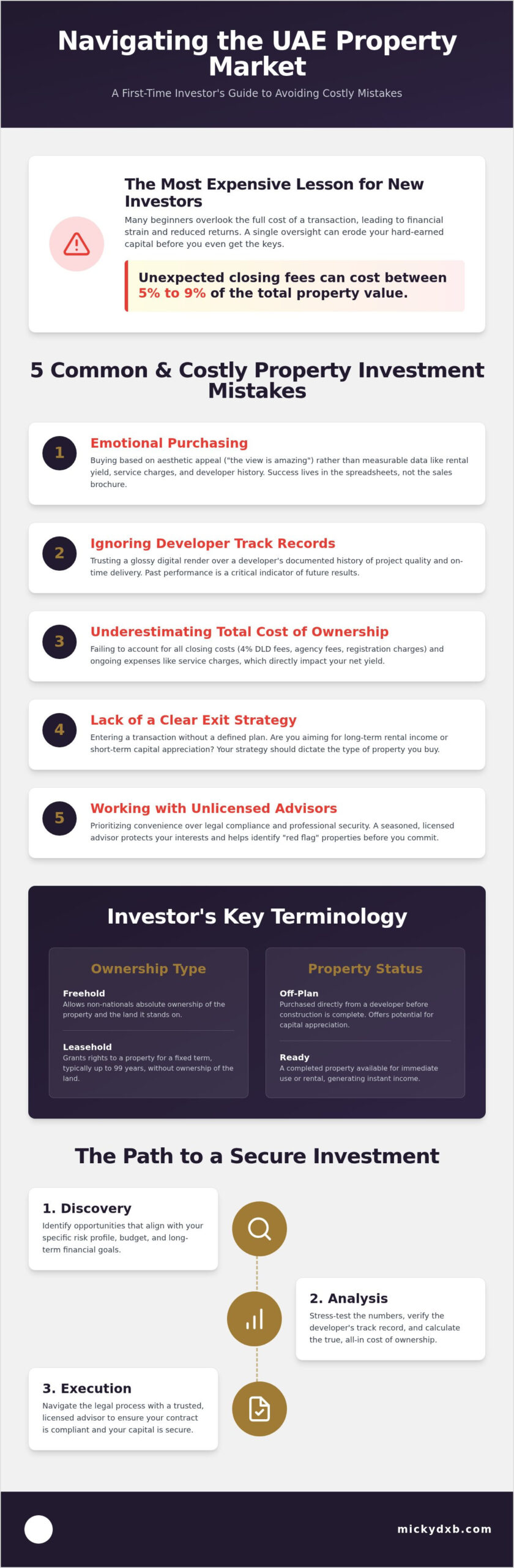
The most expensive lesson you’ll ever learn in real estate isn’t found in a glossy brochure; it’s hidden in the fine print of a contract you didn’t fully understand. Many beginners approach the UAE market with a mix of excitement and valid anxiety, fearing that a single oversight could erode their hard-earned capital. It’s a natural reaction when you’re navigating a landscape where common property investment mistakes Dubai and the wider Emirates can cost an investor between 5% and 9% in unexpected closing fees. You aren’t just looking for a beautiful apartment; you’re seeking a secure financial future that stands the test of time.
This guide is designed to transform that uncertainty into strategic confidence. We’ll master the fundamentals of the national property market, from the nuances of the June 2026 Civil Code updates to the latest visa regulations for investors. You’ll learn to identify the strategic pitfalls that separate successful investors from those who simply buy a property. By the end of this article, you’ll have a clear roadmap for a safe first purchase, a deep understanding of the true cost of ownership, and the clarity needed to select an asset that serves your long-term goals.
Key Takeaways
- Discover how to transition from a resident to a strategic market participant by leveraging the UAE’s tax-efficient, high-yield environment.
- Learn to identify and avoid common property investment mistakes Dubai and the wider national market, such as prioritizing aesthetic appeal over developer track record.
- Uncover the hidden costs of ownership, including mortgage arrangement fees and registration charges, to protect your long-term ROI.
- Build a resilient portfolio by balancing luxury residential assets with commercial or off-plan units based on your specific financial goals.
- Understand why partnering with a seasoned advisor who has managed thousands of listings is essential for identifying “red flag” properties before you commit.
Understanding the UAE Property Investment Landscape for Beginners
Entering the UAE property market is a transformative shift from simply living in a space to strategically owning it. It represents a deliberate move toward high-yield, tax-efficient wealth creation in a global hub. The national market is built on a foundation of transparency and security, bolstered by the 2026 updates to the Civil Code that strengthen buyer rights and modernize asset definitions. This year offers a unique window for disciplined entry. You aren’t just buying bricks; you’re acquiring a strategic asset in a maturing economy that rewards those who prioritize data over headlines.
The Allure vs. The Reality of National Property Markets
The industry often sells a dream of effortless wealth and architectural marvels. While the aesthetics are impressive, the reality of a successful investment lives in the spreadsheets. If an investor follows the hype of the latest “must-have” launch without due diligence, they often overlook the underlying asset fundamentals like service charges and historical yields. Avoiding common property investment mistakes Dubai beginners frequently make requires a shift in perspective. You must prioritize “Strategic Asset Acquisition” over emotional attraction. This means filtering out the market noise to focus on data-driven growth and sustainable rental demand. Understanding the nuances of Dubai’s real estate market and the wider national landscape is the first step in separating the glamour from the actual ROI.
Key Terminology Every New Investor Must Grasp
Clarity is the antidote to anxiety. Understanding the difference between Freehold and Leasehold is your first step toward building trust in your choices. Freehold areas allow for absolute ownership by non-nationals, while leasehold offers rights for a specific duration, typically up to 99 years. You must also decide between Off-plan and Ready properties. Off-plan assets often come with attractive payment plans and the potential for capital appreciation during construction, but they require a high tolerance for timelines. Ready properties offer immediate utility and rental income but usually require higher upfront capital. Your journey as a strategic investor follows a tripartite structure:
- Discovery: Identifying opportunities that align with your specific risk profile and long-term financial goals.
- Analysis: Stress-testing the numbers, verifying developer track records, and calculating the true cost of ownership.
- Execution: Navigating the legalities with a trusted advisor to ensure your contract is compliant and your capital is secure.
Mastering these basics ensures you don’t fall into the trap of common property investment mistakes Dubai novices face, such as failing to account for the 4% registration fees or underestimating the impact of service charges on net yields. By focusing on these core pillars, you move from a place of uncertainty to one of quiet, professional authority.
5 Common Property Investment Mistakes to Avoid
Success in the UAE property market depends on your ability to bypass the noise. While the potential for wealth creation is high, the margin for error is thin. Understanding the common property investment mistakes Dubai and national investors encounter is the first step in safeguarding your capital. These pitfalls often fall into five distinct categories:
- Emotional Purchasing: Buying based on aesthetic appeal rather than measurable yield.
- Ignoring Developer Track Records: Trusting a digital render over a documented history of project delivery.
- Underestimating Total Cost of Ownership: Failing to account for closing costs, which typically range from 5% to 9% of the purchase price.
- Lack of a Clear Exit Strategy: Entering a transaction without a defined plan for liquidation or resale.
- Working with Unlicensed Advisors: Prioritizing speed and convenience over legal compliance and professional security.
If you treat an investment like a home, then you’ve already lost your strategic edge. You must remain detached and focused on the numbers that drive long-term value.
The Trap of Emotional Investing
Marketing hype is designed to trigger an emotional response during new project launches. High-energy events and exclusive “pre-launch” offers can cloud your logical reasoning, leading you to invest in a feeling rather than a financial asset. If you invest in noise, then you are not investing in numbers. Successful investors utilize a “Data First” checklist before every viewing or project presentation. This list should prioritize service charge history, projected net yields, and local infrastructure development over interior finishes or trendy amenities. For personalized guidance on building a data-driven portfolio, you can consult with a strategic advisor who prioritizes your long-term well-being over a quick sale.
Developer Due Diligence: A Non-Negotiable Step
Researching a developer’s historical delivery rates and construction quality is a fundamental pillar of risk management. Developer Reputation is the primary security for off-plan assets. You must verify their track record for completing projects on time and maintaining quality standards years after the keys are handed over. Warning signs include a lack of escrow account transparency or unrealistic payment plan promises that seem too good to be true. In the UAE, tools like the Dubai REST app allow you to monitor project progress and verify escrow status, ensuring your funds are protected under current regulations. By avoiding these common property investment mistakes Dubai beginners often make, you ensure your first purchase is a stepping stone to a robust portfolio rather than a costly lesson.
Financial Pitfalls: Overleveraging and Mortgage Errors
Leverage is the most powerful tool in an investor’s kit, yet it remains the source of the most common property investment mistakes Dubai beginners make. While borrowing allows you to control a larger asset with less capital, overleveraging in a fluctuating interest rate environment can quickly turn a strategic acquisition into a financial burden. In 2026, with the UAE Central Bank base rate sitting at 3.65% and further adjustments expected to be cautious, your financing structure must be resilient. You must distinguish between “Bad Debt,” which drains your monthly cash flow, and “Strategic Financing,” which uses calculated leverage to expand your portfolio while keeping your debt-to-equity ratio healthy.
Securing a mortgage pre-approval is a non-negotiable step before you even begin negotiations. It gives you the authority of a cash buyer and protects you from the risk of losing your security deposit if your financing falls through. Without this clarity, you’re essentially guessing your budget, which is a gamble no serious strategist should take. Pre-approval ensures you know exactly what you can afford, allowing you to act with speed and confidence when the right opportunity arises.
Calculating the True Cost of Financing
The purchase price is only the beginning of your financial commitment. To avoid eroding your yields, you must account for valuation fees, bank processing fees, and mandatory life insurance requirements. Standard mortgage arrangement fees are generally 1% of the loan amount, and when combined with a mortgage registration fee of 0.25% plus a flat AED 290 fee, these costs add up quickly. Property valuation fees typically range from AED 2,500 to AED 3,500. If the financing costs exceed 1% of the property value, then the initial ROI projections must be adjusted to reflect the reality of your net income. You can use integrated mortgage lending services to streamline this complexity and ensure your financing costs are optimized from day one.
The Risk of Inflexible Payment Plans
Post-handover payment plans are often marketed as a low-friction entry point for new investors. They offer the allure of paying for the property using its own rental income, but this strategy assumes 100% occupancy and stable market rates. If your cash flow cannot support the payment schedule during a vacancy period, the investment becomes a liability. A robust strategy requires a “Liquidity Buffer” equivalent to 6 to 12 months of mortgage payments. This safety net ensures you never have to make desperate decisions during temporary market shifts, allowing you to hold the asset until it reaches its full capital appreciation potential. By preparing for these financial realities, you move beyond the common property investment mistakes Dubai novices face and join the ranks of sophisticated, long-term investors.
Strategic Portfolio Planning vs. Single Transactions
Treating a property purchase as an isolated event is a fundamental error that limits your financial potential. To achieve true wealth, you must transition from a transactional mindset to that of a Bold Strategist. This means looking beyond the immediate handover to the 10-year narrative of your capital. Successful investors don’t just buy units; they build ecosystems of assets that work in harmony to provide stability, growth, and a lasting legacy.
The first step in this journey is defining your primary objective. Is your priority immediate capital appreciation through strategic off-plan entry, or consistent rental yield from a ready residential asset? Once your goal is clear, you must diversify your asset types. Balancing luxury residential sales with commercial units or off-plan investments ensures your portfolio remains resilient against localized shifts. You should then analyze national market trends with a teacher-like patience, using data to predict the next growth cycle rather than chasing historical peaks. Finally, a regular portfolio review is essential to assess when to hold, sell, or refinance your holdings.
Building for the Long-Term
If you use the capital appreciation from your first asset to fund the down payment for your second, then you’ve mastered the art of strategic advancement. This compounding effect is the engine of high-yield wealth creation. It’s about doing things right rather than doing them fast. By viewing your investments through a tripartite structure of stability, growth, and legacy, you ensure that every choice serves a larger purpose. This approach allows you to weather short-term fluctuations while keeping your eyes on the ultimate prize: financial independence and a secure estate.
Exit Strategies: Preparing for the Resell
One of the most common property investment mistakes Dubai and national investors make is failing to envision the exit before signing the initial contract. The resale value of your asset is determined on the day you buy, not the day you sell. Factors such as the developer’s historical quality, the property’s unique positioning, and the underlying land value dictate your future liquidity. To ensure your asset remains “Premier” in the secondary market, you must maintain it to rigorous standards and stay informed on market demand. You can explore our property resale guide to understand how to position your asset for maximum return when the time comes to liquidate.
Your investment journey shouldn’t be a solitary one. A trusted advisor looks beyond the immediate transaction to see the larger narrative of your success. If you’re ready to move from a single purchase to a sophisticated, diversified portfolio, book a strategic consultation to begin your advancement today.
The Role of a Trusted Advisor in Securing Your Investment
A transactional agent focuses on the immediate sale. A strategic investment consultant focuses on your generational wealth. Micky Uppal brings 10+ years of local market experience and a documented history of 2,000+ successful listings to every conversation. This depth of insight is what allows a consultant to identify “red flag” properties that might look perfect on a brochure but fail on the balance sheet. By providing a foundation of trust through transparency and honest data, a seasoned advisor ensures you avoid the common property investment mistakes Dubai novices often make.
The “Partnership Approach” creates a synergy where the consultant’s success is directly aligned with your long-term financial health. We prioritize doing things right over doing things fast. This relationship is built on three core values: unwavering reliability, strategic foresight, and a deep commitment to your satisfaction. If you choose an advisor who views your journey as a partnership, then you gain a bold strategist who looks beyond the next commission to your next decade of growth.
Beyond the Listing: Comprehensive Consulting
Expert guidance does more than just find a property. It streamlines the complex acquisition process, simplifies integrated mortgage lending, and prepares your asset for a high-value resale. Professional Due Diligence is the ultimate shield for beginner investors. A consultant manages the intricate details of DLD registration, developer escrow verification, and contract compliance so you don’t have to. It’s the difference between a stressful transaction and a secure investment. You can move from the discovery phase to the execution phase by booking a personalized consultation today.
Your Roadmap to a National Property Portfolio
Your transition from a beginner avoiding common property investment mistakes Dubai to a bold strategist building a legacy is a journey of empowerment. The UAE national market continues to offer an unparalleled environment of security, transparency, and high-yield potential in 2026. You now have the roadmap and the fundamental knowledge to succeed. The final step is securing the right guide to navigate the nuances of the terrain. Start your investment journey with a strategic consultation and take the first step toward a premier national property portfolio.
Strategic Advancement: Your Path to a Secure National Portfolio
Successful property investment in the UAE is a transition from emotional attraction to strategic execution. By mastering market fundamentals and identifying the strategic pitfalls that separate successful investors from the rest, you move from a place of uncertainty to one of quiet authority. We’ve explored how to avoid common property investment mistakes Dubai beginners often face, from underestimating closing fees to failing to verify a developer’s delivery record. True wealth is built through disciplined analysis, calculated leverage, and a commitment to long-term asset quality.
Your journey deserves more than a mere transaction; it requires a partnership with a guide who has seen the market evolve. With over 10 years of market authority and 2,000+ successful property listings, our team provides the comprehensive mortgage and resell support needed to protect your capital. If you prioritize doing things right over doing things fast, then your success is inevitable. The national market remains a beacon of transparency and security for those ready to act with data and confidence.
Secure your financial future with expert UAE property consulting
Frequently Asked Questions
What are the most common hidden costs when buying property in the UAE?
Closing costs typically range from 5% to 9% of the purchase price. This includes the 4% DLD fee, a 2% agency fee plus VAT, and registration charges that vary based on the property value. You must also account for No Objection Certificate (NOC) fees paid to developers, which range from AED 500 to AED 5,000. Overlooking these expenses is one of the most common property investment mistakes Dubai beginners make during their first acquisition.
Can a foreigner buy property in the UAE without a local partner?
Yes, foreign nationals enjoy 100% ownership rights in designated freehold areas across the country. You don’t need a local partner or sponsor to hold the title deed. This ownership structure provides the absolute right to sell, lease, or inherit the asset as you see fit. It creates a foundation of trust for international investors seeking to build a robust national portfolio. Always verify that the development is within a recognized freehold zone.
Is it better to invest in off-plan or ready property for a first-time buyer?
The choice depends on your specific financial goals and appetite for risk. Ready properties offer immediate rental income and utility, making them ideal if you prioritize stability and cash flow. Off-plan investments often provide lower entry prices and attractive payment plans, representing a bold strategic move for capital appreciation. First-time buyers should analyze their liquidity needs carefully. Ready properties eliminate construction risk, while off-plan rewards those with a longer time horizon.
How much down payment is required for a property investment mortgage?
Expatriate investors typically require a down payment of 20% to 30% for ready properties. For off-plan investments, the requirement is often lower, usually ranging from 10% to 15% depending on the developer’s specific payment plan. You must also account for the 4% transfer fee and other closing costs when calculating your total initial capital outlay. Securing a mortgage pre-approval early ensures you understand your true purchasing power before entering the negotiation phase.
What happens if a developer fails to deliver an off-plan project on time?
UAE regulations provide robust protections for off-plan buyers through mandatory escrow accounts. If a developer faces significant delays, the national land department and RERA can intervene to protect your interests. Contracts usually include a grace period, but persistent failure to deliver may entitle you to legal remedies or project cancellation. Always verify the developer’s track record and ensure all payments are made directly into the registered escrow account to maintain your security.
How do I calculate the net ROI of a rental property accurately?
Net ROI is calculated by subtracting all annual operating expenses from your gross rental income and dividing the result by the total investment cost. You must include service charges, maintenance costs, and any insurance premiums in your calculations. For example, if your gross yield is 8% but service charges account for 2%, your net yield drops to 6%. Avoiding common property investment mistakes Dubai investors face requires accounting for these recurring costs to ensure realistic projections.
What is the role of the national land department in a property transaction?
The national land department acts as the primary regulatory body ensuring transparency and legality in every transaction. They manage property registrations, issue title deeds, and oversee the licensing of real estate professionals. Their role is to create a secure environment for discovery, analysis, and execution. By verifying every contract and project, they provide the unwavering reliability that makes the national market attractive to global strategists seeking a secure financial legacy.
Do I need a local bank account to invest in UAE real estate?
While you can technically purchase property from abroad, having a local bank account simplifies the long-term management of your investment. It’s essential for processing recurring service charge payments and receiving rental income through the national banking system. A local account also facilitates smoother mortgage payments if you choose to leverage your purchase. Most investors find that a local banking relationship provides the clarity and openness needed for professional portfolio management.

Leave a Reply