


What if the capital you need for your next off-plan acquisition isn’t sitting in a bank account, but is actually trapped within the walls of your current portfolio? It’s a common frustration to watch high monthly interest payments erode your rental yields while significant property appreciation remains untouched. You’ve likely felt the tension between wanting to expand and the reality of stagnant capital locked in your assets. If you’re feeling the weight of the current 4.85% EIBOR rates or confusion over exit fees, your hesitation is understandable.
This guide will show you how to strategically approach refinancing investment property in the UAE to lower your costs, release equity, and accelerate your growth. We’ll move from analyzing current 2026 market trends to executing a precise cash-out strategy for your next investment. You’ll discover how to navigate the 60% LTV cap for investment properties, consolidate your debt into more favorable terms, and secure the financial stability your journey deserves. By the end, the path from a single high-cost mortgage to a diversified, high-yield portfolio will be clear, logical, and entirely within your reach.
Key Takeaways
- Identify how the 2026 EIBOR landscape offers a strategic window to lower interest costs and immediately improve your property’s net rental yield.
- Master the mechanics of equity release to unlock stagnant capital while navigating the specific 60% LTV limits set for investment properties.
- Evaluate the true cost of a transition by weighing valuation and processing fees against the Central Bank’s capped 1% prepayment penalty.
- Follow a structured, professional roadmap for refinancing investment property Dubai to ensure your next mortgage aligns with your long-term wealth goals.
- Transform your current assets into a growth engine by using unlocked equity to fund the down payments for high-potential off-plan investments.
Strategic Reasons to Refinance an Investment Property in the UAE
Refinancing isn’t just a paperwork exercise; it’s a calculated move to reclaim control over your debt. To understand what refinancing is, you must view it as the strategic replacement of an existing mortgage with a new loan that offers more favorable financial terms. In the national banking sector, this typically takes the form of a “Buy-Out” mortgage. This mechanism allows a new lender to settle your original debt in full, effectively moving your liability to a product with better rates or improved flexibility. For those considering refinancing investment property Dubai, the primary motivation is usually to capitalize on the specific 2026 interest rate environment.
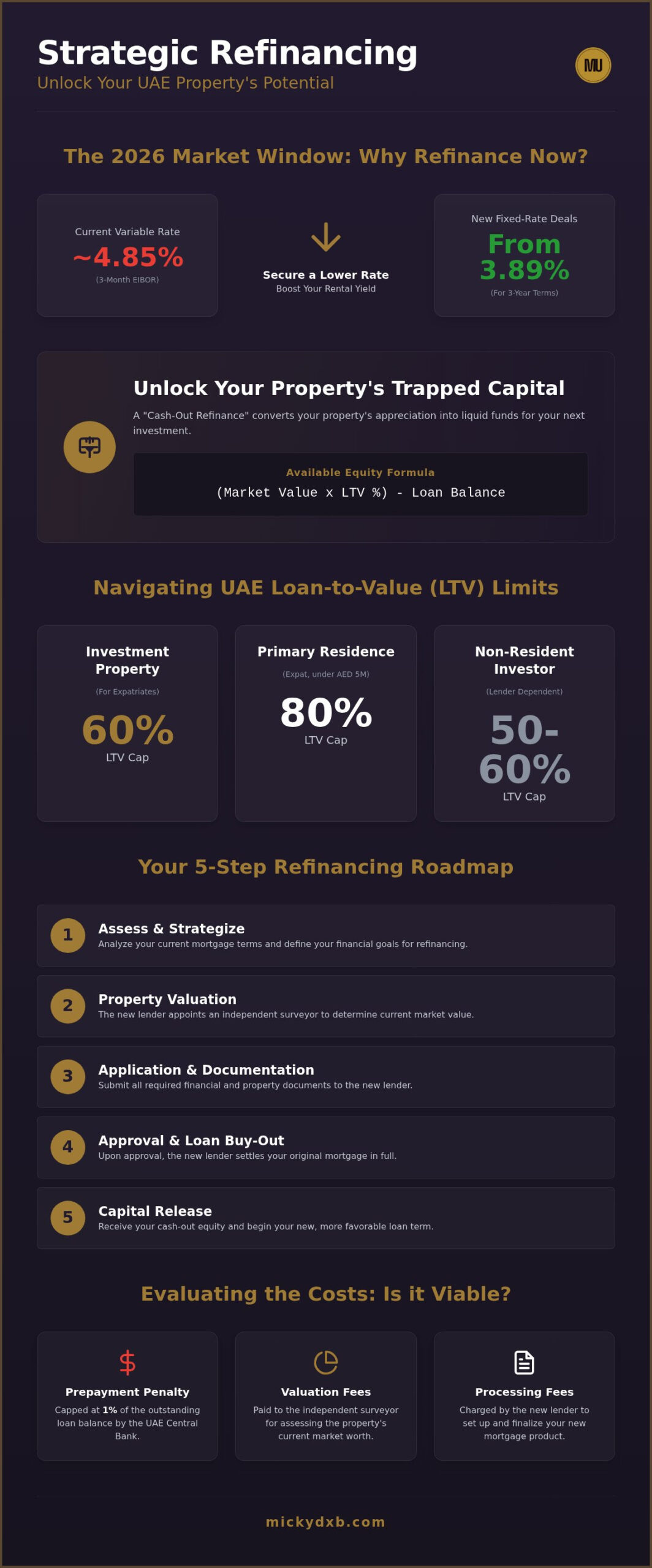
With the 3-month EIBOR hovering around 4.85% as of August 2026, many seasoned investors are moving away from the volatility of variable rates. Fixed-rate deals, currently starting as low as 3.89% for three-year terms, provide the stability needed for precise long-term planning. This shift ensures your mortgage costs remain static even if global markets fluctuate. It’s about trading uncertainty for the security of a predictable payment schedule.
Optimizing Rental Yields Through Lower Interest
High interest rates act as a silent drain on your rental profit. If you secure a 1% reduction on your interest rate, the impact on your net ROI is immediate and substantial. For high-value assets, this translates to tens of thousands of dirhams saved over the life of the loan. Smart investors balance their mortgage terms to align with their rental contract cycles, ensuring cash flow remains optimized throughout the tenancy. The Yield Gap is the critical financial spread between your annual mortgage servicing costs and the total rental income generated by the asset.
The 2026 Market Context: Why Now?
The national economy is currently defined by high liquidity and a strong appetite for lending. Property values across the country have appreciated significantly, creating a unique “refinance window” for owners who bought in previous years. Because your property is worth more now than at the time of purchase, your equity has grown naturally. The UAE Central Bank maintains clear policies, such as the 60% LTV cap for investment properties, which provides a stable framework for refinancing investment property Dubai. This environment allows you to tap into increased value, turning paper gains into a functional tool for portfolio expansion.
Unlocking Capital: Equity Release and LTV Ratios
Equity release transforms a static asset into a dynamic source of funding. If your property has appreciated over the last few years, you’re sitting on significant “paper wealth” that can be converted into liquid capital. When refinancing investment property Dubai, you can opt for a cash-out refinance. This allows you to borrow against the increased value of the asset, receiving the difference between your old mortgage and the new, larger loan in cash. While some use these funds for personal debt consolidation, the most successful investors treat this capital as a seed for their next acquisition. It’s the difference between merely managing debt and actively leveraging it for growth.
Calculating Your Available Equity
To find your “investable” equity, use a simple calculation: (Current Market Value x LTV %) minus your Outstanding Loan Balance. Because the 2026 market is highly dynamic, a fresh valuation is mandatory. Banks won’t rely on your purchase price from several years ago; they’ll appoint an independent surveyor to determine the current market worth. To prepare, ensure all maintenance records are up to date and the property is presented in its best condition. A conservative valuation is always safer for bank approval. It’s better to be pleasantly surprised by a high valuation than to have a refinance application rejected because your expectations didn’t match the surveyor’s report.
LTV Limits for Investment vs Residential
National regulations are clear regarding Loan-to-Value (LTV) ratios, and they differ based on the property’s use. For expatriates, a second or investment property is capped at a 60% LTV. This is a significant distinction from a primary residence, which allows up to 80% financing for properties valued up to AED 5 million. If you’re a non-resident investor, expect these limits to be tighter, often capped at 50% to 60% depending on the specific lender’s risk appetite. If you find yourself nearing the LTV ceiling, you might need to wait for further market appreciation or focus on principal reduction before refinancing investment property Dubai for a cash-out. Navigating these limits requires a trusted advisor who understands how to position your portfolio for maximum liquidity.
Evaluating the Costs: Is Refinancing Financially Viable?
Deciding to switch lenders requires a clear-eyed look at the balance sheet. While the promise of a lower rate is enticing, the friction costs of the transition must be justified by the long-term gains. When refinancing investment property Dubai, you’ll encounter several standardized national fees that impact your immediate liquidity. Since February 2025, regulations have prohibited banks from financing these upfront costs, meaning you must have the capital ready to settle these expenses from your own reserves.
The primary costs involve a mix of government levies and bank-specific charges:
- Early Settlement Fee: Your current lender will charge a prepayment penalty. This is capped by the UAE Central Bank at 1% of the outstanding balance or AED 10,000, whichever is less.
- DLD Mortgage Registration: The Dubai Land Department requires a fee of 0.25% of the new mortgage amount to register the charge against the title deed.
- Trustee Office Fees: Standard service fees for processing the transaction typically amount to AED 4,000 plus VAT.
- Valuation and Processing: Expect to pay for a fresh property valuation and the new bank’s processing fee, which often ranges between 0.5% and 1% of the loan amount.
The Hidden Costs of Switching Lenders
An internal refinance with your existing bank might seem simpler, but it often lacks the competitive edge of an external buy-out. While you might save on certain registration fees, you could be missing out on significantly lower market rates. You must also account for mandatory life insurance and property insurance. These premiums are often bundled into the monthly payment, but their total cost over the fixed term can vary wildly between providers. A lower headline interest rate is ultimately meaningless if the high cost of mandatory insurance premiums erodes your monthly savings.
The Investor’s Break-Even Calculation
To justify the move, you must determine your break-even point. Start by totaling all transition costs, including the exit fee, DLD registration, and valuation charges. Divide this total by the monthly savings generated by the new, lower interest rate. If your total costs are AED 25,000 and you save AED 1,500 per month, your break-even point is approximately 17 months. If you plan to hold the asset for five years, the move is highly profitable. However, if the break-even period exceeds 36 months, the strategy becomes less compelling. You must also consider the opportunity cost; if you’re releasing equity to fund a new project, the potential ROI of that new investment should be factored into your decision to pay the upfront refinance fees.
How to Refinance Your UAE Property: A Step-by-Step Guide
Executing a mortgage buy-out requires a disciplined approach to documentation and timing. It’s a journey that moves from initial self-assessment to final registration at the Land Department. If you’re refinancing investment property Dubai, you must treat the process with the same rigor as a new acquisition. Success depends on your ability to present a clean financial profile while managing the administrative timelines of two different banking institutions. Precision, patience, and professional guidance are your best tools for a seamless transition.
The process follows five critical stages:
- Step 1: Financial Health Check. Review your Al Etihad Credit Bureau (AECB) score and current mortgage statement. Banks in 2026 are highly selective, so ensuring no recent missed payments is vital for securing the best rates.
- Step 2: Securing a New Pre-Approval. Shop around to find a lender whose 2026 appetite aligns with your portfolio. A pre-approval confirms your eligibility and locks in your potential interest rate.
- Step 3: The Valuation Process. The new lender will appoint an independent surveyor to determine the current market value. This step is the foundation for your final LTV calculation.
- Step 4: Requesting the Liability Letter. You must ask your current bank for an official statement of your outstanding debt. This is often where banks attempt to retain you with counter-offers.
- Step 5: Final Offer and Registration. Once the new bank settles the original loan, the mortgage is cleared and re-registered at the Land Department under the new terms.
Documentation Required for Investors
Banks require a comprehensive look at your global and local financial standing. Salaried investors must provide recent pay slips and six months of bank statements, while self-employed individuals need audited company financials and trade licenses. To prove your property’s performance, you’ll need the current Ejari certificate and a history of rental receipts. International investors must also meet strict KYC (Know Your Customer) standards, which include providing a valid passport and proof of residence in their home country. If you’re ready to begin gathering these documents, our expert mortgage lending services can provide a tailored checklist for your specific situation.
Navigating the Liability Letter Process
The liability letter is frequently the most significant bottleneck in the entire timeline. Most banks take between 7 and 14 days to issue this document, and it usually remains valid for only 15 to 30 days. If the window closes before the new lender settles the debt, you’ll have to start the request over. During this period, your existing bank’s “retention desk” may contact you with a lower rate to prevent you from leaving. While these offers can be tempting, they rarely include the equity release options available through a full buy-out. A strategic buy-out typically takes 30 to 45 days from the initial application to the final settlement at the trustee office.
Leveraging Refinanced Capital for Portfolio Expansion
Refinancing is the catalyst that turns a single successful investment into a scalable wealth engine. Once you’ve successfully completed refinancing investment property Dubai, the liquid capital sitting in your account represents a strategic opportunity. Instead of leaving this equity dormant, you can deploy it to secure high-growth assets that were previously out of reach. This approach creates a “Snowball Effect” where the appreciation of one asset provides the down payment for the next, allowing your portfolio to expand without requiring additional external savings. Managing the process of refinancing investment property Dubai correctly ensures that your capital is always working at its highest potential.
Strategic diversification is the hallmark of a seasoned investor. You might choose to move from standard residential units into luxury real estate dubai, where yields and capital gains often follow different market cycles. This shift not only protects your capital but also positions you within the most resilient segments of the national market. Deploying this capital requires more than just a bank transfer; it demands a deep understanding of market timing and asset selection. It’s about looking beyond the immediate transaction to see the larger narrative of your financial journey.
Financing the Next Off-Plan Acquisition
One of the most effective uses of refinanced equity is funding an off-plan property investment dubai. These assets often offer staged payment plans, and your released cash can bridge the gap between the initial down payment and subsequent construction milestones. When you calculate your ROI, you must look at the combined performance of both the refinanced original asset and the new acquisition. Risk management is paramount here. While leverage is a powerful tool, you must ensure your total debt-burden ratio remains within healthy limits to withstand any potential market corrections. Balance is the key to sustainable growth.
Partnering with a Strategic Advisor
The complexity of managing multiple mortgages alongside new acquisitions makes professional consulting essential. Micky Uppal offers a unique, integrated approach by handling both the mortgage lending side and the strategic selection of new assets. This “single-window” service eliminates the friction between your financing and your investment goals. You don’t just need a loan; you need a roadmap that aligns your debt structure with your long-term wealth objectives. If you’re ready to transform your current equity into a diversified growth engine, schedule a portfolio review with Micky Uppal today to map out your 2026 strategy.
Secure Your Portfolio Growth in 2026
The transition from managing a single high-cost asset to overseeing a diversified, high-yield portfolio begins with a single strategic choice. You’ve discovered how the 2026 interest rate landscape offers a rare window to lower your monthly obligations and reclaim your rental yields. By mastering the 60% LTV limits and navigating the liability letter process, you can transform stagnant equity into a powerful engine for new acquisitions. Successful refinancing investment property Dubai is more than a simple bank transfer; it’s a calculated step toward long-term financial security.
Navigating these high-stakes decisions requires a partner who understands the intricate relationship between mortgage lending and asset selection. With over a decade of UAE market expertise and a record of more than 2,000 successful listings, Micky Uppal provides the integrated brokerage and lending services you need to scale with confidence. Don’t let your capital remain trapped in your current assets when it could be funding your next luxury or off-plan milestone.
Unlock your property equity with a strategic consultation from Micky Uppal and start building the legacy your hard work deserves. Your journey toward a more resilient portfolio is just one conversation away.
Frequently Asked Questions
Can I refinance my property if I am a non-resident in the UAE?
Yes, non-residents can refinance properties in the UAE, though they often face stricter criteria than residents. Most banks offer non-resident financing with LTV ratios typically capped at 50% to 60%. You’ll need to provide international bank statements, proof of income from your home country, and pass local KYC checks. While the process is more document-intensive, it remains a viable strategy for international investors looking to optimize their UAE portfolio’s capital structure.
How much are the total fees for refinancing an investment property?
Refinancing involves several standardized costs that you must pay upfront. These include the 0.25% DLD mortgage registration fee, a bank processing fee of 0.5% to 1%, and the valuation fee. Additionally, your current lender will charge an early settlement fee, capped by the Central Bank at 1% of the balance or AED 10,000, whichever is lower. Factoring in trustee office fees of approximately AED 4,000, you should budget for these costs from your liquidity.
What is the maximum LTV for refinancing a second investment property?
The maximum Loan-to-Value (LTV) ratio for a second or investment property is currently capped at 60% for expatriate residents. This is a regulatory limit set by the UAE Central Bank to ensure market stability. If you are refinancing investment property Dubai, your new loan cannot exceed 60% of the asset’s current appraised value. For UAE nationals, these limits are slightly higher, typically reaching up to 65% for subsequent investment properties.
Is it better to stay with my current bank or switch to a new lender?
The decision depends on whether your current bank can match the market’s most competitive 2026 rates. While staying with your current lender might save you on registration fees, switching to a new lender often unlocks significantly lower interest rates and better equity release options. You should conduct a break-even analysis to see if the monthly savings from a new lender outweigh the costs of the transition. Often, a new bank provides the fresh capital needed for expansion.
How long does the entire refinancing process take in the UAE?
The entire refinancing timeline typically spans 30 to 45 days from your initial application to the final settlement. The most significant variable is the time it takes your current bank to issue the liability letter, which can range from 7 to 14 days. Once the new bank issues the final offer and the valuation is complete, the closing process at the trustee office is relatively swift. Professional guidance helps ensure each stage moves without administrative delays.
Can I use the equity released from refinancing to buy off-plan property?
Yes, using released equity to fund an off-plan acquisition is a primary strategy for portfolio growth. When refinancing investment property Dubai, you can opt for a “cash-out” to receive your property’s appreciated value in liquid AED. This capital can then cover the down payment or subsequent installments of an off-plan project. It allows you to leverage your existing assets to grow your holdings without needing to inject new personal savings into the market.
Do I need a new property valuation for a mortgage refinance?
Yes, a new property valuation is mandatory for every refinance application. Banks won’t accept the original purchase price or an outdated report because 2026 market values have likely shifted. The new lender will appoint an independent, third-party surveyor to determine the current market worth of the asset. This valuation is the critical factor that determines how much equity you can legally release under the current LTV regulations.
Are mortgage interest rates fixed or variable for investment properties?
Investors can choose between fixed and variable rates, though 2026 trends show a strong preference for fixed terms. Fixed rates, often available for 1, 3, or 5 years, provide the payment certainty needed to calculate rental yields accurately. Variable rates are tied to the 3-month EIBOR plus a bank margin. While variable rates can be lower initially, they expose you to market fluctuations that can quickly erode your investment’s net cash flow.

Leave a Reply