


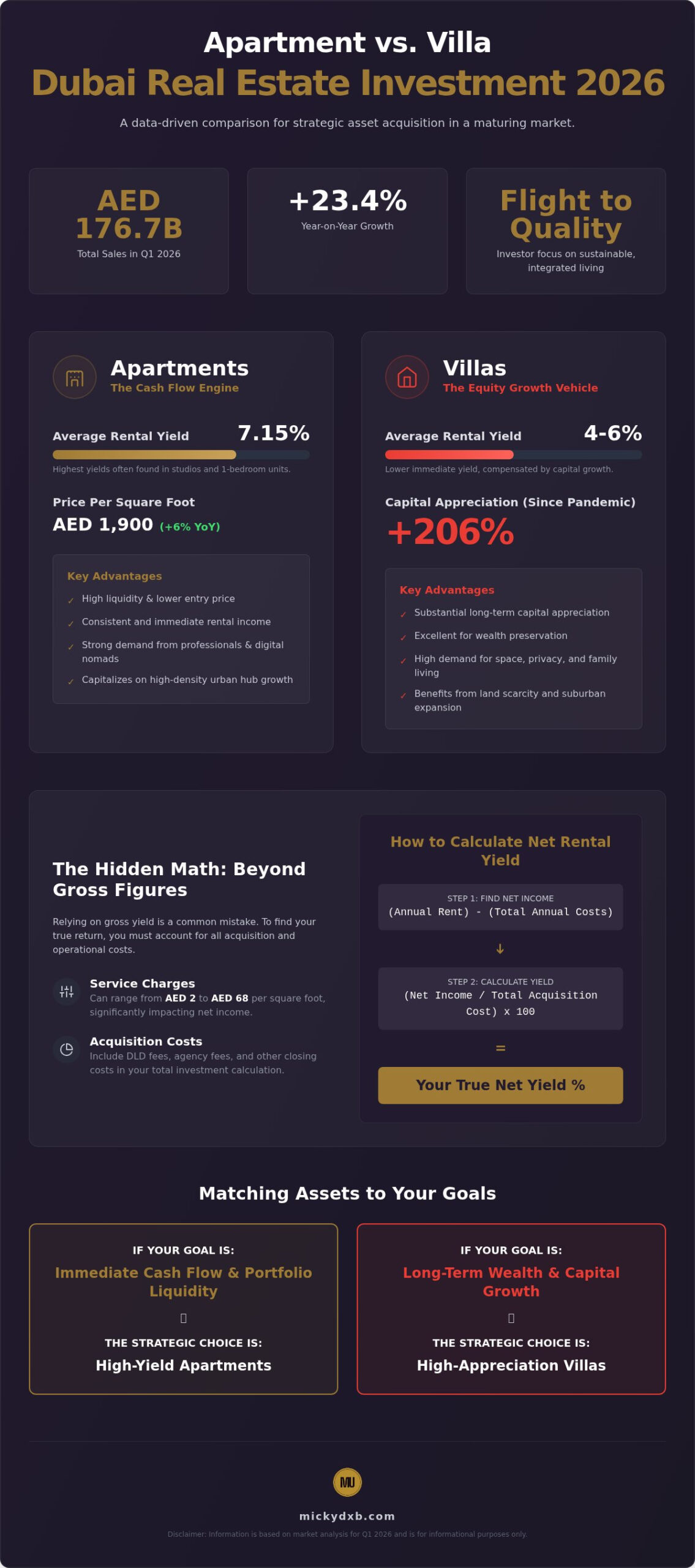
With AED 176.7 billion in total sales recorded in just the first quarter of 2026, the question for serious capital isn’t whether you should enter the market, but where you should anchor your funds. You’ve likely seen the headlines about 206% villa appreciation since the pandemic, yet the allure of 8% apartment yields remains equally magnetic. Deciding on an apartment vs villa investment Dubai requires looking past the glossy brochures and into the raw, net-yield reality of the current landscape.
It’s understandable to feel a sense of hesitation when service charges range from a modest AED 2 to a staggering AED 68 per square foot. You want the security of stable demand without the fear that hidden costs will erode your hard-earned wealth. I’ve designed this guide to provide the clarity, precision, and strategic foresight you need to navigate these choices with absolute confidence. We’ll break down the 2026 national market outlook, provide a step-by-step ROI calculation framework, and compare the distinct advantages of high-yield apartments versus high-appreciation villas. By the end, you’ll have a definitive asset acquisition strategy built on transparency, security, and proven data.
Key Takeaways
- Evaluate the 2026 national market outlook to identify whether high-yield apartments or high-appreciation villas better serve your specific financial objectives.
- Master the strategic framework for an apartment vs villa investment Dubai to ensure every acquisition strengthens your long-term wealth preservation strategy.
- Learn to calculate precise net rental yields by factoring in DLD fees, service charges, and total acquisition costs rather than relying on gross figures.
- Discover how to balance immediate cash flow from rental units with the significant capital growth potential found in the residential villa sector.
- Gain a step-by-step methodology for evaluating property listings that moves beyond marketing promises and into verifiable ROI data.
The 2026 National Real Estate Landscape: Asset Class Performance
The UAE real estate market has entered a phase of sophisticated maturity. In the first quarter of 2026 alone, the sector recorded a staggering AED 176.7 billion in total sales, representing a 23.4% increase year-on-year. This isn’t merely a spike in activity; it’s a reflection of the nation’s unwavering economic stability and its appeal as a global safe haven for capital. For those weighing an apartment vs villa investment Dubai, 2026 stands as a pivotal year where regulatory clarity and infrastructure expansion converge to create unique entry points.
A significant driver of this performance is the national shift toward ‘integrated living.’ Modern tenants and buyers no longer seek just a roof; they demand ecosystems where work, wellness, and social connectivity are within reach. This trend has kept occupancy rates across the residential sector remarkably high. Understanding Dubai’s real estate market history reveals how the city has transitioned from a speculative environment into a world-class destination for long-term residency. Today, the market is defined by a flight to quality, where investors prioritize assets that offer sustainable lifestyles over quick flips.
Emerging Demand for High-Density National Hubs
Apartments continue to serve as the functional core of the rental market. They offer the liquidity and entry-level accessibility that many investors require for a balanced portfolio. The rise of remote work and the expansion of ‘digital nomad’ visas have fundamentally altered what tenants look for in a unit. There is a clear preference for buildings that offer co-working spaces, high-speed connectivity, and central locations. National data for 2026 indicates that apartment demand continues to surge, with the average price per square foot rising by 6% year-on-year to reach AED 1,900. This steady growth makes high-density hubs a reliable choice for consistent rental income.
The Suburban Expansion: Why Villas are Gaining Ground
While apartments dominate in transaction volume, villas are driving significant value growth across the national landscape. The post-pandemic desire for privacy, outdoor space, and larger square footage remains a primary motivator for long-term residents. National infrastructure projects have made suburban villa communities more accessible than ever, effectively shrinking the distance between quiet residential enclaves and commercial centers. Investor sentiment has shifted toward these assets for wealth preservation, especially as average freehold villa values have risen 206% since the pandemic. For the strategic investor, the villa segment represents a play for substantial capital appreciation and family-oriented stability.
Apartment vs Villa: Comparing ROI, Yields, and Appreciation
Choosing an apartment vs villa investment Dubai isn’t about finding a universal winner. It’s about aligning an asset’s financial behavior with your specific timeline and liquidity needs. Apartments typically serve as the engine for immediate cash flow, while villas act as a powerful vehicle for long-term equity growth. In the first half of 2026, we’ve seen these two asset classes diverge in performance, offering distinct advantages depending on whether you prioritize monthly checks or total portfolio value.
Rental Yields: The Apartment Advantage
Apartments consistently lead the market in gross rental yields, which averaged approximately 7.15% in early 2026. Smaller units, such as studios and one-bedroom residences, often command the highest percentage returns because they cater to the massive influx of professional tenants. If you utilize off-plan property investment, you can often secure these high-demand units at a lower entry price, effectively locking in superior yields before the project even reaches completion. The rise of short-term rental platforms has further boosted these figures, allowing investors to capitalize on the UAE’s thriving tourism and business travel sectors.
Capital Growth: The Villa Long-Game
Villas may offer lower immediate yields, typically ranging between 4% and 6%, but they excel in capital appreciation. Since the pandemic, average freehold villa values have surged by 206%, a testament to the scarcity of land and the sustained demand for spacious family homes. When you target luxury real estate, you’re investing in a limited commodity. Unlike the high-volume apartment market, villa supply is naturally constrained by land availability, which creates a strong foundation for future price growth and wealth preservation.
Liquidity and risk also play vital roles in your decision. Apartments offer high liquidity; with over 36,000 transactions in Q1 2026 alone, exiting an apartment investment is generally faster than selling a villa. However, owning a single villa provides a sense of stability that high-density living cannot match. Diversifying your risk by owning multiple apartments can protect you from vacancy, whereas a villa relies on a single high-value tenant. Success in either path requires understanding Dubai property service charges and how they impact your net take-home pay. If you’re ready to build a balanced portfolio, consulting with a strategic advisor can help you identify the right mix of assets for your 2026 acquisition strategy.
The Hidden Math: Service Charges and Maintenance Costs
Gross yield is a vanity metric; net yield is the truth. While an apartment vs villa investment Dubai comparison often focuses on the headline rental figures, your actual take-home pay is determined by what happens beneath the surface. In 2026, savvy investors are looking past the initial promise of high returns to calculate the impact of service charges and operational upkeep. These costs aren’t merely inconveniences. They are fundamental variables in your wealth preservation strategy.
Apartment Service Charges: A Fixed Predictability
For apartment owners, service charges represent a predictable, recurring expense that covers the collective maintenance of the building. These fees are typically calculated on a per-square-foot basis, ranging from AED 10 to AED 30 annually in the national market, though ultra-luxury towers can reach significantly higher levels. This cost covers everything from elevator maintenance and 24/7 security to the upkeep of shared amenities like gyms and temperature-controlled pools. The Dubai Land Department, through the Real Estate Regulatory Agency (RERA), strictly governs these charges via the Mollak system to ensure transparency and prevent arbitrary fee hikes for property owners.
The trade-off for this predictability is that you pay for these amenities whether your unit is occupied or vacant. If you invest in a building with extensive luxury features, your service charge will be higher, potentially compressing your net yield. It’s vital to check if a unit is “chiller-free,” as this can significantly lower the utility burden on the tenant, allowing you to command a higher base rent while maintaining a stable cost structure.
Villa Upkeep: The Variable Expense
Villa investments offer a different financial profile. On paper, service charges for villas are much lower, often ranging between AED 2 and AED 6 per square foot. This is because these fees only cover communal areas like park maintenance and street lighting. However, the villa owner acts as their own facility manager. You are directly responsible for the internal mechanical, electrical, and plumbing (MEP) systems, as well as private landscaping and swimming pool sanitation.
Successful villa investors typically follow the “1% rule,” setting aside one percent of the property’s total value annually for major repairs and structural upkeep. To minimize these operational costs, many owners implement proactive measures:
- Preventative Maintenance Contracts: Engaging a trusted service provider for quarterly HVAC and plumbing checks to avoid emergency repair premiums.
- Sustainable Landscaping: Utilizing xeriscaping or automated irrigation to reduce water consumption.
- Smart Home Integration: Using energy-efficient systems to lower cooling costs during peak summer months.
Beyond these direct costs, national property owners must also account for building insurance and the 4% DLD transfer fee during acquisition. While the UAE remains a tax-efficient environment for residential assets, failing to budget for these “hidden” expenses can turn a high-yield asset into a liquidity drain. Understanding these nuances ensures that your 2026 acquisition remains a source of security rather than a source of stress.
How to Calculate Your Net Rental Yield: A Step-by-Step Guide
Precision is the hallmark of a seasoned investor. While many focus on gross figures, your success in an apartment vs villa investment Dubai depends on your ability to isolate the net return. This calculation moves you from speculation to strategy, ensuring your capital is working as hard as possible. Follow these five steps to reveal the true performance of any potential acquisition.
- Step 1: Determine Total Acquisition Cost. This isn’t just the purchase price. You must include the 4% DLD transfer fee, trustee registration fees (AED 4,000 plus VAT), and mortgage registration fees (0.25% of the loan amount). Budgeting roughly 7% to 8% of the purchase price for closing costs is a safe baseline.
- Step 2: Calculate Annual Gross Rental Income. Use current market averages, such as the 7.15% yield for apartments or 5% for villas, to estimate your yearly collections.
- Step 3: Deduct Operating Expenses. Subtract annual service charges, building insurance, and your 1% maintenance reserve for villas.
- Step 4: Account for Vacancy and Marketing. Deduct a 5% buffer from your gross income to cover professional listing fees and potential void periods between tenants.
- Step 5: Apply the Net Yield Formula. Divide your Annual Net Income by your Total Acquisition Cost and multiply by 100 to find your percentage.
Gross vs. Net Yield: The Critical Distinction
Gross yield is a marketing figure; net yield is the reality. For instance, an apartment showing a 7% gross yield might drop to 5.2% net once high service charges are deducted. Conversely, a villa with a 5% gross yield might retain a 4.5% net yield due to lower community fees. If you’re leveraging your acquisition, our mortgage lending services can help you calculate how current interest rates, starting from 3.75% for 1-year fixed terms, impact your cash-on-cash return. It’s about finding the balance between entry costs and long-term liquidity.
Factors That Dilute Your ROI
Costs can creep in from unexpected places. Chiller fees are a prime example. In many high-density hubs, the landlord pays the district cooling capacity charge while the tenant pays for consumption. Understanding who pays what is vital for your bottom line. Additionally, you should factor in the cost of professional property listing and resell services when you eventually decide to exit. Optimizing your unit with 2026 tenant preferences, such as smart home features or dedicated home office nooks, can reduce vacancy and protect your yield. To ensure your calculations are airtight, connect with a strategic consultant for a personalized ROI breakdown.
Strategic Acquisition: Matching Assets to Your Goals
The ultimate success of your portfolio doesn’t depend on a single property type. It depends on how well that asset aligns with your personal financial timeline. In the 2026 market, the choice between an apartment vs villa investment Dubai is often a choice between immediate liquidity and generational wealth preservation. A seasoned investor knows that a “good deal” is only good if it serves the specific purpose of their capital at that moment in time.
Scenario A: The Income-Focused Investor
If your primary objective is consistent cash flow to fund your lifestyle or reinvest into new opportunities, apartments are your strongest tool. Studio and one-bedroom units remain the 2026 yield kings because they cater to the massive influx of young professionals entering the national workforce. By targeting high-demand commercial hubs, you ensure your vacancy rates stay near zero. Many strategists choose to leverage financing to acquire three or four high-yield apartments rather than sinking all their capital into a single villa. This diversification protects you from the risk of a single tenant vacating, ensuring your monthly income remains steady and predictable.
Scenario B: The Equity-Focused Investor
Villas represent the ultimate hedge against inflation and a primary vehicle for equity growth. While the rental yield might be lower than a city-center apartment, the scarcity of land in premium national communities drives significant capital appreciation. The long-term play involves holding these residences for a period of 7 to 10 years. This duration allows you to ride out market cycles and capture the full value of infrastructure improvements. If you seek stability and a tangible legacy for your family, luxury villas offer a level of security that high-density developments simply cannot match. You aren’t just buying a home; you’re buying a finite piece of the national landscape.
Building a hybrid portfolio is often the most sophisticated path forward. By combining the high monthly yields of apartments with the robust growth potential of villas, you create a balanced financial ecosystem. This is where professional real estate investment consulting becomes invaluable. A consultant looks beyond the immediate transaction to see the larger narrative of your journey, helping you time your entries and exits with surgical precision. Before you sign a Memorandum of Understanding (MOU), run through this final checklist to ensure your 2026 acquisition strategy is airtight:
- Does the net rental yield (not gross) meet my minimum threshold?
- Is the service charge structure regulated by RERA and visible in the Mollak system?
- Have I budgeted for the 7% to 8% upfront acquisition costs in cash?
- Does the property’s location align with national 2026 infrastructure expansion plans?
- Is my exit strategy based on capital gain or sustained rental demand?
Taking the time to answer these questions transforms a high-stakes decision into a calculated step toward financial freedom. Whether you choose the vertical efficiency of an apartment or the expansive potential of a villa, doing it right always beats doing it fast.
Mastering Your 2026 Acquisition Strategy
The 2026 market rewards the precise, the patient, and the well-informed. You now have the framework to look past gross yield marketing and calculate the net reality of your potential returns. Whether you prioritize the immediate cash flow of high-density units or the generational wealth preservation of luxury residences, your choice should reflect a clear alignment with your broader financial journey. Navigating an apartment vs villa investment Dubai ensures that your capital isn’t just spent, but strategically deployed for maximum security, clarity, and growth.
Success in this high-stakes landscape requires a partner who has navigated every market cycle. With over 10 years of UAE market mastery and a record of 2,000 successful listings, I provide the steady guidance you need to move forward with certainty. From identifying exclusive off-plan opportunities to providing integrated mortgage lending support, every step we take is designed to protect your long-term interests. Your path to a resilient portfolio starts with a single, well-informed decision.
Secure your 2026 investment strategy with Micky Uppal’s expert consulting and transition from uncertainty to a position of quiet authority. You have the vision; let’s build the reality together.
Frequently Asked Questions
Which asset class has higher rental yields in Dubai in 2026?
Apartments generally command higher rental yields, averaging approximately 7.15% across the national market in 2026. This performance is driven by the consistent demand for studio and one-bedroom units in central hubs. In contrast, villas typically offer gross yields around 4.98%. While villas provide lower immediate cash flow, they often outperform in capital appreciation. Your choice should depend on whether you prioritize monthly income or the long-term growth of your equity.
Are service charges higher for apartments or villas?
Apartment service charges are significantly higher on a per-square-foot basis, typically ranging from AED 10 to AED 30 annually. These fees cover building-wide amenities like 24/7 security, elevators, and shared gyms. Villa community fees are much lower, often between AED 2 and AED 6. However, villa owners must directly fund their own internal maintenance, landscaping, and pool care. Understanding this distinction is vital when weighing an apartment vs villa investment Dubai.
Is it easier to get a mortgage for an apartment or a villa?
Both asset classes are equally accessible for financing, provided the property is located in a designated freehold area. Lenders often view villas as stable, long-term assets, while apartments offer high liquidity and lower entry points. Current 2026 mortgage rates start from 3.75% for one-year fixed terms. Utilizing integrated mortgage lending services can help you navigate the specific requirements for each, ensuring your acquisition remains a secure and well-structured financial commitment.
How much should I budget for villa maintenance annually?
You should adhere to the 1% rule by setting aside one percent of the property’s total value every year for maintenance. Unlike apartments, where major structural costs are covered by collective service charges, villa owners are responsible for private HVAC systems, roofing, and plumbing. Proactive preventative contracts can help stabilize these variable expenses. This fund acts as a necessary safeguard, ensuring your residence remains a high-quality asset that preserves its value over time.
What is a good net rental yield for a UAE property investment?
A strong net rental yield for an apartment vs villa investment Dubai typically falls between 5% and 7% for apartments and 3% to 5% for villas. It’s essential to look past gross marketing figures and subtract all service charges, insurance, and vacancy allowances. If your net return stays within these ranges, your asset is performing well relative to global standards. Achieving these figures requires careful selection and a clear understanding of the total acquisition cost.
Can foreigners buy both apartments and villas in freehold areas?
Foreign investors have the right to own both apartments and villas with 100% freehold title in designated areas across the UAE. This ownership includes the right to sell, lease, or occupy the property as you see fit. The regulatory environment is designed to be transparent and welcoming, providing the same level of legal protection to international buyers as it does to local residents. This openness is a cornerstone of the nation’s enduring economic appeal.
How does off-plan investment affect capital appreciation for villas?
Off-plan acquisitions often act as a catalyst for capital appreciation by allowing you to lock in a lower entry price before project completion. As the community matures and infrastructure expands, the value of the villa naturally rises. This strategy is particularly effective for large-scale family residences where supply is constrained. By the time the keys are handed over, many investors have already seen significant growth in their equity, making it a bold strategic move.
What are the hidden costs of selling a property in Dubai?
Selling your asset involves several costs that can impact your final liquidity. You should budget for a 2% agency commission plus VAT, as well as a No Objection Certificate fee from the developer, which typically ranges from AED 500 to AED 5,000. If you have an active loan, there are also mortgage discharge fees and potentially early settlement penalties to consider. Factoring these in early ensures your exit strategy is as profitable as your entry.

Leave a Reply