


If you believe that a 1.7% year-on-year dip in residential prices signals a market retreat, you might be missing the most sophisticated entry point of the decade. The debate over off-plan vs ready property investment has shifted from simple speculation to a nuanced calculation of timing and intent. You’ve likely felt the weight of conflicting reports, wondering if now is the time to secure a steady 6.93% apartment yield or if the 75% market dominance of off-plan sales points to a larger capital gain opportunity. It’s natural to feel a sense of hesitation as the market transitions into a more mature phase, especially when multi-currency financing and new regulations like the Shared Housing Law add layers of complexity to your decision.
We understand that high-stakes financial commitments require more than just a guess; they require a partnership-oriented strategy. This 2026 guide will help you determine whether rental yields or capital appreciation should drive your portfolio growth. We will provide a structured ROI framework, examine liquidity across different models, and give you the confidence to choose a path that secures your long-term wealth. From identifying the impact of the 180,000 new homes expected by 2028 to mastering the strategic transition between income and exit, this comparison ensures your next move is both bold and grounded.
Key Takeaways
- Learn how the Buy-to-Let model provides a stable hedge against market volatility through consistent, passive rental income.
- Discover how to capitalise on capital appreciation by mastering the specific timing and milestones associated with Buy-to-Sell strategies.
- Evaluate the critical differences between off-plan vs ready property investment Dubai to determine which model best supports your immediate liquidity needs.
- Understand the distinct risk profiles of each path, from managing tenant defaults in rental portfolios to timing market exits for resells.
- Use our structured framework to audit your financial goals and leverage national mortgage lending for strategic asset acquisition.
Defining the Core Strategies: Buy-to-Let vs Buy-to-Sell Dubai
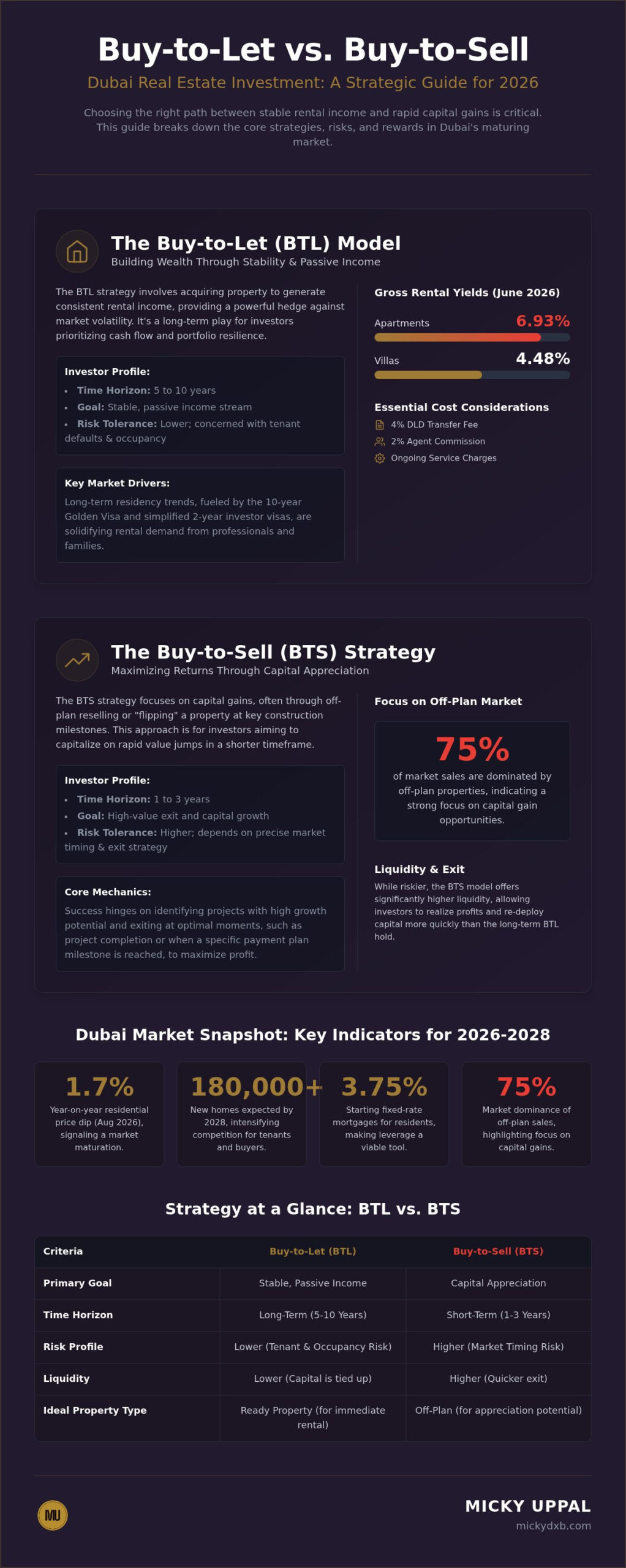
Choosing between a rental portfolio and a capital growth strategy isn’t just about the numbers; it’s about the financial legacy you intend to build. At its heart, Buy-to-Let (BTL) involves acquiring property to generate consistent, passive rental income. In contrast, Buy-to-Sell (BTS) focuses on capital appreciation, often through off-plan reselling or strategic “flipping” at key construction milestones. Both are valid real estate investment strategies, but their success in 2026 hinges on your ability to read a maturing market with precision.
The 2026 landscape requires a more nuanced approach than previous cycles. For the first time in five years, we saw a slight annual price decline of 1.7% in August 2026. This shift means the fundamental trade-off between immediate liquidity and long-term cash flow stability is more pronounced. Deciding on off-plan vs ready property investment Dubai is no longer a binary choice but a strategic alignment with your personal risk tolerance and liquidity requirements.
The Investor Mindset: Cash Flow vs. Capital Gains
Your strategy begins with your psychological approach to wealth. Are you seeking the “safety” of quarterly rental cheques or the “growth” of a high-value exit? A BTL investor typically has a horizon of 5 to 10 years, prioritising stability and hedging against market volatility. Conversely, a BTS investor looks at a 1 to 3 year window, aiming to capitalise on the rapid value jumps seen as a project moves from ground-breaking to completion. Aligning these choices with your broader national financial portfolio ensures you aren’t over-leveraged when market conditions pivot.
Market Indicators for 2026
Supply and demand trends are the pulse of your investment. With an estimated 180,000 new homes expected to enter the market by 2028, the competition for tenants and buyers will intensify. Interest rate shifts also play a critical role. As of late 2026, fixed-rate mortgages for residents start at 3.75%, making leverage a viable tool for those who understand the mechanics of property resale Dubai. When comparing off-plan vs ready property investment Dubai, you must account for these macro indicators to ensure your capital isn’t just parked, but actively working to meet your “Freedom Number.”
The Buy-to-Let (BTL) Model: Stability and Passive Income
Stability is the cornerstone of any resilient portfolio. While capital gains offer the thrill of rapid growth, the Buy-to-Let model provides the steady heartbeat of passive income. In the UAE, the appeal is grounded in mathematics. As of June 2026, gross rental yields for apartments stood at 6.93%, a figure that consistently outperforms global metropolitan averages in cities like London or New York, where yields often struggle to cross the 3% or 4% threshold. This income acts as a powerful hedge against market volatility. If residential prices experience a minor dip, as seen with the 1.7% year-on-year fall in August 2026, your quarterly rental checks remain a constant, protecting your cash flow while the market corrects.
Long-term residency trends are further solidifying this demand. The May 2026 removal of the AED 750,000 minimum requirement for two-year investor visas, alongside the established 10-year Golden Visa for investments over AED 2,000,000, has transformed the national market. We aren’t just seeing transient workers; we’re seeing families and professionals committing to the UAE for a decade or more. When weighing off-plan vs ready property investment Dubai, the BTL investor prioritises these long-term tenants who value stability over temporary stays.
Success in this model requires a ruthless focus on the gap between gross and net yields. Gross yield is a simple calculation of annual rent against purchase price, but net yield is your actual profit. You must account for the 4% DLD transfer fee, the 2% agent commission, and the ongoing service charges that maintain the building’s quality. If you don’t calculate these precisely, a high-performing asset on paper can quickly become a break-even burden in reality.
Maximising Your Rental Yield
Selecting the right property type is essential for maintaining high occupancy rates. While villas offer prestige, their 4.48% average yield in 2026 suggests that apartments are the superior choice for pure income generation. Smaller units like studios and one-bedroom apartments often attract the widest pool of tenants, ensuring fewer vacancy periods. Many investors find that off-plan property investment dubai is the most effective way to secure lower entry prices, which naturally amplifies the eventual yield once the property is handed over and tenanted.
Managing the BTL Investment
Professional consulting is vital for identifying assets that offer a true balance of quality and return. You need to account for maintenance, potential vacancy periods, and the impact of the March 2026 Shared Housing Law on your specific property type. BTL remains the preferred choice for first-time international investors because it offers a clear, logical path to wealth without the timing risks associated with flipping. If you want to secure your financial future through consistent returns, you can speak with an investment consultant to identify high-performance assets that match your goals.
The Buy-to-Sell (BTS) Strategy: Leveraging Capital Appreciation
While rental yields provide a steady pulse for your portfolio, the Buy-to-Sell (BTS) model is built for velocity. It is a strategy designed to capture capital appreciation by entering a position early and exiting when market demand peaks. In 2026, where off-plan transactions accounted for 75% of residential sales in August, the BTS path remains a powerful engine for those who can navigate the “flip” timeline with precision. Success in the debate of off-plan vs ready property investment Dubai often comes down to how you leverage construction milestones to your advantage.
A typical strategic flip begins at the project launch. By acquiring an asset during the initial phase, you benefit from the developer’s scheduled price increases as the building rises. The goal is not always to hold until handover. Many sophisticated exits occur when a project reaches 50% or 70% completion. This allows you to capture a significant percentage of the appreciation while the property is still under construction, often attracting buyers who want a shorter wait time than a launch phase purchase. Strategic asset acquisition in emerging national hubs requires an eye for under-valued projects that are poised for rapid growth as infrastructure matures.
Off-Plan Reselling: The High-Growth Engine
Structured payment plans are the secret weapon of the BTS investor. You might only commit 30% of the property value in staggered payments before reselling, yet you gain the appreciation on 100% of the asset’s worth. This leverage effect can transform a modest market price increase into a substantial return on your actual invested capital. Identifying the “sweet spot” for reselling is a craft; it requires working with a consultant who has deep luxury real estate dubai market knowledge to understand which project types are seeing the highest resale demand in the current cycle.
BTS Risk Management
Liquidity is the primary variable in any exit strategy. In a market showing signs of cooling, such as the 1.7% year-on-year price dip recorded in August 2026, timing becomes everything. You don’t want to be forced to sell when national supply is at its peak, especially with 180,000 new homes expected to enter the market by 2028. You must also factor in the 2% agent commission and the 4% DLD transfer fee, which can thin your final profit margins if not accounted for from day one. When evaluating off-plan vs ready property investment Dubai, the BTS investor must be a bold strategist, looking beyond the brochure to the actual resale potential in a competitive secondary market.
Direct Comparison: Risk, Reward, and Liquidity
Choosing between a rental portfolio and a capital growth play requires a clear-eyed look at your immediate liquidity needs and long-term wealth goals. When evaluating off-plan vs ready property investment Dubai, you’re essentially deciding between the security of a steady income stream and the high-octane potential of a capital exit. BTL offers the reassurance of quarterly cheques, while BTS provides a lump sum profit that can be aggressively reinvested into larger assets. The “entry price” factor also creates a natural divide; off-plan models allow for staggered capital outlays through payment plans, whereas ready properties typically require a larger upfront commitment of capital and fees.
Risk profiles in 2026 have become more distinct as the market matures. For the BTL investor, the primary risks are tenant defaults and vacancy periods, particularly as 60,000 new units enter the national market annually. BTS investors face a different hurdle: market timing. In a climate where residential prices saw a 1.7% year-on-year dip in August 2026, an ill-timed exit can erode the gains made during the construction phase. You must decide if you prefer the “slow burn” of a 6.93% apartment yield or the “sprint” of a 15% to 20% capital gain milestone.
The Role of Financing and Mortgages
Leveraging your capital is where these two strategies truly diverge in their net performance. Utilizing mortgage lending Dubai can significantly amplify BTL returns by allowing you to control a high-value asset with a smaller equity stake, effectively using the tenant’s rent to pay down the debt. However, financing a BTS flip remains more challenging; banks often prefer the stability of completed, income-generating homes over speculative off-plan resells. Consulting a mortgage broker vs bank Dubai is essential to find a loan structure that doesn’t penalise you for the early exits common in capital appreciation strategies.
Regulatory and Fee Considerations
The UAE remains a global outlier for its investor-friendly tax environment, offering zero capital gains tax on both models. However, the 4% DLD transfer fee is a critical “sunk cost” that short-term BTS investors must account for. If your appreciation doesn’t exceed this 4% plus agent commissions, your “flip” could result in a net loss. Legal safety is also paramount; you must ensure your off-plan contract allows for resale before a specific construction percentage is met. To navigate these regulatory nuances with a seasoned guide, you can book a strategic investment consultation to align your financing with your chosen exit path.
Strategic Selection: How to Choose Your 2026 Investment Path
Making a final decision on your portfolio direction requires a transition from theory to execution. The choice between off-plan vs ready property investment Dubai is rarely about which model is “better” in a vacuum; it’s about which model serves your specific financial stage. To find clarity, you must first define your “Freedom Number.” If your goal is to replace a monthly salary with passive income, your path leads toward ready, high-yield assets. If you are in a wealth-building phase and seek to aggressively grow your net worth, the capital gains potential of the off-plan market is your primary engine.
Once your goal is set, you must conduct a rigorous audit of your current liquidity and access to national mortgage lending. Ready properties demand a higher upfront capital commitment, including the full deposit and immediate 4% DLD fees. Off-plan investments offer more breathing room through staggered payment plans, yet they require the patience to wait for project completion. You should also evaluate your desired time commitment. Buy-to-Let is a semi-passive journey, while Buy-to-Sell is an active pursuit that requires constant monitoring of market cycles and construction milestones with a trusted advisor.
The Hybrid Approach: BTL-to-BTS
For many sophisticated investors, the most resilient strategy is a hybrid model that captures the best of both worlds. By holding an off-plan acquisition for three years of rental income after handover, you can achieve a superior total return. This period allows the community to mature, driving up the property’s value while the rental income helps pay down any mortgage debt. Transitioning from a “yield” mindset to an “appreciation” mindset at the market peak allows you to exit with a significantly higher equity multiple than a quick flip would provide.
Partnering for Success
In a maturing market where 180,000 new homes are expected by 2028, expert real estate investment consulting is no longer a luxury; it’s a vital risk mitigation tool. Success depends on having a partner who understands the full lifecycle, from the initial acquisition to the complexities of how to sell apartment in Dubai when the time is right. A seasoned guide ensures that your exit strategy is baked into the purchase from day one, protecting your margins against shifting national supply trends. If you’re ready to move beyond conflicting reports and build a data-driven 2026 portfolio, your next step is to book a strategic consultation to map your path with confidence.
Mastering the 2026 Market Cycle
Success in the current landscape isn’t about following the crowd; it’s about aligning your asset acquisition with your personal “Freedom Number.” Whether you seek the consistent 6.93% average apartment yields of a rental portfolio or the high-velocity capital gains of a strategic flip, the debate of off-plan vs ready property investment Dubai ultimately rewards the well-informed strategist. By understanding the interplay between national supply trends and construction milestones, you can transform market cooling into a calculated entry point that serves your long-term wealth goals.
Navigating these high-stakes decisions requires a partner who has seen the market evolve firsthand. With over 10 years of expertise and more than 2,000 successful listings, Micky Uppal provides the integrated mortgage and resell services needed to manage your full transaction lifecycle. Don’t let decision paralysis stall your progress in this maturing market. Book a Strategic Investment Consultation with Micky Uppal today to build a portfolio that offers both immediate security and long-term satisfaction. Your journey toward a sophisticated financial future starts with a single, well-placed choice.
Frequently Asked Questions
Is Buy-to-Let better than Buy-to-Sell in Dubai for 2026?
The choice depends on whether you prioritise quarterly cash flow or a lump-sum capital exit. In 2026, Buy-to-Let offers a stable hedge against market maturation, providing consistent income as national supply increases. Conversely, Buy-to-Sell capitalises on the current dominance of off-plan transactions in the secondary market. If you seek long-term security, rental models are superior; if you aim for rapid portfolio growth, flipping off-plan assets remains a powerful wealth-building tool.
What is the typical ROI for a Buy-to-Let property in the UAE?
Gross rental yields in the UAE consistently outperform other global hubs. While specific returns depend on the asset class, apartments have recently achieved gross yields nearing 7%, whereas villas generally offer a more modest 4.5%. When evaluating off-plan vs ready property investment Dubai, it’s vital to focus on net ROI by accounting for annual service charges. These stable returns provide a reliable income stream that remains resilient even during periods of broader market correction.
How soon can I resell an off-plan property for a profit?
You can typically resell once you’ve met the developer’s minimum payment threshold, which is often between 30% and 40% of the total purchase price. Profitability depends on timing your exit around key construction milestones or project sell-outs. In the 2026 market, many investors find the “sweet spot” for reselling occurs just before handover. This allows them to capture appreciation without committing to the final payment or long-term property management responsibilities.
Do I need a mortgage for a Buy-to-Sell investment strategy?
While many investors use cash for fast deals, mortgages can amplify your return on equity through leverage. As of September 2026, fixed-rate mortgages for residents start at 3.75%. Using finance allows you to control a high-value asset with a smaller initial deposit. You must ensure your loan agreement doesn’t include restrictive early repayment penalties. These charges can erode your profit when you exit the position during a successful capital appreciation play.
What are the hidden costs of the Buy-to-Let model?
Beyond the purchase price, you must account for critical outlays that impact your net yield. These include:
- The 4% DLD transfer fee paid at acquisition.
- Annual service charges for building maintenance and amenities.
- A 2% real estate agent commission plus VAT.
- Provision for vacancy periods and minor property repairs.
Calculating these costs accurately ensures your passive income remains truly profitable rather than just a break-even exercise.
Can foreigners use mortgages for Buy-to-Sell investments?
International investors have full access to the UAE’s mortgage market, though terms differ from resident loans. In 2026, the best available fixed rate for non-residents is 4.19% for a three-year term. This allows foreigners to participate in the off-plan vs ready property investment Dubai debate with significant leverage. A professional mortgage broker can help you navigate the multi-currency complexities to secure a loan that aligns with a short-term capital growth strategy.
Which property types offer the best capital appreciation in 2026?
Apartments currently show resilient growth patterns as the national market transitions toward a more stable phase. While luxury villas offer exclusivity, the significant volume of new inventory entering the market over the next three years means that high-quality apartments often see more consistent demand in the secondary market. Strategic investors focus on assets with premium amenities to ensure their capital appreciation remains robust, protecting their portfolio against the minor price fluctuations recorded recently.
How does the DLD fee affect short-term property flipping?
The 4% DLD fee is a non-negotiable cost that you must recover before seeing any actual profit. In a short-term flipping scenario, this fee, combined with the 2% agent commission, creates a significant hurdle rate. If the property doesn’t appreciate by more than 6% during your holding period, your investment could result in a net loss. Professional investors use detailed ROI frameworks to ensure their exit price comfortably covers these regulatory and transaction costs.

Leave a Reply