


The 2026 market isn’t just about listing your property; it’s about timing an exit that captures the absolute peak of your investment’s lifecycle. You’ve likely watched the rapid growth of the past few years and now find yourself wondering if the window for maximum capital appreciation is beginning to narrow. It’s natural to feel a sense of urgency mixed with the stress of navigating complex DLD regulations or the fear of hidden transaction costs eating into your margins. You want a transition that’s as profitable as it is seamless, but the path of how to sell apartment in Dubai has evolved into a sophisticated game of strategy and precision.
If you’re ready to move from a state of hesitation to a position of total market authority, then this guide is your definitive blueprint. We’ll demystify the entire process, from securing that essential No Objection Certificate to leveraging integrated mortgage lending to attract qualified buyers faster. This strategic checklist ensures you master the legal and financial nuances of the current market while avoiding the pitfalls that stall most sellers. From understanding the 4% DLD transfer fee to managing broker commissions with transparency, you’re about to discover how to exit your investment with the confidence of a seasoned pro.
Key Takeaways
- Evaluate your property’s current capital appreciation against long-term rental yields to confirm if 2026 is your most profitable exit window.
- Master the essential document checklist and DLD requirements to understand exactly how to sell apartment in Dubai with full legal compliance.
- Prioritize a seasoned consultant with a specific track record in luxury assets over high-volume agencies to ensure your property is positioned for maximum returns.
- Execute a structured seven-step roadmap that focuses on high-value staging and rigorous buyer vetting to accelerate your transaction timeline.
- Secure your ROI by accurately calculating net proceeds, factoring in the 4% DLD fee, developer NOC charges, and mandatory trustee office costs.
Preparing Your Exit Strategy for the 2026 Market
Success in real estate isn’t found in the purchase; it’s realized in the exit. As we move through 2026, the market is showing signs of healthy stabilization. Annual house price growth has settled near 10%, a shift from the 16% surges seen in previous years. This transition from a frantic boom to a mature, regulated environment means your strategy must shift as well. You’re no longer just listing a property. You’re executing a financial maneuver designed to protect your equity.
Evaluating your current capital appreciation against average rental yields of 5% to 8% is your first step. If your apartment has seen significant growth but the rental market is cooling in your specific segment, the data suggests it’s time to capture those gains. A clean exit plan requires you to resolve all service charges and documentation before the first buyer even walks through the door. This proactive approach eliminates the friction that often kills high-value deals. Mastering how to sell apartment in Dubai in this climate requires a data-driven mindset that prioritizes actual transaction history over neighborhood gossip.
Timing Your Sale for Maximum ROI
When learning how to sell apartment in Dubai, you’ll find that market cycles follow distinct seasonal rhythms. Historical data shows that buyer activity typically peaks in the final quarter of the year as international investors return to the city. However, you must also look at the supply side. The launch of massive new off-plan projects can temporarily draw attention away from the secondary market. A bold strategist times their listing to coincide with low inventory periods or just before major handovers in competing developments to ensure their property stands out as the premium ready option. Understanding the broader debate around off-plan vs ready property investment Dubai can sharpen your timing instincts and help you position your exit against prevailing buyer sentiment.
The Pre-Listing Valuation Checklist
Setting the right price is a delicate balance of logic and psychology. You must move beyond asking prices found on portals, which are often inflated by 5% to 10%, and focus on actual closing prices recorded by the Dubai Land Department. Minor upgrades, such as modernizing lighting fixtures or refreshing kitchen cabinetry, often yield a 2x return on the investment cost by increasing the property’s perceived value.
The Appraisal Gap is the discrepancy between a seller’s aspirational price and the bank’s formal valuation, which frequently prevents buyers from securing the necessary mortgage to close the deal in the 2026 market.
The Essential Document and Legal Checklist
High-stakes financial exits require a foundation of ironclad documentation. In 2026, the Dubai Land Department has moved toward a near-total digital ecosystem, yet the burden of verification still remains with you. Precision at this stage prevents the “deal fatigue” that often occurs when technicalities delay a closing. If you ensure your paperwork is ready before the first offer arrives, you position yourself as a serious, professional seller.
- Title Deed (Mulkiyat): You must have the latest digital version issued via the Dubai REST app. Physical deeds are largely legacy; the DLD’s digital record is the final word on ownership.
- Identification: Provide valid Passports and Emirates IDs for every owner listed on the deed. If the property is owned by a company, you’ll need the trade license and board resolution.
- Form A: This is the mandatory RERA listing agreement. It’s the legal contract between you and your broker that authorizes the marketing of your property.
- No Objection Certificate (NOC): This developer-issued document confirms you have no outstanding service fees. Fees for an NOC typically range from AED 500 to AED 5,000 depending on the developer.
Navigating the DLD and RERA Requirements
Every legitimate listing in 2026 must carry a unique Trakheesi permit number. If your property is advertised without one, it’s an illegal listing that risks heavy fines and immediate removal from portals. For non-resident sellers, a Power of Attorney (POA) is a common tool. However, it must be attested by the UAE Ministry of Foreign Affairs and registered with the DLD to be valid for property transfers. Accuracy here is non-negotiable.
The Mortgage Clearance Process
Selling a mortgaged property is one of the most misunderstood aspects of how to sell apartment in Dubai. You must first request a liability letter from your bank, which usually takes 7 to 10 working days. Once a buyer is found, a “block and transfer” procedure is initiated at a Registration Trustee office. This ensures your mortgage is settled using the buyer’s funds before the title is transferred. Understanding the nuances of a mortgage broker vs bank in Dubai is vital here, as an experienced broker can help your buyer secure financing that aligns with your specific exit timeline. If you’re feeling overwhelmed by these procedural hurdles, consulting with a seasoned advisor can simplify the entire legal journey.
Selecting the Right Representation: Consultant vs. Agent
Your choice of partner is the single most significant variable in your exit strategy. While high-volume agencies often tout massive headcounts, quantity rarely translates to the specialized attention a luxury asset requires. Mastering how to sell apartment in Dubai involves more than just uploading photos to a portal; it requires a consultant who understands the broader narrative of your wealth journey. A seasoned consultant acts as a steady advocate, prioritizing the integrity of the deal over the speed of the commission.
Evaluating a broker’s track record should go beyond general numbers. You need to see evidence of successful closings in your specific property category and price bracket. A partner with high financial literacy is indispensable in 2026. They must be able to speak the language of ROI, yields, and capital gains to attract sophisticated investors. This “Trusted Advisor” model ensures your property isn’t just another listing, but a carefully positioned investment opportunity. If you align with a strategist who views your portfolio as a long-term relationship, then your transaction becomes a calculated step toward your next financial milestone.
Questions to Ask Before Signing Form A
Before you commit to a listing agreement, you must verify the broker’s operational standards. Ask specifically how they qualify potential buyers. A professional shouldn’t just bring “leads” to your door; they should bring vetted individuals with confirmed proof of funds or mortgage pre-approvals. Inquire about their specific marketing budget for your property, ensuring it includes high-end videography and targeted digital placement. Brokers with advanced mortgage knowledge significantly accelerate your timeline by identifying which buyers have the genuine liquidity to close versus those who will fail at the valuation stage.
The Value of Integrated Financial Services
Micky Uppal’s approach provides a unique advantage in the 2026 market through integrated mortgage lending services. When a consultant can assist the buyer with their financing, it removes the primary hurdle that stalls most secondary market sales. This dual-sided expertise reduces the risk of “valuation failure,” where a bank’s appraisal comes in lower than the agreed sale price. By managing the buyer’s financial path, we ensure your exit remains on track. Beyond the current transaction, a bold strategist helps you look at what comes next, whether it’s diversifying into off-plan property investments or securing a new luxury residence. This comprehensive support transforms the stress of selling into the satisfaction of a well-executed plan.
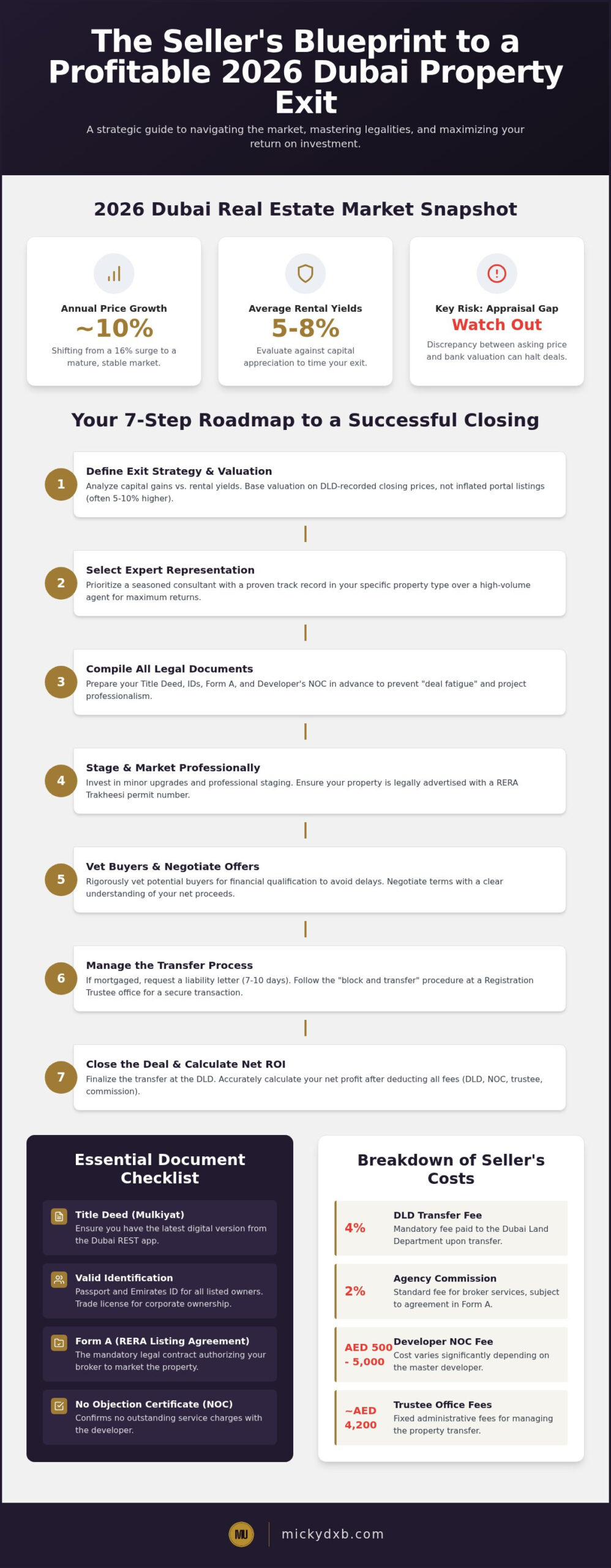
The 7-Step Roadmap to a Successful Closing
A successful closing isn’t an accident; it’s the result of a meticulously managed process. While many guides present a linear path, the reality of how to sell apartment in Dubai involves navigating specific friction points where deals frequently stall. By following a structured roadmap, you maintain control over the timeline and protect your financial interests. Each step requires precision to ensure the transition from listing to liquidity is as smooth as possible.
- Step 1: Marketing and Staging: Elevate your property’s perception through professional videography and neutral staging. High-value perception leads to high-value offers.
- Step 2: Managing Viewings and Vetting: Direct your energy only toward qualified buyers. We prioritize those with a mortgage pre-approval or verified proof of funds to avoid time-wasters.
- Step 3: Signing the MOU (Form F): This is the legally binding contract. It outlines the sale price, completion date, and any special conditions that protect both parties.
- Step 4: Securing the Developer NOC: Apply for the No Objection Certificate once the MOU is signed. This confirms the unit is clear of all service charge liabilities and is ready for transfer.
- Step 5: Finalizing Buyer Finance: If the buyer is financing, their bank will conduct a formal valuation. This is a critical moment where integrated mortgage expertise ensures the deal remains viable.
- Step 6: The Transfer: The physical or digital meeting at a Registration Trustee office where the DLD officially records the change of ownership.
- Step 7: Final Settlement: The final exchange of manager’s cheques for the digital title deed and physical keys.
Negotiation Tactics for 2026 Sellers
In the current market, you’ll often face the “cash vs. finance” dilemma. Cash buyers offer speed and certainty, often demanding a 2% to 3% discount in return. Finance buyers may offer your full asking price but come with the risk of bank valuation delays. You should hold firm on your price if your property has unique upgrades, but consider offering a move-in incentive if you need a faster exit. Always ensure the 10% security deposit is held by the broker to protect you against a buyer’s sudden withdrawal.
The Trustee Office Transfer Day
Transfer day is the culmination of your strategy. You must bring your original Passport and the latest digital Title Deed. The DLD manager’s cheque system remains the gold standard for security. You’ll receive your funds via a cheque issued by the buyer’s bank, ensuring the transaction is guaranteed. Before you arrive, ensure your DEWA account is settled and you have the final bill clearance ready. If you want to ensure every step of this roadmap is handled with precision, start your listing process with an expert today.
Maximizing Net Proceeds: Fees and ROI Calculation
The true measure of a successful exit isn’t the headline figure on your sales agreement; it’s the net liquidity that remains after every obligation is settled. In the 2026 market, sophisticated sellers look beyond the gross price to calculate their “Net Exit Value” with surgical precision. Understanding how to sell apartment in Dubai requires a clear-eyed view of the mandatory costs that bridge the gap between a signed offer and a final bank transfer. Transparency at this stage ensures you aren’t surprised by deductions during the final settlement at the Trustee Office.
Your primary outgoings typically include the 2% agency commission plus 5% VAT on that commission. While the 4% Dubai Land Department (DLD) transfer fee is standardly paid by the buyer, market dynamics can occasionally lead to negotiations where this cost is shared to facilitate a high-value transaction. Beyond these major percentages, you must account for the Developer No Objection Certificate (NOC) fees, which range from AED 500 to AED 5,000, and the Registration Trustee fees, which are AED 4,000 for properties valued above AED 500,000. If you’re settling a mortgage, remember to factor in the 0.25% mortgage registration fee and any bank-specific early settlement charges.
Hidden Costs to Watch Out For
Financial leaks often occur in the smaller, pro-rated adjustments that happen during the final week of the sale. You’ll need to settle all service charges in advance, but you’re entitled to a pro-rated refund from the buyer for any days remaining in the quarter after the transfer. Sinking fund contributions, which are long-term reserves for building maintenance, are typically not refundable to the seller, so ensure your asking price reflects your contribution to these assets.
Service Charge Clearance is a formal document issued by the building’s owners’ association or developer confirming that all community fees are paid in full, serving as a mandatory prerequisite for the issuance of the NOC.
Strategic Reinvestment of Your Capital
Once you’ve realized your capital appreciation, the next step is determining where that wealth will work hardest. Many investors are currently shifting their focus from residential units toward Dubai commercial real estate investment to capture higher yields and longer lease stabilities. For those who prefer to stay within the residential sector, our Property Resale Dubai: The 2026 Strategic Guide provides deeper insights into identifying the next high-growth district. Consulting with Micky Uppal ensures your next acquisition is backed by a decade of market data and integrated financial expertise, allowing you to move from one successful exit into a more powerful investment position. If you’re weighing whether to reinvest into a rental-generating asset or pursue another capital gain, the buy-to-let vs buy-to-sell Dubai strategic guide offers a rigorous framework for making that decision with confidence.
Executing Your High-Value Exit Strategy
The transition from property owner to successful investor requires more than just a listing; it demands a comprehensive understanding of the 2026 market dynamics. Success hinges on a “clean exit” plan that prioritizes rigorous documentation and a deep awareness of your net proceeds after all DLD and developer fees are settled. Mastering how to sell apartment in Dubai is ultimately about moving with precision through each stage of the roadmap, from the initial valuation to the final key handover at the Trustee Office.
You don’t have to navigate these complex financial and legal hurdles alone. With over a decade of national market expertise and 2,000 successful property listings managed, Micky Uppal provides the steady guidance needed to protect your equity. By leveraging bespoke mortgage and financial insights, we don’t just find buyers; we find qualified individuals who are ready to close. If you’re ready to capture your capital appreciation and plan your next strategic move, book a strategic exit consultation with Micky Uppal today. Your investment journey deserves a partner who values your long-term security as much as you do.
Frequently Asked Questions
How long does it typically take to sell an apartment in Dubai in 2026?
Selling an apartment typically takes between 30 and 90 days in the 2026 market. The first 30 to 45 days are usually spent on marketing, viewings, and securing a Memorandum of Understanding. Once the MOU is signed, the legal and financial processing, including the developer NOC and bank clearances, takes another 2 to 4 weeks. Working with a consultant who has integrated mortgage services can often shorten this window by vetting buyers faster.
Do I need to be physically present in the UAE to sell my property?
You don’t need to be physically present in the UAE to complete your sale. By appointing a legal representative through a Power of Attorney, you can manage the entire process remotely. The Dubai Land Department’s digital transformation in 2026 allows for remote notarization and document submission. This is a common practice for international investors who rely on a trusted advisor to handle the physical transfer at the Trustee Office on their behalf.
What are the total fees a seller should expect to pay?
Sellers should budget for total costs ranging from 2.5% to 4.5% of the property’s sale price. This includes the standard 2% agency commission plus 5% VAT on that service. You’ll also encounter developer NOC fees between AED 500 and AED 5,000 and minor administrative charges at the Trustee Office. Understanding these figures is essential when learning how to sell apartment in Dubai to ensure your final net proceeds meet your expectations.
Can I sell my apartment if it currently has a tenant?
You can absolutely sell a tenanted property. The existing tenancy contract remains valid and simply transfers to the new owner under the same terms. If the buyer intends to move in themselves, they must respect the 12-month notice period required by law for eviction. Disclosing the rental status early is a key part of how to sell apartment in Dubai, as it attracts investors looking for immediate rental yields and stable long-term assets.
What happens to my mortgage when I sell the property?
Your mortgage must be settled in full before the Title Deed can be transferred to the buyer. This is usually handled through a “block and transfer” process at a Registration Trustee office, where the buyer’s funds are used to pay off your outstanding bank liability. We help coordinate this tripartite agreement between you, the buyer, and the banks to ensure the debt is cleared and your equity is released safely on transfer day.
Is a No Objection Certificate (NOC) mandatory for all sales?
A No Objection Certificate is mandatory for almost every secondary market sale. This document is issued by the developer to confirm that you have no outstanding service charges or maintenance fees. Without this certificate, the Dubai Land Department will not process the transfer of ownership. It serves as a vital safeguard for the buyer, ensuring they aren’t inheriting any hidden financial liabilities from your period of ownership and that the community remains well-funded.
How do I know if I am getting a fair market price for my apartment?
Determining a fair price requires looking at actual transaction data from the Dubai Land Department rather than just asking prices on public portals. Asking prices often include a buffer that doesn’t reflect the final reality. We use a decade of market experience and over 2,000 listings worth of data to provide a precise valuation. This approach helps you avoid the Appraisal Gap where a bank’s low valuation might cause a buyer’s finance to fail.
Can I sell an off-plan apartment before it is completed?
Selling an off-plan unit is possible, but it depends on the specific developer’s policies. Most developers require you to have paid a minimum percentage of the total purchase price, often between 30% and 40%, before they will issue an NOC for resale. You’ll also need to ensure the property is registered with Oqood. This is a strategic way to capture capital appreciation before the final handover and the start of your service charge obligations.

Leave a Reply