

Did you know that commercial real estate transactions in the UAE surged by 188% in value during the first half of 2026? It’s a staggering figure that highlights a shift many investors are still trying to process. You likely understand that relying solely on one luxury residential unit creates an uncomfortable concentration risk. When market volatility strikes, that lack of variety can turn a secure investment into a source of anxiety. Achieving true portfolio diversification Dubai real estate is no longer just a recommendation; it’s a fundamental necessity for anyone seeking to protect their capital while capturing the market’s highest yields.
In this strategic guide, you’ll learn how to mitigate risk by spreading your investments across different property sectors and development stages. From the capital appreciation of off-plan projects to the robust 7% to 10% net yields found in industrial assets, we’ll map out a balanced approach for the year ahead. If you use mortgage leverage strategically to free up liquidity, then you can transition from a single-asset owner to a sophisticated strategist. We’ll explore current 2026 trends, compare commercial versus residential performance, and provide a clear roadmap for your future acquisitions. A well-structured portfolio provides security, consistent income, and long-term growth.
Key Takeaways
- Master the art of portfolio diversification Dubai real estate to move beyond concentration risk and build a resilient foundation for your wealth.
- Discover how to balance the high-yield potential of residential assets with the steady, long-term security of commercial and industrial contracts.
- Learn to synchronize your investment timeline by pairing the capital growth of off-plan projects with the immediate ROI of ready-to-occupy properties.
- Explore how strategic mortgage financing can help you scale your holdings and maintain liquidity in the 2026 interest rate environment.
- Gain a clear, step-by-step roadmap for auditing your current exposure and identifying high-value opportunities for future acquisitions.
The Fundamentals of Portfolio Diversification in the UAE
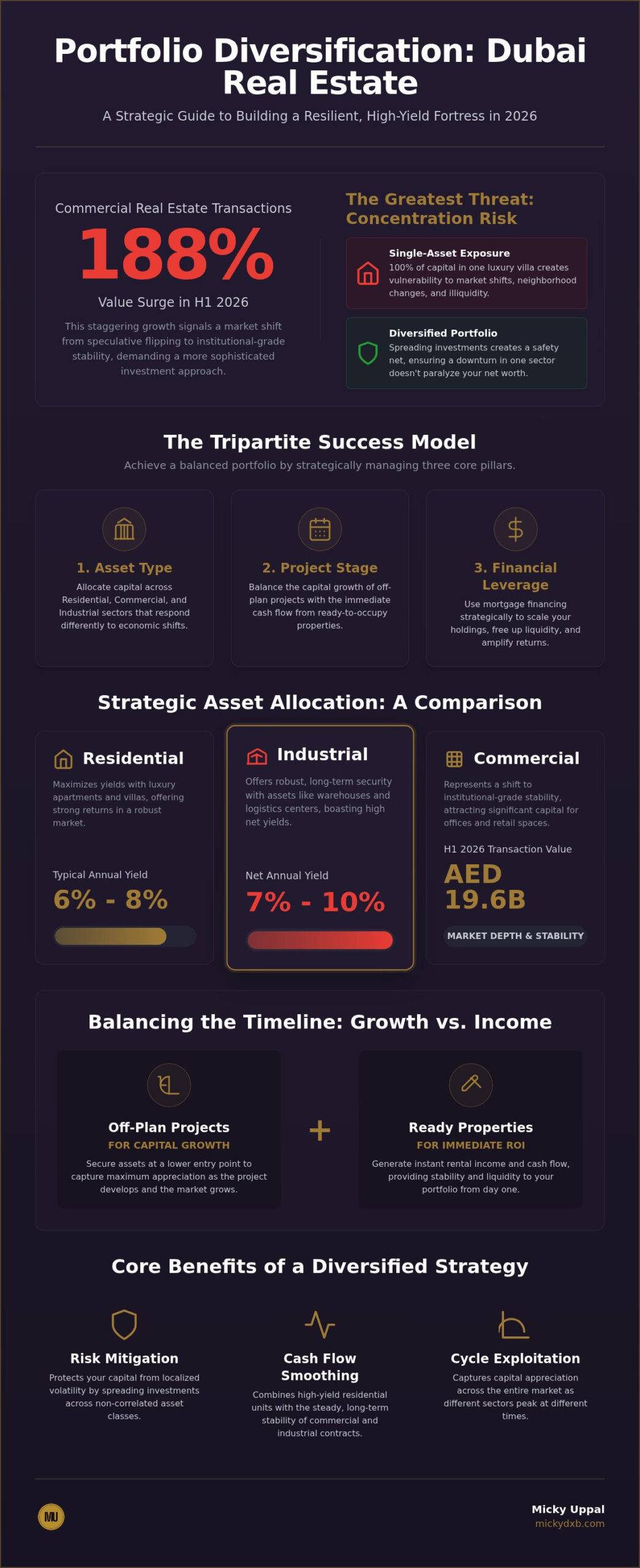
Real estate isn’t just about buying a property; it’s about building a financial fortress. In the context of the UAE, mastering portfolio diversification Dubai real estate involves more than just owning multiple title deeds. It requires a deliberate allocation of capital across sectors that respond differently to economic shifts. As we move through 2026, the market has matured significantly, shifting from speculative flipping to institutional-grade stability. The 188% surge in commercial transaction value seen in the first half of 2026 isn’t just a number; it’s a signal that the market is diversifying at an institutional level. This evolution demands a “Bold Strategist” mindset where every acquisition serves a specific purpose within a larger narrative. To achieve this, you must adopt the Tripartite Success Model: balancing Asset Type, Project Stage, and Financial Leverage.
Understanding the Fundamentals of Portfolio Diversification is the first step toward long-term security. If you treat your property holdings as a single, unified entity rather than a collection of isolated bets, you can better withstand the natural ebbs and flows of the economy. This holistic view is what separates a casual investor from a professional one. It involves looking beyond the immediate transaction to see how a new acquisition complements your existing assets, ensuring that your wealth remains protected even if one specific sector faces a temporary slowdown.
Why Concentration Risk is the Greatest Threat to Investors
Many investors fall into the trap of over-exposure. If you have 100% of your capital tied up in a single luxury villa, you’re vulnerable to specific neighborhood shifts or residential demand fluctuations. Sector-specific changes, such as the rise of hybrid work models, might impact commercial demand while leaving residential untouched. Additionally, large single assets are notoriously illiquid. If you need to access capital quickly, selling one massive property is far harder than offloading a smaller unit within a broader collection. Concentration risk is the correlation of all wealth to a single market variable.
The Core Benefits of a Diversified Property Strategy
The primary goal of portfolio diversification Dubai real estate is to create a safety net that doesn’t compromise on growth. By mixing non-correlated assets, you ensure that a downturn in one niche won’t paralyze your entire net worth. A diversified strategy allows you to remain agile. If residential rents plateau, your industrial holdings might be seeing the 6.8% year-on-year growth observed in early 2026. Consider these three key advantages:
- Risk Mitigation: Spreading capital across residential, commercial, and industrial sectors protects you from localized volatility.
- Cash Flow Smoothing: You can combine high-yield residential units (averaging 6% to 8%) with the long-term stability of commercial contracts.
- Cycle Exploitation: Different sectors peak at different times, allowing you to capture capital appreciation across the entire market cycle.
This approach transforms your holdings from a simple collection of buildings into a resilient financial engine. It provides the peace of mind that comes from knowing your wealth is anchored in multiple, independent streams of value.
Strategic Asset Allocation: Residential vs. Commercial vs. Industrial
True wealth preservation requires a delicate balance between aggressive growth and defensive stability. As the UAE market matures, effective portfolio diversification Dubai real estate now demands that you look beyond the familiar residential landscape. While the first half of 2026 saw residential yields remain robust at 6% to 8%, the commercial sector experienced a massive AED 19.6 billion in transactions. This shift suggests that sophisticated investors are moving toward a more balanced asset mix. If you align your capital with these broader economic trends, then you can create a portfolio that is both resilient and high-performing. For a deeper look at these shifts, consult our Strategic Guide to Dubai Commercial Real Estate Investment in 2026.
Maximising Yields with Luxury Residential Assets
Luxury residential properties continue to serve as the bedrock of many successful portfolios. There is a persistent, high-value demand for waterfront villas and premium apartments, which often act as a “Safe Haven” during global economic shifts. These assets offer a combination of lifestyle prestige and reliable capital appreciation. In early 2026, the trend has leaned heavily toward exclusive, ready-to-move-in units that cater to the growing influx of high-net-worth individuals. You can explore the nuances of this sector in our Luxury Real Estate in Dubai: The 2026 Strategic Investment Guide. If you prioritize quality and location, these assets provide a consistent 6% to 8% return that anchors your broader investment strategy.
The Stability of Commercial and Industrial Investments
To truly achieve portfolio diversification Dubai real estate, you must consider the stability offered by long-term corporate leases. The office sector led the way in H1 2026 with 2,571 transactions, reaching an average price of AED 3,202 per square foot. These commercial contracts often include multi-year commitments, providing a hedge against the more frequent turnover seen in residential rentals. Industrial assets have also emerged as a standout performer, fueled by the rapid growth of e-commerce and logistics. With industrial rents increasing by 6.8% year-on-year and net yields reaching as high as 7% to 10%, these assets are essential for a mature portfolio.
Grade A industrial facilities currently maintain an average occupancy rate of 95%, reflecting the intense demand for logistics space. If you are looking to diversify into this sector, our Warehouse for Sale Dubai: 2026 Industrial Investment Guide provides the technical clarity needed to make an informed choice. Integrating retail and office spaces alongside industrial units creates a tripartite foundation of stability. This approach ensures that your cash flow remains steady, regardless of temporary fluctuations in the housing market. If you’re ready to evaluate how these sectors fit into your journey, speaking with a trusted advisor can help clarify your next strategic move.
Balancing the Timeline: Integrating Off-plan and Ready Property
Time is just as critical as asset class when structuring your holdings. To achieve true portfolio diversification Dubai real estate, you must balance the immediate gratification of rental income with the long-term potential of capital growth. If you only focus on ready properties, then you might miss out on the significant appreciation that comes from early-stage developments. Conversely, over-committing to future projects can leave you cash-poor if construction timelines shift. A sophisticated approach involves a “Laddering Strategy,” where the steady yields from your ready units directly fund the payment plans of your off-plan acquisitions. This creates a self-sustaining cycle of expansion that doesn’t strain your personal liquidity. Mixing these timelines is the secret to portfolio diversification Dubai real estate that stands the test of time.
Off-plan Assets: Capturing Future Capital Appreciation
Off-plan properties serve as the high-octane growth engines of a modern portfolio. They offer lower entry points and highly attractive payment structures, such as the 1% monthly plans frequently seen in 2026. This allows you to control a high-value asset with a relatively small initial outlay. However, the risk-reward ratio requires careful management. While the potential for capital appreciation is significant, you must account for the possibility of handover delays. It’s generally prudent to limit off-plan exposure to 30-40% of your total portfolio value to maintain a healthy risk profile. For a comprehensive breakdown of these opportunities, see The Ultimate Guide to Off-Plan Property Investment in Dubai (2026).
Ready-to-Move Units: Securing Immediate Cash Flow
Ready-to-move units in the secondary market provide the defensive stability your portfolio needs. These assets generate immediate ROI, with residential yields in early 2026 averaging between 6% and 8%. Beyond cash flow, these properties offer superior liquidity; they are much easier to resell or leverage for further financing than a project still under construction. If a developer faces a delay, your ready assets act as a financial buffer, ensuring your overall income remains uninterrupted. They are the reliable anchors that allow you to take calculated risks elsewhere. By evaluating current rental yields for immediate occupancy units, you can identify which established communities offer the most consistent performance for your defensive strategy. This blend of growth and security ensures your journey remains steady regardless of market shifts.
Financial Diversification: Using Mortgage Leverage to Scale
Leverage is the multiplier that turns a modest investment into a sprawling empire. While many view debt with hesitation, a “Bold Strategist” recognizes that strategic financing is a cornerstone of portfolio diversification Dubai real estate. In the 2026 market, indicative mortgage rates have stabilized, with 1-Year Fixed options starting from 3.75% and 3-Year Fixed rates from 3.89%. These competitive figures allow you to preserve your liquid capital. Instead of locking all your wealth into a single cash purchase, you can use that same capital as down payments for three distinct assets. This approach doesn’t just grow your footprint; it spreads your risk across different sectors and locations. To understand the finer points of high-value financing, our Dubai Luxury Property Mortgage: 2026 Strategic Guide offers essential clarity.
The Power of Leverage in Real Estate
Consider the difference between a cash purchase and a financed strategy. If you have AED 5 million, you could buy one premium apartment outright. However, if you use that same amount to cover 25% down payments and fees for three different properties, your exposure and potential for gain triple. This financed approach significantly boosts your Return on Equity (ROE) during market upswings. If property values rise by 10%, a cash investor sees a 10% gain, but a leveraged investor can see their initial equity grow by a much larger margin. Professional mortgage lending services are vital here to ensure the Loan-to-Value (LTV) ratios remain sustainable. By spreading your capital, you ensure that a vacancy in one unit doesn’t eliminate your entire income stream.
Managing Debt Risk in a Diversified Portfolio
Risk management is the hallmark of a “Trusted Advisor.” To maintain long-term stability, you should balance your debt-to-income ratios carefully across your holdings. Choosing fixed-rate mortgages, such as the 2-Year Fixed from 3.78%, provides predictable costs that protect you from sudden EIBOR fluctuations. You must also factor in the 0.25% DLD mortgage registration fee to ensure your initial cost projections are accurate. As your properties appreciate, you can use mortgage services to refinance and pull equity from established assets. This “equity release” becomes the fuel for your next acquisition, allowing your portfolio to grow organically. If you’re ready to explore how financing can unlock your next stage of growth, contact our mortgage lending team to find the most competitive national rates.
Executing Your Strategy: The Roadmap to a Balanced Portfolio
Execution is the bridge between a collection of properties and a resilient financial legacy. To master portfolio diversification Dubai real estate, you must transition from being a passive buyer to a “Bold Strategist” who views every asset through a holistic lens. This means stepping back from the individual transaction to assess the larger narrative of your wealth. If you manage your holdings with this high-level perspective, then you can identify hidden risks before they impact your returns. A truly balanced portfolio doesn’t happen by accident; it’s the result of meticulous planning, constant evaluation, and the courage to rebalance when the market shifts.
Conducting a Real Estate Portfolio Audit
The first step in your roadmap is a comprehensive audit of your current holdings. You should begin by calculating your sector concentration to see if you’re too heavily weighted in one area, such as luxury residential. Next, analyze your yields to identify “dead equity”—capital trapped in underperforming ready properties that could be better utilized elsewhere. Finally, assess your liquidity by determining how quickly you could exit certain positions if needed. It’s essential to conduct an annual review with a real estate investment consultant to ensure your strategy remains aligned with the latest UAE market trends. This process provides the clarity, security, and stability needed to move forward with confidence.
The Long-Term Partnership Approach
True success in the UAE market is rarely a solo journey. Moving from transactional buying to strategic wealth building requires a partner who values transparency and honesty above all else. A “Trusted Advisor” doesn’t just show you listings; they provide the financial guidance needed to navigate complex mortgage environments and sector shifts. If you partner with an expert who has over 10 years of market experience and 2,000 successful listings, then you gain access to an intimate understanding of the market’s inner workings. This relationship allows you to focus on the satisfaction of well-informed choices rather than the stress of high-stakes decisions.
Rebalancing is a vital part of this partnership. If a property no longer meets your 2026 growth targets, then our resell services can help you exit that position efficiently. This allows you to reinvest that capital into emerging growth sectors, such as the high-performing industrial or commercial markets discussed earlier. By constantly refining your holdings, you ensure that your portfolio diversification Dubai real estate remains optimal. Your journey toward a balanced, high-yield portfolio starts with a single, strategic conversation. Consult with Micky Uppal to diversify your portfolio today and secure your financial future.
Securing Your Financial Legacy in the 2026 Market
Securing your financial future requires more than just capital; it requires a bold strategy. By now, you understand that true portfolio diversification Dubai real estate is built on three pillars: sector variety, timeline balance, and smart leverage. If you mix high-yield luxury residential units with the stability of industrial contracts, then you create a resilient engine for wealth. Integrating off-plan growth with immediate rental income ensures your journey remains steady through every market cycle. This holistic approach transforms a collection of properties into a sophisticated financial fortress.
Success in this maturing market depends on having a trusted advisor who sees the larger narrative of your investment journey. With over 10 years of UAE market expertise and a strategic focus on off-plan and commercial growth, Micky Uppal provides the personalized mentorship you need to thrive. Our integrated mortgage lending services further empower you to scale your holdings without compromising liquidity. It’s time to move from transactional buying to intentional wealth building. Your roadmap to a balanced, high-performing portfolio is ready for execution.
Build a High-Growth Property Portfolio with Micky Uppal today and take the first step toward lasting financial security. The market of 2026 offers unparalleled opportunities for those who act with clarity and foresight.
Frequently Asked Questions
What is the ideal percentage of off-plan property in a diversified portfolio?
Aim for a 30% to 40% allocation of off-plan property within your total portfolio value to balance growth with stability. If you exceed this threshold, then your liquidity may suffer during construction delays. Off-plan assets act as powerful growth engines due to lower entry points and flexible monthly payment plans. However, maintaining the majority of your capital in ready properties ensures you have consistent rental income to cover installments and ongoing costs.
How does commercial real estate diversification differ from residential?
Commercial diversification focuses on long-term corporate stability and higher net yields, which often reach 7% to 10% for industrial assets. Residential property typically offers higher liquidity and a broader tenant pool but faces more frequent turnover. If you integrate commercial units, then you secure multi-year lease contracts that hedge against residential rental fluctuations. Effective portfolio diversification Dubai real estate requires balancing the prestige of luxury homes with the steady reliability of office or warehouse spaces.
Can I use a mortgage to buy multiple investment properties in the UAE?
Yes, you can use mortgage financing to acquire multiple investment properties across the UAE. If you use integrated mortgage lending services, then you can spread your capital across three or four assets instead of purchasing a single unit with cash. This strategy increases your return on equity and provides a broader safety net. Professional brokers can help you navigate the 2026 interest rate environment to find competitive national rates that align with your wealth goals.
Is it better to diversify across property types or project stages?
A sophisticated strategy requires diversifying across both property types and project stages simultaneously. If you only diversify by type, such as buying three different residential units, then you remain exposed to sector-specific downturns. A balanced roadmap includes a mix of off-plan growth engines and ready-to-move defensive assets. This tripartite approach ensures you capture capital appreciation from new developments while securing immediate cash flow from established commercial or residential listings across the country.
What are the risks of over-diversifying in real estate?
Over-diversification can lead to fragmented management and diluted returns if you spread your capital too thin across low-value assets. If you own too many small units, then the administrative burden and transaction costs, such as the 4% DLD fee, can erode your net gains. It’s often better to focus on a few high-quality, institutional-grade assets across different sectors. Quality and strategic selection are more important than simply increasing the number of title deeds in your collection.
How often should I rebalance my property portfolio?
You should conduct a formal portfolio audit at least once a year with a real estate investment consultant. This annual review allows you to identify “dead equity” in underperforming units and assess whether your current sector concentration still aligns with national market trends. If an asset no longer meets its performance targets, then using resell services to exit and reinvest in growth corridors is a prudent move. Regular rebalancing ensures your portfolio remains agile and high-performing.
Do commercial properties offer better capital appreciation than luxury villas?
Luxury villas often provide superior capital appreciation during periods of high migration and lifestyle demand, acting as a safe haven for wealth. Conversely, commercial properties typically offer higher annual rental yields and more stable long-term cash flow. If you prioritize capital gains, then luxury residential is often the preferred engine. However, a mature portfolio diversification Dubai real estate strategy uses the steady income from commercial assets to fund the acquisition of high-growth residential villas.
How does the Golden Visa program impact portfolio diversification strategy?
The Golden Visa program encourages diversification by requiring a minimum investment of AED 2,000,000, which can be spread across multiple properties. If you distribute this capital across residential and commercial sectors, then you secure long-term residency while building a resilient investment foundation. This regulatory environment supports a bold strategist approach, allowing you to meet visa requirements through a collection of high-value assets rather than a single, high-risk purchase across the UAE market.

Leave a Reply