


In a market that processed AED 252 billion in transactions during the first quarter of 2026 alone, the greatest danger isn’t the volatility of the soil, but the silence of the fine print. You’ve likely felt a familiar hesitation when considering the risks of off-plan property Dubai, especially when a project exists only on a digital render. It’s a natural response to the high stakes of the Emirates’ real estate sector; the promise of a 10% capital value growth this year often feels shadowed by anxieties over construction delays or shifting market cycles. If you’ve found yourself confused by the nuances of escrow accounts or the recent updates to the UAE Civil Code, you’re certainly not alone.
This guide will empower you to master these complexities by identifying hidden pitfalls and implementing the mitigation strategies used by the nation’s most seasoned institutional investors. We’ll provide a clear risk-assessment framework, a deep dive into legal safeguards, and the strategic confidence required to secure your future. From understanding your rights under Federal Decree-Law No. 25 of 2025 to verifying developer liquidity, we’ll replace uncertainty with logic. We’ll start by deconstructing the regulatory environment to show you exactly where your capital is protected and how to ensure your portfolio remains resilient.
Key Takeaways
- Understand how the Dubai Land Department (DLD) formalizes your acquisition to ensure every dirham is protected through official project registration.
- Learn to navigate the risks of off-plan property Dubai by analyzing market volatility and the specific resale thresholds required to maintain liquidity.
- Identify critical developer “red flags” and performance gaps to ensure your investment adheres to projected construction timelines and quality standards.
- Gain clear insights into how RERA-monitored escrow accounts and the 2026 legal updates provide a transparent safety net for your capital.
- Discover a strategic framework for integrating mortgage lending and professional due diligence to transform high-stakes decisions into secure, long-term assets.
Understanding the Mechanics of Off-Plan Property Dubai
The 2026 Dubai real estate market operates on a foundation of rigorous transparency and digital integration. Off-plan property is a contractual right to a future asset secured by regulatory frameworks. It represents a commitment to a vision, allowing you to secure a premium unit before the scaffolding even rises. For this commitment to be secure, the Dubai Land Department (DLD) mandates that every project must be fully registered with a dedicated escrow account. This isn’t just a formality; it’s the fundamental mechanism that validates the developer’s right to sell. By verifying these registrations, you effectively neutralize many of the foundational risks of off-plan property Dubai before signing a Sale and Purchase Agreement (SPA).
The Appeal of Pre-Construction Entry Prices
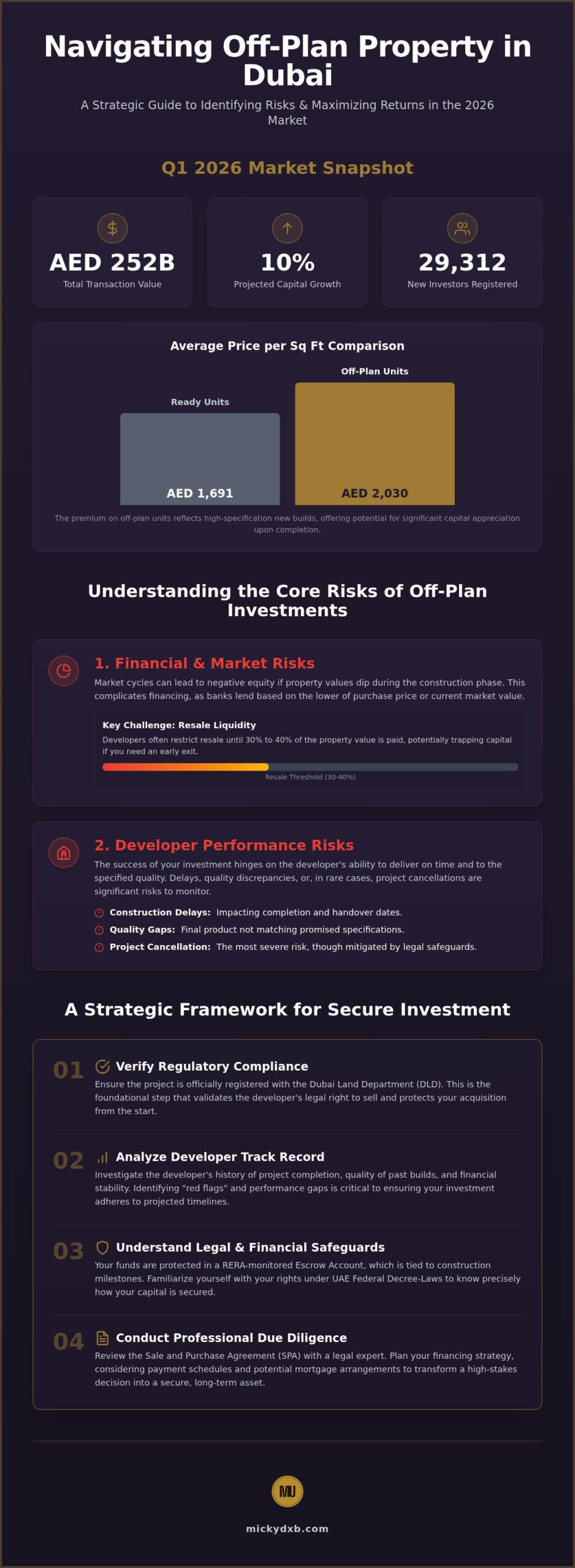
Investors view these acquisitions as a strategic play for capital growth. While current transacted data shows off-plan homes averaging AED 2,030 per sq ft compared to AED 1,691 for ready units, this premium reflects the high-specification, future-proofed nature of the newest luxury stock. Buying early allows you to capture the appreciation that occurs as construction milestones are reached. It’s a psychological shift from merely purchasing a residence to acquiring a high-yield financial instrument. If the market continues its projected 10% citywide growth, your entry price becomes a powerful anchor for future equity. You’re not just buying a home; you’re acquiring a strategic asset at its most malleable stage.
Payment Plans as a Financial Tool
The true leverage of this model lies in the payment structures. You aren’t just buying brick and mortar; you’re buying time and liquidity. Standard 60/40 plans or the increasingly popular post-handover structures allow you to deploy capital gradually. This flexibility preserves your cash flow for other ventures. It also provides a unique hedge against immediate interest rate fluctuations. By committing to a fixed payment schedule with the developer, you delay the need for mortgage lending until the property is closer to completion, potentially securing better terms as the economic landscape evolves. Managing the risks of off-plan property Dubai requires this kind of forward-thinking financial coordination. It ensures your capital remains productive throughout the entire build cycle. For a comprehensive understanding of how modern payment structures and financing strategies work together, our ultimate guide to off-plan property investment in Dubai provides the definitive framework for navigating these decisions.
- Strategic Entry: Lock in current prices for future delivery.
- Regulatory Safety: DLD registration ensures project legitimacy.
- Cash Flow Efficiency: Payment plans reduce the need for large upfront capital.
Financial Risks: Market Volatility and Resale Liquidity
Market cycles don’t pause for construction timelines. While the first quarter of 2026 saw a staggering 31% increase in transaction value, reaching AED 252 billion, every upward trend carries the shadow of a potential correction. The primary risks of off-plan property Dubai involve the possibility of negative equity. If the market value dips during the three to four year build cycle, the property’s valuation at handover might be lower than your original purchase price. This gap can complicate future financing, as banks lend based on the lower of the purchase price or current market value. Understanding the regulatory framework for off-plan property is the first step in recognizing how Law No. 13 of 2008 protects your initial deposit in these scenarios.
Liquidity in off-plan depends on the project reaching a specific construction milestone. Most developers impose strict resale restrictions, often requiring you to have paid a minimum of 30% to 40% of the total property value before they issue a No Objection Certificate (NOC). If you need to exit your position early due to personal financial shifts, you might find your capital trapped until that threshold is met. Global economic factors, including interest rate adjustments in major foreign markets, directly influence the influx of the 29,312 new investors seen in early 2026. A sudden shift in international sentiment can slow down the secondary market, making it harder to find a buyer for your contract before completion.
The Danger of Over-Leveraging
Success can sometimes breed dangerous overconfidence. Committing to multiple concurrent payment plans across different projects can stretch your cash flow to a breaking point. If a primary income source fluctuates, the obligation to meet quarterly installments remains absolute. Failing to meet these deadlines triggers a cascade of legal notices and potential forfeiture of your previous payments. Maintaining a conservative debt-to-equity ratio ensures you can weather temporary downturns without losing your principal. For those looking to scale their portfolio safely, professional investment consulting provides the necessary guardrails to balance ambition with security.
Fluctuating Rental Yield Forecasts
Projected yields are often based on current scarcity rather than future supply. By the time your project is handed over, thousands of similar units may have entered the same hub, creating a supply glut that compresses rental income. While villas are currently projected for a 17.7% appreciation in 2026, apartments face more modest growth. You must look beyond the developer’s brochure and analyze the total pipeline of upcoming units in the area. Mitigating this risk requires a “Bold Strategist” mindset; you should diversify your asset types to ensure your portfolio isn’t overly dependent on a single, saturated residential segment.
Developer Performance: Delays, Cancellations, and Quality Gaps
The developer’s track record is the single most predictive indicator of your investment’s success. While the regulatory framework provides a safety net, the execution of the project rests entirely on the developer’s operational efficiency and financial stability. A “Tier 1” developer is defined by a historical record of delivering projects within the 12-month contractual grace period without compromising on the specifications outlined in the original Sale and Purchase Agreement. Identifying the risks of off-plan property Dubai requires a deep dive into these track records; you must look beyond the glossy renders to see how previous projects matured after handover. Red flags often include frequent changes in the main contractor, a history of litigation with owners’ associations, or projects that remain at zero percent progress on the RERA portal for more than six months after launch.
Managing Construction Delays
Expectations must be grounded in the reality of the 12-month grace period. National contracts typically allow developers this one-year window beyond the projected completion date before any breach of contract is recognized. If you’ve secured a mortgage commitment early, a significant delay can be costly. Your initial rate lock might expire, forcing you to renegotiate financing in a potentially higher-interest environment. Legal recourse exists for unreasonable postponements, but it’s often a lengthy process that emphasizes the need for selecting partners with proven delivery accuracy.
Project Cancellation Realities
Cancellations are rare in the modern, regulated market, but they remain a theoretical possibility. If a project is officially scrapped, the RERA-monitored escrow account ensures your principal is protected. The funds are returned through a formal liquidation process overseen by the Dubai Land Department. You can proactively monitor this by checking the “Project Status” on the official Dubai REST app. This transparency allows you to see real-time construction percentages and escrow balances, ensuring you’re never left in the dark about your asset’s progress.
The Quality Discrepancy Risk
The gap between a show home and the final delivered unit is a common point of friction. Developers may use general language in contracts that allows for “similar quality” substitutions in materials. This makes the snagging process at handover vital. You should employ a professional inspection service to document every deviation from the SPA before signing the final acceptance. Contractual protections are your primary defense against significant design changes, ensuring the luxury residential sale you envisioned is exactly what you receive.
- Verify Track Records: Research the developer’s last three completed projects.
- Monitor Progress: Use the Dubai REST app for monthly construction updates.
- Professional Snagging: Budget for a third-party inspection before final handover.
Legal Protection: Escrow Accounts and Regulatory Frameworks
Trust is the currency of the Emirates’ real estate market, but it’s a currency backed by steel-clad regulations. To effectively manage the risks of off-plan property Dubai, you must understand the architecture of the Law No. 8 of 2007 regarding escrow accounts. Every developer is legally required to open a project-specific account for each individual development they launch. This ensures that your installments aren’t used to fund the developer’s other ventures or corporate overheads. Escrow funds can only be used for construction-related expenses for that specific project. This ring-fencing of capital is your primary defense against developer insolvency or project mismanagement.
RERA acts as the vigilant auditor of these accounts. Funds are only released to the developer in stages, tied directly to verified construction milestones. A third-party consultant must certify that a specific percentage of work is complete before the bank releases the next tranche of capital. This system ensures that the developer’s progress and your financial contributions remain in perfect lockstep. If construction halts, the release of funds halts too. This regulatory oversight transforms a high-stakes transaction into a logical, milestone-based acquisition where your capital is always accounted for.
The Role of the Dubai Land Department (DLD)
Your legal journey begins with the Oqood certificate. This document is your proof of ownership in the interim period before the property is completed; it’s essentially a pre-title deed registered with the DLD. When you pay the mandatory 4% DLD transfer fee, your Sales and Purchase Agreement (SPA) gains full legal weight. Should any disagreement arise, the DLD’s dispute resolution center provides a specialized legal channel designed to protect investor rights without the need for protracted civil litigation. It’s a system built for clarity, speed, and fairness.
Contractual Clauses to Watch
The fine print in your SPA deserves the eye of a “Bold Strategist.” You must scrutinize the “Force Majeure” definitions to ensure they aren’t overly broad, as these can sometimes be used to justify delays beyond the standard 12-month grace period. Assignment of rights is another critical clause; it dictates exactly when you can legally sell your contract to another investor. Most contracts allow this after you’ve paid 30% to 40% of the purchase price. Additionally, look for service charge guarantees. Transparency regarding future maintenance costs is essential for calculating your long-term ROI accurately.
Securing your future requires more than just reading a brochure; it requires a partnership with experts who know the law as well as they know the market. To ensure your contract is as robust as your investment goals, explore our Real Estate Investment Consulting services for a comprehensive legal and strategic review.
Strategic Risk Mitigation: The Micky Uppal Framework
Successful investing isn’t about avoiding risk; it’s about quantifying it with surgical precision. The “Trust but Verify” approach serves as the cornerstone of the Micky Uppal Framework, acting as the final filter for your capital. While the DLD and RERA provide the essential safety net discussed in earlier sections, your own independent due diligence is what separates a speculative gamble from a strategic acquisition. Micky Uppal’s 2,000+ listings provide a proprietary database of developer performance. This data allows us to look beyond the marketing renders and analyze actual delivery timelines, post-handover quality, and historical capital appreciation across various market cycles. By leveraging more than a decade of market experience, you can effectively neutralize the risks of off-plan property Dubai before they ever impact your balance sheet. Investors seeking to build a resilient portfolio will find that the principles outlined in our comprehensive off-plan property investment guide for Dubai align directly with this rigorous, data-driven approach.
We view every acquisition as a long-term partnership rather than a mere transaction. This philosophy means “doing things right” is always prioritized over “doing things fast.” We seek out clarity and openness in every contract, ensuring that the absence of hidden complexities builds a foundation of trust you can rely on. From identifying undervalued assets to securing long-term financing, our framework covers every variable in the investor’s journey.
Financing as a Risk Buffer
Risk management and financing are two sides of the same strategic coin. Many investors make the mistake of waiting until the handover date to seek a mortgage, but this leaves them vulnerable to shifting interest rates and tightened bank lending criteria. Securing a mortgage pre-approval during the construction phase provides a critical safety buffer. It ensures that when the final installments of your payment plan fall due, your liquidity is already guaranteed. If the market shifts, then your pre-arranged financing acts as a shield against capital shortfalls. Our integrated approach ensures a seamless synergy between property acquisition and strategic debt management. You can Explore our mortgage lending services to understand how early-stage financing creates a more resilient investment structure.
The 10-Year Market Perspective
Market maturity is a continuous process of evolution. Having witnessed the growth of the Emirates’ real estate sector over the last 10 years, we analyze the 2026-2030 cycle through the lens of a “Bold Strategist.” We don’t just see a single purchase; we see the larger narrative of your wealth journey. The 2026 market, which saw AED 252 billion in Q1 transactions, requires a seasoned guide who knows the inner workings of the industry intimately. This long-term perspective helps you move from a reactive mindset to a proactive one. You’ll learn to anticipate market shifts, allowing you to build a high-growth portfolio that withstands volatility and delivers consistent value.
Securing Your Legacy in the 2026 Property Market
Mastering the risks of off-plan property Dubai isn’t about eliminating every variable; it’s about building a fortress of data and legal protection around your capital. From verifying escrow milestones to securing integrated mortgage approvals, every step you take should be rooted in logic rather than emotion. By aligning your goals with the regulatory frameworks provided by the DLD, you transform a speculative purchase into a calculated strategic advancement. Success in this landscape requires a shift from viewing property as a mere home to seeing it as a high-performance asset that demands rigorous due diligence.
With over 10 years of expert market guidance and a track record of 2,000+ successful property transactions, Micky Uppal provides the seasoned perspective necessary to navigate these complexities. We offer a unique combination of mortgage lending, investment consulting, and strategic asset acquisition to ensure your journey is both secure and profitable. It’s time to move beyond the renders and secure a portfolio built on transparency and professional insight. Consult with Micky Uppal for a secure off-plan strategy and step forward with the confidence that comes from expert mentorship. Your future in Dubai real estate is ready to be built.
Frequently Asked Questions
Is it safe to buy off-plan property in Dubai in 2026?
Yes, it’s safe if you perform due diligence on the developer and ensure the project is registered with the Dubai Land Department (DLD). The 2026 market is governed by strict transparency rules, including mandatory escrow accounts that protect your capital. While the risks of off-plan property Dubai include market fluctuations, the legal framework is designed to prioritize buyer security. Always verify the project’s escrow account number before making any initial payments.
What happens if a developer cancels an off-plan project?
If a project is cancelled, the developer’s liquidation process is overseen by RERA to ensure investors are refunded. Funds held in the project-specific escrow account are returned to buyers through a formal legal channel. This system prevents developers from using your capital for other debts. While cancellations are rare in the current mature market, these safeguards ensure your principal remains protected even if the development doesn’t reach completion.
Can I sell my off-plan property before it is completed?
You can sell your off-plan property once you meet the developer’s specific “minimum paid” threshold, which is typically between 30% and 40% of the purchase price. You must obtain a No Objection Certificate (NOC) from the developer to finalize the resale on the secondary market. This allows you to capture capital appreciation before handover. It’s a common strategy for investors looking to maintain liquidity without waiting for the full build cycle to conclude.
How do escrow accounts protect my investment in the national market?
Escrow accounts protect your investment by ensuring your money is used exclusively for the construction of your specific property. Funds are released to the developer only when third-party consultants certify that specific construction milestones have been reached. This prevents the misallocation of capital and ensures the developer has a financial incentive to stay on schedule. It’s the most effective mechanism for neutralizing the risks of off-plan property Dubai related to developer insolvency.
What are the hidden costs of buying off-plan property?
Beyond the purchase price, you must budget for the 4% DLD transfer fee and the property registration fee. For units valued at AED 500,000 or more, the registration fee is AED 4,000 plus 5% VAT. If you’re financing the purchase, there’s also a mortgage registration fee of 0.25% of the loan amount. Don’t forget to account for future service charges, which should be clearly outlined in your initial Sale and Purchase Agreement.
How much of a delay is legally allowed for off-plan construction?
Most Sale and Purchase Agreements (SPAs) in the UAE include a standard 12-month grace period for construction delays. This means the developer isn’t considered in breach of contract until one year has passed beyond the projected completion date. If the delay exceeds this window, you may have legal grounds for compensation or contract termination through the DLD’s dispute resolution center. Always check the specific “Force Majeure” clauses in your contract to understand your rights.
Can expats get a mortgage for off-plan property?
Expats can certainly secure mortgages for off-plan properties, though the loan-to-value (LTV) ratios are generally lower than for ready homes. Banks typically offer up to 50% financing during the construction phase, with the remaining balance due upon handover. It’s wise to get a mortgage pre-approval early to lock in rates and ensure your financing is secure. Integrated mortgage services can help you navigate the specific requirements of national lenders for pre-construction assets.
How do I verify if a project is registered with the DLD?
You can verify any project’s registration status instantly using the official Dubai REST app provided by the Dubai Land Department. Simply enter the project name or developer details to see the real-time construction percentage, escrow account number, and official photos of the site. This digital transparency is a key tool for investors. If a project doesn’t appear on this official portal, it’s a major red flag that requires immediate professional investigation.

Leave a Reply